
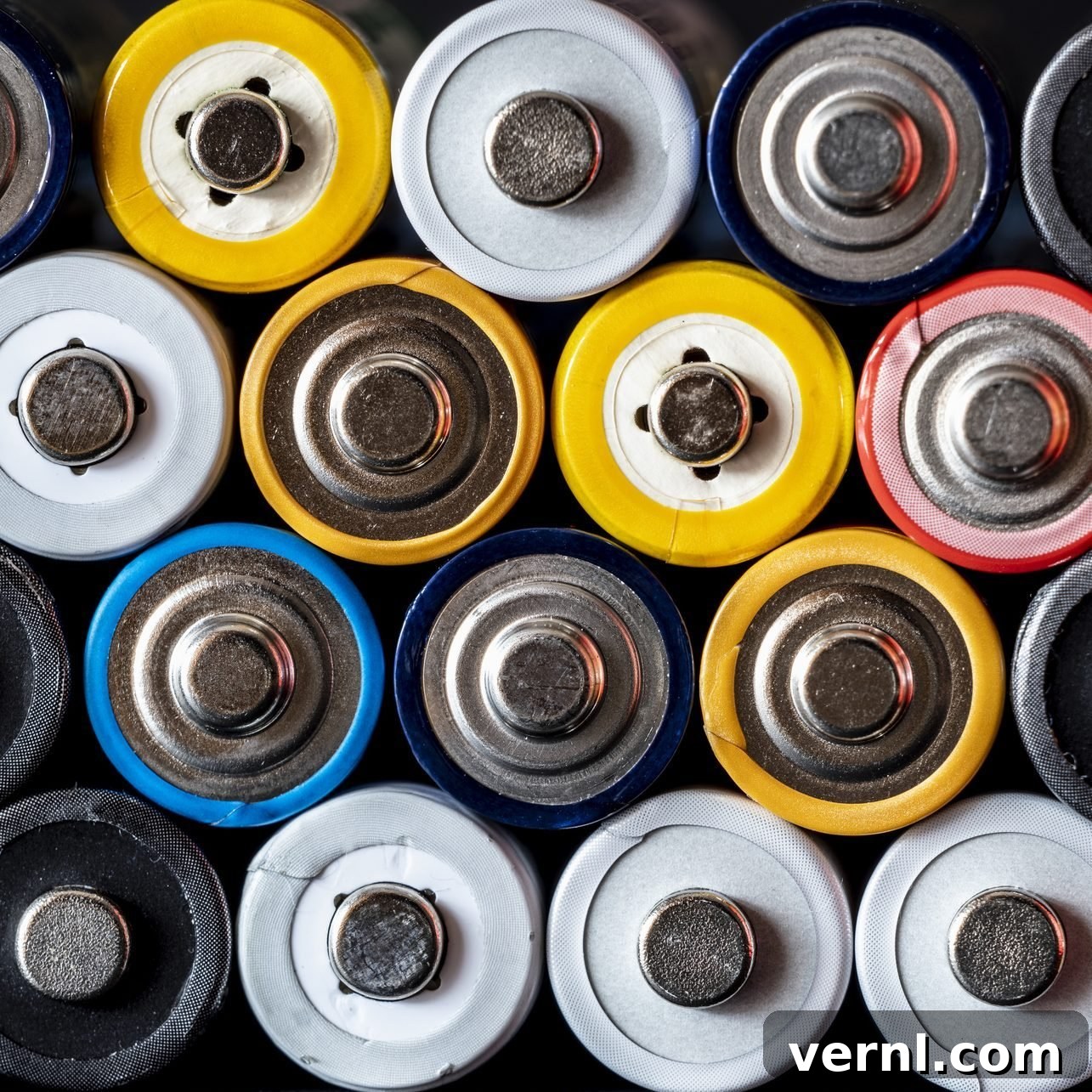
Batteries are the silent workhorses powering countless aspects of our daily lives. From the precision of your stud finder to the convenience of your wireless mouse, and the simple act of changing channels with your TV remote, these energy cells are indispensable. We often take them for granted until that dreaded moment when a device unexpectedly dies, leaving us scrambling for replacements. It’s in these moments of minor crisis that ingenious solutions shine brightest. My discovery of a simple yet revolutionary hack that transforms a common AAA battery into a functional AA battery didn’t just expand my understanding of basic electronics; it has repeatedly saved me from countless emergency trips to the store.
The Ingenious Battery Hack: Converting AAA to AA for Emergency Power
The first time I encountered this remarkable trick was through a viral video circulating on social media. The scenario was instantly relatable: a user’s wireless computer mouse had stopped working, clearly a victim of depleted AA batteries. Instead of replacing them with new AA cells, the individual demonstrated an astonishing workaround. They carefully placed a smaller AAA battery into the AA compartment. The crucial step involved then taking a small, neatly folded wad of aluminum foil and positioning it to fill the gap between the negative terminal of the AAA battery and the metal connector plate inside the device. The result? The mouse sprang back to life, functioning perfectly. My initial reaction was a mix of awe and profound skepticism.
Could something so simple truly be effective? Determined to verify this claim, I decided to conduct my own experiments. I grabbed my trusty TV remote, an essential tool for evening relaxation, followed by my Xbox controller, notorious for its power consumption, and finally, my reliable camping headlamp, a critical piece of gear for outdoor adventures. To my astonishment, the hack worked flawlessly across all three devices. Each sprang to life, powered by a smaller, seemingly mismatched AAA battery, bridged by a tiny piece of aluminum foil. This wasn’t just a random fluke; it was a consistent and effective solution.

Demystifying the Power Output: Understanding Voltage vs. Capacity in AA and AAA Batteries
Are AAA Batteries Less Powerful Because They’re Smaller? The Voltage Myth Debunked
It’s a common misconception: because AAA batteries are physically smaller than AA batteries, many assume they are inherently “less powerful” in every aspect. While they do differ in overall energy storage, the critical insight that makes this hack possible lies in understanding electrical voltage. What I, and likely many others, didn’t realize is that both AA and AAA batteries deliver the exact same voltage output, typically ranging between 1.2 and 1.5 volts. This is a fundamental characteristic of their respective chemistries (most commonly alkaline). This shared voltage is precisely why a AAA battery can successfully power a device designed for AA batteries.
To grasp this concept more easily, imagine a battery as a water pipe or a garden hose. Voltage isn’t about the amount of water (energy) stored in the hose; rather, it’s akin to the pressure inside the hose. Whether it’s a slender garden hose (AAA) or a wider fire hose (AA), if the water pressure (voltage) is the same, it can perform the same immediate task, like spraying water a certain distance or, in the case of batteries, pushing electrons from one terminal to another to create an electrical current. The “pressure” or electromotive force needed to operate many electronic devices is consistent, regardless of battery size, as long as it falls within the device’s operating voltage range.
The Crucial Difference: Battery Capacity and Runtime Explained (Milliamp-Hours)
While voltage is identical, there is indeed a significant difference between AA and AAA batteries, and that lies in their energy storage capacity. This capacity dictates how long their power lasts. Battery capacity is typically measured in milliamp-hours (mAh). Simply put, a higher mAh rating means the battery can deliver a certain current for a longer period.
Because AA batteries are physically larger, they contain a greater volume of active chemicals, allowing them to store substantially more energy. Standard AA alkaline batteries, for instance, typically offer a capacity of around 2,200 to 2,700 mAh. In stark contrast, AAA alkaline batteries, due to their smaller size, usually provide about 1,000 to 1,200 mAh. This means that if both battery types are powering the same device, a AA battery will last more than twice as long as a AAA battery. When we consider longer-lasting lithium batteries, the disparity can be even greater, sometimes four times as long.
This difference in capacity is crucial for understanding the limitations of the hack. While a AAA battery will indeed get your device working, it’s not a permanent, equal replacement. It’s a temporary solution designed to bridge the gap until you can acquire the correct, higher-capacity AA batteries. The device will function, but for a significantly shorter duration.
The Science Behind the Hack: Why Aluminum Foil is Your Emergency Conductor
The effectiveness of this clever hack hinges on a fundamental principle of electricity: conductivity. Aluminum, the material from which foil is made, is an excellent electrical conductor. When you place a AAA battery into a compartment designed for a AA battery, there’s an obvious size mismatch. The AAA battery is shorter, leaving a significant gap between its negative terminal and the corresponding metal contact inside the device.
This is where the small wad of aluminum foil comes into play. By carefully folding a piece of foil, you create a conductive bridge. When this foil wad is placed to fill the space, it successfully completes the electrical circuit. It physically connects the negative terminal of the AAA battery to the negative contact point of the device, allowing the electrons to flow from the battery, through the device, and back to the battery’s positive terminal, thus powering the gadget. Without a complete circuit, electricity cannot flow, and the device remains inert. The foil acts as a perfect, albeit temporary, extension to make this connection possible.
Real-World Applications: When This Emergency Battery Hack Saves the Day
This isn’t just a clever trick; it’s a genuinely practical solution for numerous everyday scenarios. While it’s always best to use the correct battery size, life often throws unexpected curveballs. Imagine these common situations:
- The Dying TV Remote: You’re settled in for a movie night, only for your TV remote to suddenly stop responding. You check the battery drawer, and lo and behold, only AAA batteries are available. A quick foil fix means your entertainment isn’t interrupted.
- Wireless Peripherals Go Dark: Your wireless computer mouse or keyboard suddenly gives up the ghost right in the middle of an important task. Instead of frantically searching for new AA batteries, this hack can get you back to work in seconds.
- Camping Trip Emergencies: You’re on a family camping trip, miles from the nearest store, and your crucial AA-powered flashlight or headlamp dies. If you have AAA batteries for another device (perhaps a small radio or a child’s toy), you can quickly adapt one to keep your path illuminated.
- Children’s Toys: Any parent knows the chaos that ensues when a beloved, battery-operated toy stops working. This hack can be a temporary savior, preventing meltdowns until a proper battery run can be made.
- Power Outages: In an unexpected power outage, reliable light sources are paramount. If your AA-powered lanterns or radios go out, and you only have AAA spares, this trick can literally bring light to a dark situation.
The sheer convenience of this hack lies in its ability to provide immediate relief and avoid the frustration of an inoperable device. It empowers you to tackle minor power emergencies with confidence and resourcefulness.
Important Considerations and Final Thoughts on the Battery Hack
A Temporary Lifeline, Not a Permanent Solution
It’s crucial to reiterate: we are not suggesting you abandon AA batteries forever or make this your default power solution. This hack is a brilliant stopgap, a temporary measure to get your device functioning again until you can purchase the correct AA batteries from the store. Due to the significant difference in capacity (mAh), a AAA battery, even with the foil trick, will not last as long as a proper AA battery.
Optimizing the Hack and Ensuring Safety
When using the aluminum foil, ensure it is folded neatly and firmly to create good contact. Loose foil could lead to intermittent power or, in rare cases, generate a small amount of heat if the connection is poor. Always aim for a snug fit. While this hack is generally safe for low-power devices, it’s not recommended for high-drain devices that require consistent, long-term power, or for sensitive electronics where precise power delivery is critical.
Beyond the Hack: Understanding Your Batteries Better
This hack also serves as a fantastic reminder of the basic principles of electricity and the different characteristics of batteries. Taking a moment to understand voltage (the push) and capacity (the amount of stored energy) can help you make more informed decisions about your electronic devices and their power needs. Consider investing in rechargeable AA and AAA batteries, which are an environmentally friendly and cost-effective long-term solution.
Empowering You in a Pinch
The next time you’re faced with a dead AA-powered device and only have AAA batteries on hand, remember this simple trick. Whether you’re in the middle of a family camping trip and your flashlight dies, or your remote control gives up during your favorite show, a little aluminum foil and a AAA battery can be your unexpected saviors. It’s a testament to ingenuity and a testament to the power of understanding basic science. This knowledge equips you to handle those minor power inconveniences with a newfound sense of confidence and resourcefulness.