Electric Vehicle Fire Risk: A Comprehensive Guide to EV Safety in Floods and Beyond
The burgeoning popularity of electric vehicles (EVs) marks a significant shift towards sustainable transportation. However, as more EVs hit the roads, a critical question arises for both current owners and prospective buyers: Can electric vehicles catch fire? The straightforward, albeit unsettling, answer is yes. While EV fires are statistically less common than those in gasoline-powered cars, their unique causes and characteristics demand specific attention, especially concerning the heightened risks posed by environmental factors like floodwaters.
A recent incident vividly underscored this concern. Following the devastation of Hurricane Helene, a video widely shared on USA Today depicted an EV spontaneously igniting while submerged in floodwaters. This alarming event sent ripples of concern through the EV community, highlighting a vulnerability many might not consider.
“It’s not a surprise to those who understand the raw power of these systems,” remarked a seasoned electrical contractor, currently upgrading my home’s backup generator. “When you short-circuit a battery operating at 300 to 400 volts, you’re not just getting a few sparks; you’re unleashing significant electrical energy.” To put this into perspective, imagine the serious sparking you’d witness from shorting a conventional 12-volt car battery. Now, amplify that voltage by a factor of 30, and you begin to grasp the immense potential for energy release. Such high-voltage energy, particularly if sustained or uncontrolled, can lead to massive electrical arcing, rapid heat generation, and extensive damage, potentially escalating into a fire.
To gain deeper insights into this pressing issue, we consulted with Jason Fladhammer, the Director of Quality Assurance at Batteries Plus, a leading nationwide battery outlet. His expertise sheds light on the intricacies of EV battery safety and the specific dangers presented by adverse conditions.
Can Electric Cars Catch Fire? Examining the Evidence
Beyond the dramatic footage from Hurricane Helene, numerous other incidents confirm that EVs are susceptible to fires. These events are not isolated and stem from various causes, including impacts, manufacturing defects, and environmental stressors.
For instance, on August 21st, the National Transportation Safety Board (NTSB) announced an investigation into a post-collision fire involving a Tesla truck. The incident occurred after the vehicle collided with a tree on Highway 80 near Sacramento, CA, highlighting how significant structural damage can compromise battery integrity and lead to ignition. Just weeks prior, an equally alarming event unfolded in Seoul, South Korea. The Japan Times reported that an unplugged Mercedes-Benz sedan exploded and subsequently caught fire in an underground car park. This catastrophic event necessitated the evacuation of 700 residents from the overlying apartment complex, demonstrating the potential for widespread danger when EV battery fires occur in confined spaces.
The phenomenon of lithium-ion batteries catching fire is, in itself, not entirely new. These powerful energy cells are ubiquitous in modern electronics, from laptops to power tools. Even cell phone batteries can overheat and ignite under certain conditions, albeit on a much smaller scale. However, an EV battery pack is exponentially larger, comprising thousands of individual cells, and contains significantly more energy. This sheer scale means that when an EV battery fire occurs, it can cause immensely more damage, poses greater challenges for firefighters, and presents a more substantial risk to life and property.
So, if you’re still pondering the question, “Can electric vehicles catch fire?” the answer is a definitive yes. The true surprise and a critical point of concern for many is the revelation that these fires can indeed occur even when the vehicle is submerged in water – a counterintuitive scenario that warrants deeper examination.
Why Are Electric Cars Catching Fire in Floods? Understanding the Saltwater Hazard
The idea of water-induced fire might seem paradoxical, yet it’s a stark reality for electric vehicles, particularly when that water is saline. As Jason Fladhammer explains, it’s not the water itself that acts as the catalyst for ignition. Instead, it’s the dissolved elements within the water – most notably salt – that transform it into a highly effective electrolyte. An electrolyte is essentially an ion-rich solution that possesses the remarkable ability to conduct electricity, thereby creating unintended pathways for current flow within a battery system.
“Saltwater is inherently extremely conductive due to the abundance of dissolved ions it contains,” Fladhammer states. “When this conductive solution comes into direct contact with a battery pack, especially a sophisticated lithium-ion battery designed for precise electrical management, it can create unintended channels for electricity to flow. These external current paths often lead to internal short circuits within the individual battery cells.”
The consequences of these short circuits are profound. Electrical energy, when diverted or flowing uncontrollably, is converted into heat. If this heat rapidly accumulates within the battery pack, it can trigger a dangerous chain reaction known as thermal runaway. Thermal runaway is a critical condition where the temperature inside a battery rapidly escalates, leading to further internal reactions that generate even more heat. This self-accelerating cycle can quickly cause the battery to catch fire or, in severe cases, even explode. Fladhammer emphasizes that “the saltwater significantly accelerates this entire process by acting as an exceptionally efficient conductor, enabling electrical currents to move in ways the battery system is simply not engineered to handle, bypassing its safety mechanisms.”
Beyond Submersion: The Threat of Salt Spray
The danger isn’t confined to full submersion. A 2024 study published in Science Direct shed light on an even more insidious threat: salt spray. This research demonstrated that even exposure to fine salt spray can cause an EV battery to self-ignite. The likelihood of ignition, the study found, increases proportionally with the duration of exposure to the spray and, notably, with the age of the vehicle. Salt spray, much like floodwaters, acts as an electrolyte, creating those dangerous conductive pathways. However, its threat extends further: salt is also highly corrosive. Over time, salt residue can critically damage the delicate internal components and individual cells within the battery pack. This corrosion can lead to internal short circuits, which then generate localized heat that can swiftly propagate throughout the entire battery, initiating thermal runaway even without direct liquid submersion. This makes coastal regions and areas prone to storm surges particularly vulnerable.
Freshwater vs. Saltwater: A Crucial Distinction
It’s important to distinguish between freshwater and saltwater. While deep freshwater submersion can still pose risks due to potential damage to insulation, short circuits, or lingering contaminants, saltwater significantly amplifies the danger. Freshwater is a poor conductor of electricity compared to saltwater, meaning it is less likely to immediately create the same rapid, widespread short-circuiting that saltwater facilitates. However, any prolonged water exposure can compromise an EV’s electrical system, making it crucial to exercise caution regardless of the water type.
Essential Tips to Prevent Your Electric Vehicle from Catching Fire in Extreme Weather
Given the specific vulnerabilities of electric vehicles to water, especially saltwater, proactive measures are paramount for EV owners in areas prone to floods or severe weather. Jason Fladhammer provides crucial advice to mitigate these risks:
- Move the Vehicle to Higher Ground (If Possible): This is the most critical preventative step. If a flood forecast is issued or floodwaters are rising, prioritize relocating your EV to an elevated area well above anticipated water levels. This proactive measure can prevent any contact with floodwaters altogether, eliminating the primary risk factor. Always check local weather alerts and evacuation routes well in advance.
- Ensure the Car is Turned Off and Unplugged: Before a flood or if water exposure is imminent, it is vital to power down your EV completely and, if it’s currently charging, immediately unplug it from any charging source. This action helps to isolate the battery pack, minimizing the potential for electrical flow through unintended pathways if water makes contact. A disconnected and de-energized system is inherently safer than one actively connected to an electrical grid or still in an operational state.
- Protect the Car with a Waterproof Cover: While not a guaranteed solution against deep submersion, a high-quality, waterproof cover can offer a layer of protection against light flooding, splashing, and corrosive salt spray. Ideally, use a cover specifically designed or supplied by the vehicle manufacturer to ensure a proper fit and optimal material for protection against the elements. However, remember that no cover can fully safeguard against significant submersion.
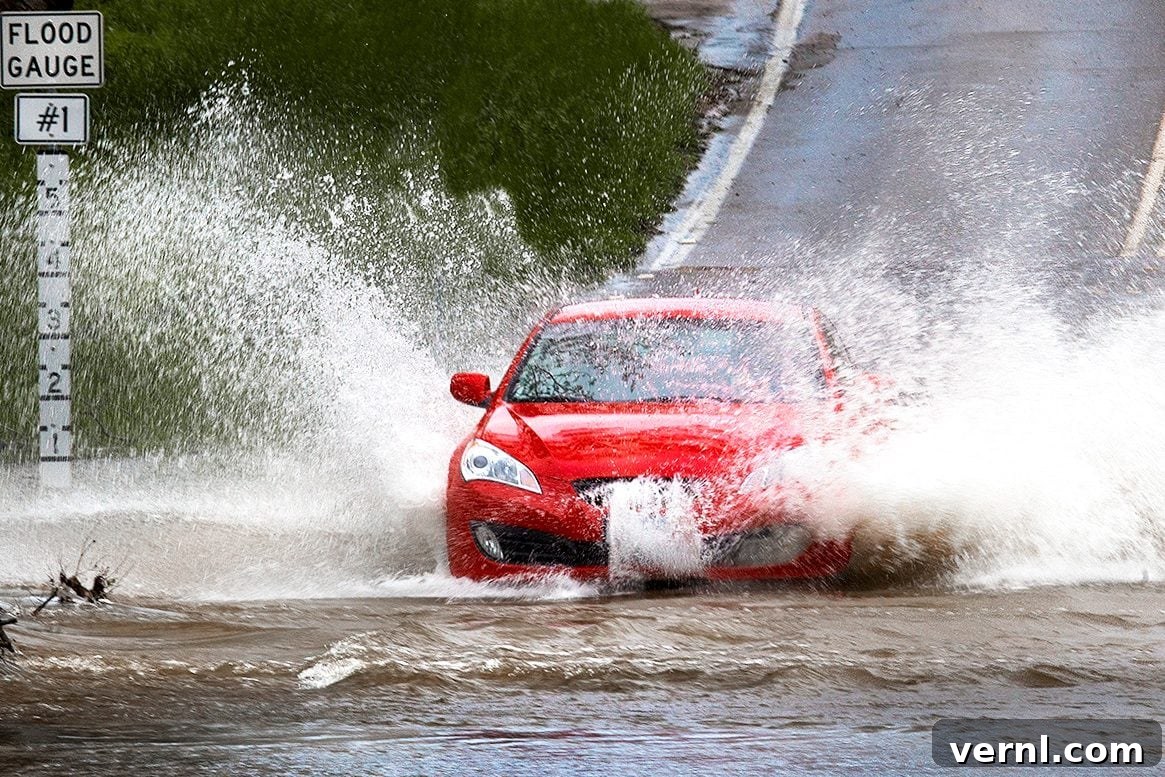
- Avoid Driving Through Floodwaters: This might seem obvious, but many drivers underestimate the depth of floodwaters. Even shallow water can hide hazards or be deeper than it appears. Driving through water can create a “bow wave” that pushes water into engine compartments or battery packs, initiating the dangerous short-circuiting process. If you encounter floodwaters, turn around and find an alternative route.
- Stay Informed and Have an Emergency Plan: Monitor local weather forecasts and emergency advisories. Understand your vehicle’s specific recommendations from the manufacturer regarding water exposure. Have an emergency plan that includes safe locations for your EV in case of a flood threat and how you would evacuate if necessary.
Post-Flood Actions: What to Do If Your EV Was Submerged
If, despite your best efforts, your EV does become submerged in saltwater, or any significant depth of water, Fladhammer strongly recommends having it professionally inspected as soon as the water recedes. This critical assessment should be conducted at a dealership or an ASE Certified repair facility specializing in electric vehicles. Their expertise is vital for several reasons:
- Thorough Inspection and Cleaning: The primary objective is “to meticulously clean any salt and/or corrosion off of the battery terminals and surrounding components.” Salt is highly corrosive, and its lingering presence can continue to degrade electrical connections and battery casings long after the water has receded. This corrosion can lead to latent short circuits, significantly increasing the likelihood of a fire occurring at some unpredictable point in the future.
- Assessment of Internal Damage: Beyond visible terminals, professional technicians can use specialized diagnostic tools to assess potential internal damage to the battery pack, wiring harnesses, and control modules. Water intrusion can compromise seals, introduce contaminants, and cause subtle electrical faults that are not immediately apparent but could become critical over time.
- Safety Protocol: EV batteries are high-voltage systems. Attempting DIY repairs or inspections after water damage can be extremely dangerous due to the risk of electrocution or accidental short-circuiting. Certified professionals are trained to safely handle these systems and follow strict safety protocols.
Ignoring water damage, especially from saltwater, can have dire consequences. The longer corrosive elements remain in contact with the battery and electrical systems, the higher the cumulative risk of a fire or critical system failure when you least expect it. Prompt professional intervention is not just about repair; it’s about ensuring ongoing safety.
About the Expert
- Jason Fladhammer is the Director of Quality Assurance at Batteries Plus, a nationwide battery outlet that has been in operation since 1988. His extensive experience in battery technology and safety provides invaluable insights into managing the risks associated with modern energy storage solutions.
Sources
- USA Today: Video captures Tesla Vehicle Bursting into Flames as Hurricane Helene Floods Florida Garage; October 2024.
- X (formerly Twitter): @NTSB_Newsroom; August 2024.
- The Japan Times: Seoul EV Explosion Sparks Safety Fears, Prompting Charging Rethink; August 2024.
- PC Mag: Why Phones Explode, and How to Prevent It From Happening to You; September 2024.
- ScienceDirect: The Electro-Thermal Behaviors of the Lithium-Ion Batteries Corroded by the Salt Spray Environment: February 2024.
- RD.com: What Happens If Your Car Goes Underwater?