
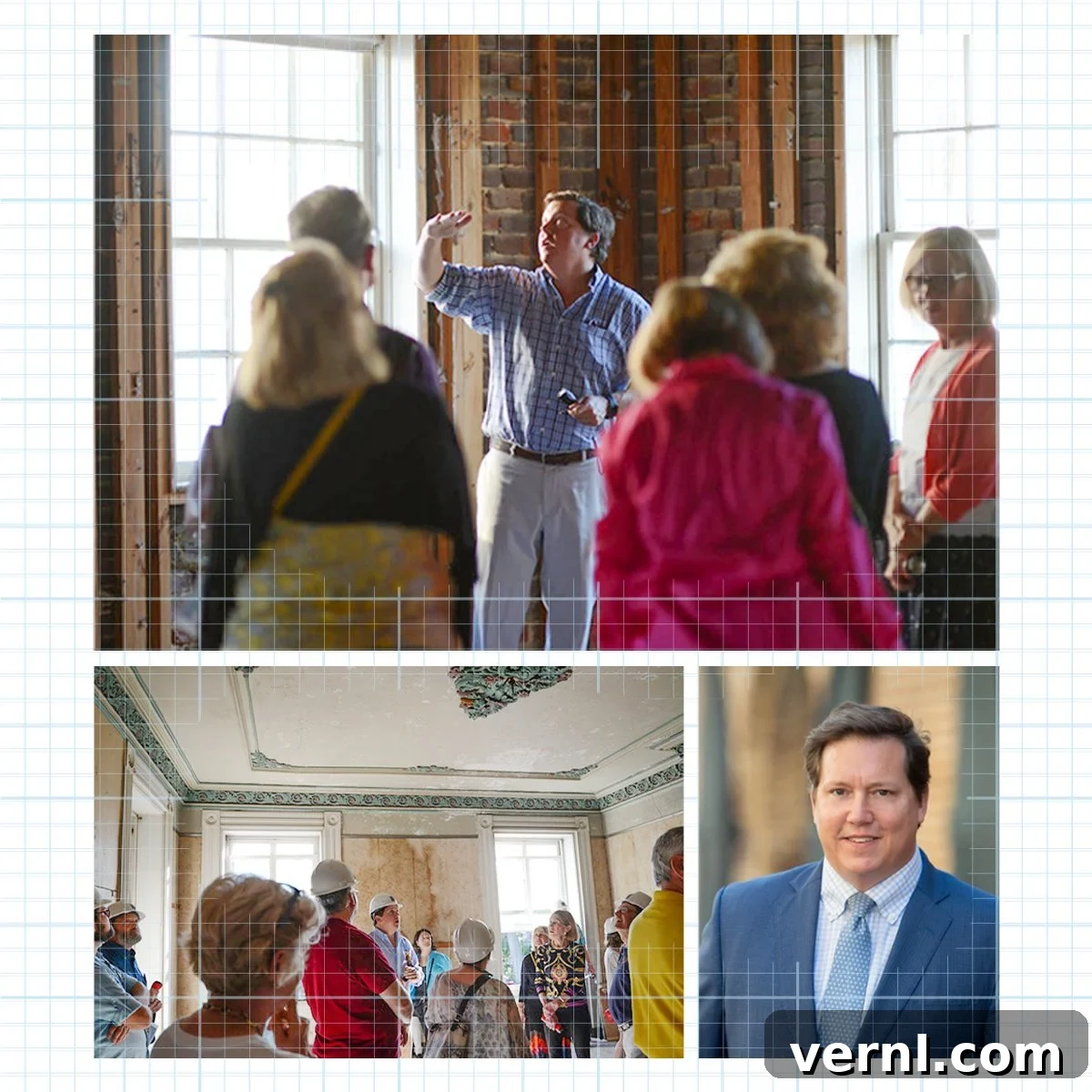
Nestled along the South Carolina coast, Charleston stands as a living testament to centuries of history, its cobblestone streets and elegant historic buildings whispering tales of resilience and grandeur. For Kristopher King, a native of Aiken, South Carolina, this captivating city always held an undeniable allure. His frequent childhood visits to Charleston sparked an innate curiosity, a fascination with its architectural tapestry that he wouldn’t fully comprehend until a pivotal college course on architecture and preservation.
“I suddenly realized why I was drawn to historic cities and buildings,” King recounts. “I didn’t know that was something someone could actually do for a career and get paid for. It’s awesome.” This revelation ignited a lifelong passion, steering him toward a path dedicated to understanding, preserving, and celebrating the unique heritage embedded in every beam, brick, and molding of an ancient structure.
King’s academic journey laid a robust foundation for his career. He earned an undergraduate degree in architectural history from Trinity College, followed by a master’s in historic preservation from the prestigious University of Pennsylvania. Armed with profound theoretical knowledge and a burgeoning practical understanding, he returned to Charleston, the city that had initially sparked his curiosity. Over the past two decades, King has become an integral figure in the city’s preservation landscape, dedicating himself to restoring houses, both for his own development projects and for numerous clients.
“There aren’t many houses left in the historic district that I haven’t had some level of interaction with,” he proudly states, underscoring his extensive engagement with Charleston’s architectural treasures. His work is far from monotonous; each project presents a unique set of challenges and learning opportunities. “I love it. And every time I think I understand how all old buildings work, the next one I walk into is just going to hand it to me. That’s what’s so neat, you can always learn something every single time you work on an historic building.” This philosophy drives his continuous quest for knowledge, making every restoration an exciting intellectual and practical endeavor.
Today, Kristopher King channels his expertise through Carriage Properties in Charleston, a distinguished firm renowned for its specialization in historic real estate. His transition into the real estate sector allows him to guide prospective buyers and sellers through the intricate world of historic properties, ensuring that these valuable assets find owners who appreciate and commit to their preservation. We recently had the opportunity to speak with King shortly after the filming of “Rucker’s Reno,” a popular celebrity renovation show, to delve into his day-to-day activities, uncover some of his most intriguing discoveries, and understand the profound importance of his work.
Q: What exactly is an architectural historian, and what does your specialization entail?
A: My role often feels more akin to an architectural archaeologist, with a distinct and passionate focus on building pathology. When I step into a 200-year-old house, it’s not just a structure; it’s a living document waiting to be deciphered. My expertise lies in knowing how to precisely date every single component of that house. This involves meticulous examination of everything from the moldings, whose profiles changed significantly over decades, down to the subtle saw cut-marks left on rough-hewn beams—which can indicate whether an up-and-down sash saw or an early circular saw was used. Even the manufacturing method of the nails, whether hand-wrought, cut, or modern wire nails, tells a story of the period. It’s all datable, providing a chronological fingerprint of the building’s construction and subsequent alterations.
I often joke that I’m an “attic and basement guy,” not a “pretty museum house guy.” My fascination isn’t just with the aesthetic appeal of a finished historic home, but with the raw, underlying craftsmanship that brought it into existence. I thrive on understanding the intricate skills, tools, and materials that went into building these houses centuries ago. This deep technical understanding allows me to help homeowners make truly informed decisions, striking a delicate balance between preserving the authentic character of their historic building and updating it for contemporary living.
A significant challenge in my field is guiding people who may not fully grasp how to reconcile the imperative of historic preservation with the practical necessity of modernization. Buildings, by their very nature, need to be used and adapted over time. The original function of a space might change, or modern amenities might be required, leading to inevitable alterations. My role is to help people “unpack” these complexities, to discern what elements are truly valuable, what is original to the building’s earliest form, and what is genuinely worth preserving for future generations, while still allowing for thoughtful and sensitive updates that extend the building’s lifespan and utility.
Q: Could you describe a typical day in your professional life?
A: My career has seen some evolution. Until recently, I had the immense privilege of running the Preservation Society of Charleston, which is the oldest preservation group of its kind in the entire country. That role involved significant advocacy, educational outreach, and policy work aimed at protecting Charleston’s irreplaceable architectural heritage. It was incredibly rewarding, but a different pace and focus.
Now, I work in real estate for a specialized group dedicated exclusively to historic properties. This transition allows me to apply my preservation knowledge in a commercial context, directly assisting individuals who are passionate about owning and caring for these unique homes. So, on any given day, my activities are quite varied. I might be showing potential clients an exquisite 18th-century townhouse, pointing out original features and discussing its historical significance, or walking through a property with an existing owner, helping them understand the nuances of what they possess.
This guidance often includes identifying original elements like intricate mantles, antique hardware on doors, or plasterwork, distinguishing them from later additions or reproductions. This educational aspect is crucial, as many owners are keen to restore their homes authentically but lack the specialized knowledge. Beyond client education and property showings, I also engage in project management for various restoration and renovation projects. This involves coordinating with contractors, architects, and artisans to ensure that preservation principles are upheld throughout the construction process. A particularly critical aspect of my work in Charleston involves helping clients navigate the often-complex world of permitting approvals. Due to the city’s stringent regulations, virtually everything you do to the exterior of an historic building, from painting to structural changes, has to be meticulously reviewed and approved by the Board of Architectural Review. It’s a challenging but essential part of preserving the city’s distinct character.
Q: What are some of the most interesting things you’ve discovered during your projects?
A: Well, that’s truly the fun of it; there’s always a delightful surprise lurking within every historic house. These buildings are like time capsules, often holding secrets from past occupants or previous eras of construction. For instance, the house featured on “Rucker’s Reno” presented a fascinating discovery. It had served as an office space for many, many years before its residential conversion. During its commercial life, someone had constructed an incredible, hidden concrete walk-in safe within the structure. It was an elaborate setup, almost like something out of a classic mystery novel—you know, where you open a bookshelf, and suddenly there’s a secret room behind it. Uncovering something so unexpected and robust offers a tangible connection to the building’s utilitarian past.
Another memorable instance involved a house that had remained within the same family since its construction in the 1850s. The new owner was a truly preservation-minded buyer, which makes all the difference. During our initial walkthrough, they astutely pointed out that one of the light fixtures was an original Philadelphia-made gas chandelier that had, at some point, been converted to electricity. This was an exciting find in itself, but the story didn’t end there. As we explored further, we found the remnants of another identical gas chandelier—partially disassembled and forgotten—in the property’s cistern, which had long been disused. It turns out these fixtures were incredibly rare and valuable, worth almost $200,000 as a pair. Most people, unaware of their historical significance and intrinsic value, would have simply considered them old junk and thrown them out. These discoveries underscore why having an architectural historian involved is so crucial; we can identify and save elements that might otherwise be lost forever, uncovering hidden value and preserving irreplaceable pieces of history.
Q: Could you tell us about a specific project that truly stands out in your career?
A: One project that consistently comes to mind is an 18th-century house I acquired as a developer. What made it particularly compelling was its missing piazza. In Charleston, piazzas (what many outside the Lowcountry call porches) are a defining architectural feature, providing essential outdoor living space and contributing significantly to the streetscape. Through meticulous research in the vast archives of the Library of Congress, I unearthed historical photographs from the 1930s. These images clearly showed that the house once boasted a magnificent, giant two-story piazza. Shockingly, the photographs also revealed that this elegant architectural element had been completely ripped off the house, ostensibly to create more space for parking cars, reflecting a shift in urban priorities at the time.
The discovery of these photographs was a revelation. It presented a unique opportunity not just to restore a house, but to restore a piece of its lost identity and, by extension, a fragment of Charleston’s historical streetscape. My goal became to completely reconstruct this piazza, bringing the house back to its original, intended grandeur. The process was painstaking, involving careful architectural analysis, sourcing appropriate historic materials, and working with skilled craftsmen to replicate the period detailing. Rebuilding a two-story structure, ensuring it integrated seamlessly with the existing 18th-century fabric, was a complex undertaking. However, seeing that piazza rise again, transforming the facade and restoring the architectural balance of the house, was incredibly rewarding. It was a tangible act of reversing a historical wrong, allowing the house to reclaim its authentic form and contributing significantly to the visual and historical integrity of the neighborhood. It was pretty amazing to witness that transformation and know I had a hand in it.
Q: What are some common misconceptions or errors people make when undertaking historic renovations?
A: One of the fundamental issues stems from a profound shift in construction methodologies over the last two centuries. Construction transitioned from being a highly skilled, localized, handmade, and craft-driven industry to what is now a completely product-driven industry. This paradigm shift means that most people, including many contractors, don’t recognize the inherent design philosophy of historic building components.
Take, for example, an historic window. It was masterfully designed to “fail” in a specific, repairable way. It was meant to be easily removed, taken apart, have individual components repaired or replaced, put back together, and then reinstalled. The timber frames, the traditional glazing, the joinery—all contributed to a system designed for longevity through maintenance and repair. However, the prevailing mentality today is simply to “throw out a window and replace it with a new one.” This is where the problem arises. Few contractors today possess the specialized knowledge or the inclination to perform that kind of meticulous, craft-intensive repair work. They’re trained in modern installation techniques, not traditional restoration.
This is a significant pet peeve of mine because something built in 1800 isn’t just an old object; it’s the culmination of thousands of years of architectural tradition, inherited knowledge, and skilled craftsmanship. Discarding such an item represents a profound loss of that accumulated wisdom.
Beyond the loss of craft, there’s a critical environmental aspect. If you simply throw things like historic windows into a dumpster, it’s inherently wasteful and profoundly unsustainable. The reality is that anything you replace a 200-year-old window with will probably not last as long. Why? Because the original wood was typically old-growth heart pine or exceptionally durable cypress. These woods were harvested from ancient forests, possessing incredible density, natural resistance to rot and insects, and unparalleled longevity. Modern, fast-grown timber simply cannot compare in terms of durability and inherent quality.
I believe a fundamental flaw in the modern sustainability movement, particularly concerning buildings, is that durability is often not adequately factored into the equation. We tend to assume that everything is going to be replaced in 30 years, operating on a short-term cycle. But if you truly look at an historic building, it stands as a testament to 300 years of continuous use and adaptation. There is genuinely nothing “greener” or more sustainable than a building that has stood for centuries, embodying embodied energy, reducing waste, and demonstrating incredible longevity through thoughtful care and preservation. Durability is the ultimate form of sustainable design.
Q: Why is the preservation of historic buildings so critically important?
A: The importance of preserving historic buildings extends far beyond their immediate aesthetic appeal or mere age. You obviously have the inherent age value, which is significant, representing a tangible connection to the past. There’s also the uniqueness and the specific architectural character—the styles, the craftsmanship, the materials that define a particular era and place. These elements are often irreplaceable, reflecting construction techniques and artistic sensibilities that are no longer common.
However, the value of historic preservation runs even deeper. It’s also about the rich tapestry of history that has occurred within and around those walls. These buildings are silent witnesses to momentous events and everyday lives. I recall one restoration project where we discovered something truly remarkable. It looked as though someone had placed a stick of dynamite on just one particular rafter; it was completely blown out and splintered. After careful investigation, we figured out the incredible truth: it was damage from a cannonball that had come straight through the roof during the Civil War. This specific neighborhood in Charleston was shelled relentlessly from Fort Sumter for hundreds of days during the conflict. That rafter wasn’t just a piece of wood; it was a physical artifact of a defining moment in our nation’s history. It’s a powerful, visceral reminder of the human cost of war, embedded within the very fabric of a home.
Beyond the Civil War, many other houses in Charleston have endured and survived a staggering array of catastrophic events. They’ve weathered devastating earthquakes, ferocious hurricanes, massive city-wide fires, and even the Revolutionary War. Each scar, each repair, each adaptation tells a part of their incredible story. So, there are numerous different layers of value—architectural, aesthetic, cultural, and historical—all contributing to their profound significance. I mean, they’re not just buildings; they’re survivors. And there’s something incredibly moving, inspiring, and profoundly humbling about preserving these testaments to human resilience and continuity. They anchor us to our past and provide invaluable lessons for our future.
Q: Do you have any advice for young people aspiring to become architectural historians or work in preservation?
A: Absolutely, I have a great deal of advice for aspiring architectural historians and preservationists. First and foremost, it’s crucial to understand that historic preservation is not a singular, narrow field; rather, it’s a vibrant, multidisciplinary endeavor where many different skills, trades, and academic disciplines converge. So, before anything else, take the time to deeply consider what aspect of preservation truly calls to you. Do you envision yourself as an architect, designing sympathetic additions and restorations? Or perhaps a contractor, specializing in the hands-on, skilled work of traditional building repair? Are you drawn to policy and planning, working for a municipal planning department to shape zoning and design guidelines for historic districts? Or does the non-profit sector appeal to you, advocating for historic resources and educating the public?
Once you’ve identified your primary area of interest, the next step is to meticulously focus on how to acquire the specific skills, knowledge, and, crucially, the professional connections you will need to succeed in that chosen path. It’s not just about academic degrees; it’s about practical application and networking.
I frequently speak with graduate students who are earning advanced degrees in historic preservation, often with a clear desire to jump directly into project work. And while their academic knowledge is invaluable, I often give them a piece of advice that might initially sound counterintuitive: I tell them that the next job they need to get is to clean up job sites for a contractor. The reason for this seemingly humble start is profound. You have to get your foot in the door somewhere, at the ground level. You need to immerse yourself in the practical realities of construction and restoration. By cleaning job sites, you’re not just sweeping floors; you’re observing, listening, learning from those who possess decades of hands-on experience—the master carpenters, the plasterers, the masons. You learn how materials behave, how tools are used, how projects are organized, and how problems are solved in real-time. This kind of experiential learning is priceless. It allows you to build a foundational understanding of building mechanics, gain respect from tradespeople, and gradually work your way up, acquiring practical skills that will complement your academic knowledge and make you an incredibly effective and well-rounded preservation professional.
Kristopher King Bio
Kristopher King is a distinguished expert in the field of historic preservation and real estate, currently contributing his extensive knowledge and passion to Carriage Properties in Charleston, South Carolina. In his multifaceted role, he specializes in real estate sales, investment, and development, with a particular focus on the unique challenges and opportunities presented by historic properties. Beyond his work in real estate, King also operates as a highly sought-after historic preservation and project consultant, lending his expertise to complex restoration and renovation initiatives. Committed to fostering the next generation of preservationists, he teaches historic preservation to students at both the College of Charleston and Clemson University. Furthermore, demonstrating his deep commitment to community engagement and the stewardship of cultural heritage, Kristopher King serves on the board of the Drayton Hall Preservation Trust, actively contributing to the long-term care and interpretation of one of America’s most significant historic plantations.
[cf]skyword_tracking_tag[/cf>