The Unseen Hero: A Comprehensive Guide to Choosing the Right Motor Oil for Your Vehicle
Imagine two identical, clear liquids. Both feel similar, perhaps slightly viscous. One is harmless, the other, if used incorrectly, could destroy your engine. This isn’t a riddle; it’s the reality of lubricating oils. Unless they’re deliberately dyed for identification, most oils look and feel the same. This seemingly minor detail can lead to major problems, as one early experience in my career vividly demonstrated.
Back in 1969, when I first started working at a car repair shop, we stored motor oil in large 55-gallon drums. Our process involved hand-pumping the oil into dispensing funnels before adding it to engines after an oil change. This system worked without a hitch for a while, until a critical error occurred: a drum filled with hydraulic oil was mistakenly labeled as 10W-30 motor oil. The consequences could have been catastrophic.
Fortunately, we caught the mistake quickly. We immediately replaced the oil and filters in every vehicle that had received the incorrect fluid. Every car, that is, except one. We promptly contacted the owner of the unlucky vehicle and had it towed back to the shop the very next day. While the engine had already begun to exhibit a faint knocking sound, we were incredibly fortunate. A new oil pump and the correct type of engine oil resolved the issue, preventing severe damage. Had that car been driven for any longer with the wrong lubricant, extensive and costly engine damage would have been inevitable. To put it in perspective, replacing a six-cylinder engine today can cost around $5,500 for the engine alone, plus an additional $2,000 or more for labor. This experience solidified a crucial lesson: the right oil isn’t just a recommendation; it’s a necessity for engine longevity and performance.
Today, selecting the appropriate motor oil for your vehicle or power equipment should not be a daunting or mystifying task. With the right information, you can make an informed decision that safeguards your investment. This comprehensive guide will help demystify motor oil, enabling you to choose the best lubricant for your specific needs.
Understanding the Lifeblood of Your Engine: What is Motor Oil?
Motor oil is far more than just a simple lubricant; it is, quite literally, your engine’s lifeblood. Its multifaceted role is critical for the optimal functioning and longevity of internal combustion engines. Motor oil performs several vital functions:
- **Lubrication:** It creates a thin film between moving metal parts, preventing direct metal-on-metal contact and drastically reducing friction. This not only minimizes wear but also ensures smooth operation.
- **Cleaning:** Modern motor oils contain detergents and dispersants that actively clean the engine. They suspend harmful byproducts of combustion, such as sludge, varnish, and abrasive particles, preventing them from accumulating and causing damage.
- **Cooling:** While the cooling system handles the majority of heat dissipation, motor oil also plays a significant role. It absorbs heat from engine components like pistons, cylinder walls, and bearings, carrying it away to be dissipated in the oil pan or through an oil cooler.
- **Cushioning/Sealing:** Oil provides a hydraulic cushion for various engine components, particularly in hydraulic lifters, reducing shock and noise. It also helps seal the gap between piston rings and cylinder walls, which is crucial for maintaining proper compression and maximizing power output.
- **Corrosion Protection:** Engine parts are susceptible to corrosion from acids and moisture that are byproducts of combustion. Motor oil contains anti-corrosion additives that form a protective barrier, preventing rust and chemical attack.
Without the correct motor oil performing these crucial functions, an engine would quickly overheat, seize, and fail, resulting in irreversible damage.
Decoding the Labels: Viscosity and Service Rating Explained
The key to choosing the correct oil lies in understanding the information printed on its label. Always select an oil that precisely matches the vehicle’s or original equipment manufacturer’s (OEM) recommended viscosity and service rating. These specifications are typically found in your vehicle’s owner’s manual.
* **Viscosity:** This term refers to an oil’s resistance to flow at different temperatures. It’s a critical factor because oil needs to be thin enough to flow easily when the engine is cold (for immediate lubrication upon start-up) but thick enough to maintain a protective film when the engine is hot and running at full operating temperature.
* **Multi-weight oils** (e.g., SAE 5W-30) are designed to perform effectively across a wide range of temperatures. The “W” stands for “Winter” and indicates the oil’s viscosity at lower temperatures. The first number (e.g., “5W”) represents its flow characteristics in cold weather; a lower number means better flow in cold conditions. The second number (e.g., “30”) indicates its viscosity at higher operating temperatures. For example, SAE 0W-30 will flow better than 10W-30 at very low temperatures, providing quicker engine protection during cold starts.
* **Single-weight oils** (e.g., SAE 30) have a narrower temperature range and are typically used in environments with stable temperatures or in specific applications where multi-grade oils are not required or recommended. It’s crucial to consider significant temperature fluctuations in your region—for instance, from 0 degrees Fahrenheit in winter to 100 degrees Fahrenheit in summer—when choosing between single- and multi-weight oils.
* **Service Rating/Category:** This indicates the oil’s performance level and is determined by organizations like the American Petroleum Institute (API). The API service categories evolve to meet the demands of modern engines and environmental regulations.
* The current gasoline engine rating, introduced in May 2020, is **API SP**. This category aims to provide enhanced protection against low-speed pre-ignition (LSPI), chain wear, reduce engine emissions, and protect engines that utilize fuels containing ethanol. Older categories like SN Plus and SN are still suitable for many vehicles but SP offers superior protection for newer engines.
* Always look for the official American Petroleum Institute (API) “starburst” service symbol on the oil container, along with the Society of Automotive Engineers (SAE) viscosity grade/weight, and the manufacturer’s usage label. These seals are your assurance that the oil meets industry standards.
Two-Stroke vs. Four-Stroke Engines: A Critical Distinction
Beyond viscosity and service ratings, it’s vital to differentiate between two-stroke and four-stroke engines, as they require fundamentally different lubrication approaches.
* **Four-Stroke Engines:** These are the most common engines found in cars, trucks, and many types of power equipment. In a four-stroke engine, the motor oil is contained in a separate crankcase and circulates independently, lubricating, cooling, and cleaning the engine without mixing with the fuel.
* **Two-Stroke Engines:** Often referred to as crankcase compression engines, these are typically found in smaller, high-revving equipment such as scooters, motorcycles, and yard tools like string trimmers, chain saws, and leaf blowers. In two-stroke engines, gasoline and motor oil are mixed together in specific ratios before entering the combustion chamber. The oil is then burned along with the fuel, providing lubrication and escaping as exhaust. Using four-stroke oil in a two-stroke engine can lead to severe damage due to improper combustion and lubrication.
Exploring the Spectrum: Different Types of Motor Oil
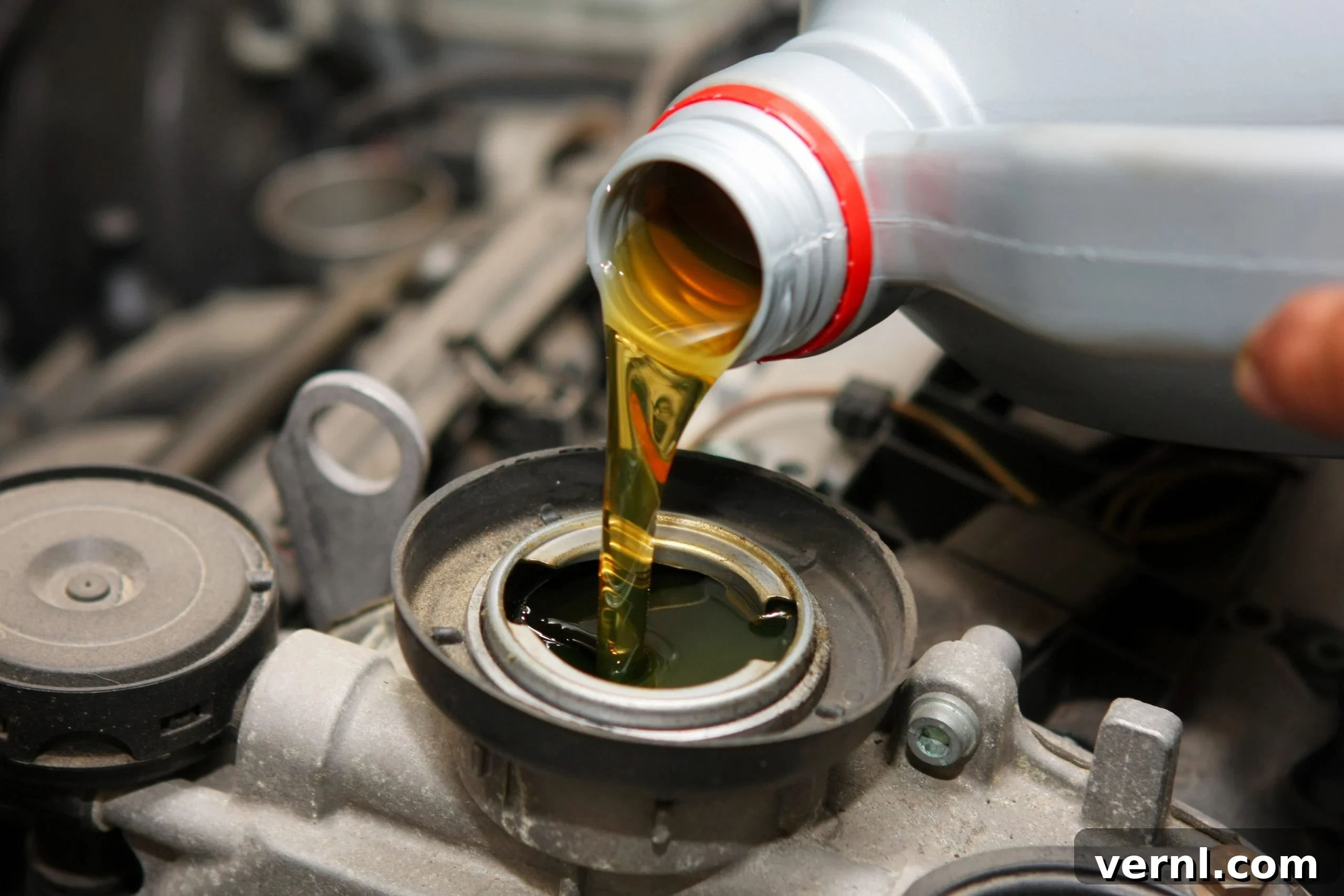
While virtually all new motor oil appears as a transparent, yellowish-amber liquid with a consistency similar to olive oil, it’s crucial to understand that motor oils are NOT interchangeable. There are significant distinctions based on their base stock and additive packages, dictating which type you should use in your car, truck, motorcycle, or power equipment.
Always consult your vehicle’s or equipment’s owner’s manual for specific OEM oil specifications. These guidelines are paramount. Beyond the manual, consider your driving or operating conditions. Factors like city versus highway driving, off-roading, extreme temperatures, and exposure to dust and dirt can influence the optimal oil choice. For power equipment, the duration and intensity of use are also important considerations.
Conventional Motor Oil
All conventional motor oil begins as crude oil extracted from the ground. This “base oil” undergoes extensive refining processes to remove impurities, waxes, and undesirable components. After refining, it’s blended with a carefully formulated package of additives designed to enhance its performance. These additives neutralize sludge, inhibit corrosion, prevent foaming, and improve viscosity stability.
Conventional oils are generally best suited for:
- Cars and light trucks that do not explicitly require synthetic motor oils, particularly older models.
- Four-stroke power equipment with single and multiple-cylinder engines, such as older lawn mowers, power washers, generators, and snowblowers, which do not specify synthetic oil.
- Two-stroke conventional motor oils, which are specially refined and formulated to be mixed with gasoline for small gasoline-powered two-stroke engines.
High-Mileage Motor Oil
Specifically formulated for vehicles that have accumulated 75,000 miles or more, high-mileage motor oil contains a unique blend of additives. These enhanced additives are designed to condition and rejuvenate internal and external O-rings and gaskets, causing them to swell slightly. This action can effectively reduce oil leaks and minimize oil burning, common issues in older, higher-mileage engines. It’s an excellent choice for extending the life and improving the performance of well-used cars and light trucks.
Full-Synthetic Motor Oil
Representing the pinnacle of engine lubrication technology, full-synthetic motor oil offers ultimate engine protection and performance. Unlike conventional oils, synthetics are engineered from synthetic base stocks through extensive chemical distillation and refinement processes, which remove far more impurities and create uniform molecular structures. This precise engineering, combined with advanced chemically enhanced friction modifiers and robust additive packages, provides exceptional engine protection that is simply not achievable with conventional or synthetic blended oils.
While superior, synthetic oil is generally not recommended for very old model vehicles and equipment that were originally designed for and have always used conventional oil, as it can sometimes expose old seal leaks that conventional oil had effectively plugged with sludge deposits.
Full-synthetic oils are ideal for:
- Modern cars and light trucks with all engine configurations, including high-performance, turbocharged, and diesel engines, where OEMs often explicitly require it.
- Modern motorcycles, whether air- or water-cooled, especially those without a wet clutch (as some additives can affect clutch performance).
- Newer two- and four-cycle air-cooled power equipment like portable concrete saws, snowmobiles, and jet skis, unless specifically not recommended by the OEM.
Synthetic Blend Motor Oil
Synthetic blend motor oil offers a compelling compromise, combining the best attributes of both conventional and full-synthetic oils. It’s a precisely engineered mixture of conventional petroleum base oils and synthetic compounds. This blended formulation provides enhanced engine protection and performance benefits compared to conventional oil, but at a more accessible price point than full synthetics.
Synthetic blend oils are an excellent choice for:
- Cars and light truck engines that do not feature turbocharged or diesel engines, or for owners looking for improved protection over conventional oil without the full synthetic price.
- Motorcycles with air- and water-cooled engines, offering robust performance for diverse riding conditions.
- Most air- and water-cooled four-stroke power equipment engines with single or multiple cylinders, provided the OEM recommendation permits its use. Always double-check the owner’s manual.
Racing Motor Oil
Designed for the most extreme engine conditions, racing motor oils are specialized full synthetics engineered to withstand the intense demands of high-revving, full-throttle engine acceleration and heavy loads. These oils are formulated with robust additive packages that ensure lubrication integrity under conditions that would cause conventional oils to break down. Racing oils are compatible with both air- and water-cooled engines and are particularly beneficial for motorcycles. They often improve wet-clutch performance by meticulously eliminating “friction modifiers” like molybdenum, which can lead to shifting difficulties in high-performance motorcycle transmissions.
Applications for racing motor oils include:
- Racing motorcycle engines and drivetrains (always verify OEM specifications first).
- Certain four-cycle small engines that operate under demanding conditions, such as log splitters, pump motors, compressors, and go-karts.
- Four-cycle air-cooled small engines and long-running backup generators that require exceptional thermal stability and wear protection.
Marine Motor Oil
Engineered for the unique and often harsh environment of the water, motor oil for marine engines is available in both conventional and full synthetic formulations. These oils are specifically blended for high-revving two- or four-stroke marine engines. What sets marine oils apart is their specialized additive package, which offers significantly enhanced corrosion protection—a critical feature for engines operating in damp, saltwater, or humid conditions. They also provide superior resistance to thermal breakdown, maintaining their protective properties under extreme summer temperatures and severe engine loads common in marine applications.
When selecting marine oil, choose a reputable brand that is compatible with your boat engine, whether it has catalytic converters or not. These oils are essential for all types of stern-drive and outboard motors.
Navigating Manufacturer Recommendations and Your Warranty
It’s common for Original Equipment Manufacturers (OEMs) to recommend specific motor oil brands, often under their own private label. This practice is rooted in their commitment to ensure their products are adequately protected and to safeguard consumers against premature failures that could fall under their warranties. OEMs invest considerable resources in testing and validating specific oils that meet their exacting standards and ratings, ensuring optimal performance and longevity for their engines.
However, consumers have rights protected by law. The Federal Trade Commission enforces the Magnuson-Moss Warranty Act. This crucial piece of legislation generally prohibits companies from “conditioning a consumer product warranty on the consumer’s using any article or service which is identified by brand name unless it is provided for free.” In simpler terms, an OEM typically cannot void your warranty solely because you didn’t use *their brand* of oil, as long as the oil you *did* use meets or exceeds their specified performance standards (e.g., API rating, SAE viscosity).
Therefore, while you are not legally required to use the manufacturer’s branded oil, it is highly advisable to do so while your vehicle or equipment is still under the factory warranty. If you opt for another brand, you must ensure it rigorously meets or exceeds all the manufacturer’s specifications outlined in your owner’s manual. To protect yourself and your warranty, meticulously retain all purchase receipts for oil and filters, and keep detailed records of all maintenance performed on your car or equipment, regardless of whether you or a professional mechanic performed it.
If you are ever unsure whether a specific brand or type of oil meets your OEM’s specifications, do not hesitate to research online, consult your dealer’s service department, or contact an approved repair facility. They should be able to provide you with a comprehensive list of approved motor oils for your engine.
Can the Manufacturer Detect Non-Recommended Oil Use?
The answer is a resounding “yes.” While an oil analysis conducted by a manufacturer or a third-party lab most likely cannot identify a specific *brand* of oil, it can definitively verify a host of critical fluid properties. This includes the oil’s type (synthetic, conventional), its actual viscosity at various temperatures, and the levels of specific additive components. More importantly, an oil analysis can reveal the presence of contaminants and, crucially, the levels of wear debris in the oil. Abnormal levels of wear metals or unusual fluid properties are clear indicators of improper lubrication or engine issues.
Manufacturers, and particularly third-party aftermarket warranty companies, are diligent in protecting their interests. If an engine failure occurs and an oil analysis determines that you used a non-compatible motor oil—meaning it did not meet the OEM’s specified viscosity or service rating—they will likely deny the engine repair claim and void the warranty (at least for the engine component). Why take such a significant financial risk by using a non-recommended oil that could potentially cause premature engine failure and cost you thousands of dollars in repairs? After your factory warranty expires, you have more freedom to experiment with different oil brands if you wish, but during the warranty period, adherence to specifications is key.
In conclusion, choosing the right motor oil is a foundational aspect of vehicle and equipment maintenance. By understanding viscosity, API ratings, and the distinctions between different oil types, you empower yourself to make informed decisions that ensure your engine receives the optimal protection it deserves. This small investment of time and knowledge can save you significant repair costs and extend the life of your valuable assets for years to come.