
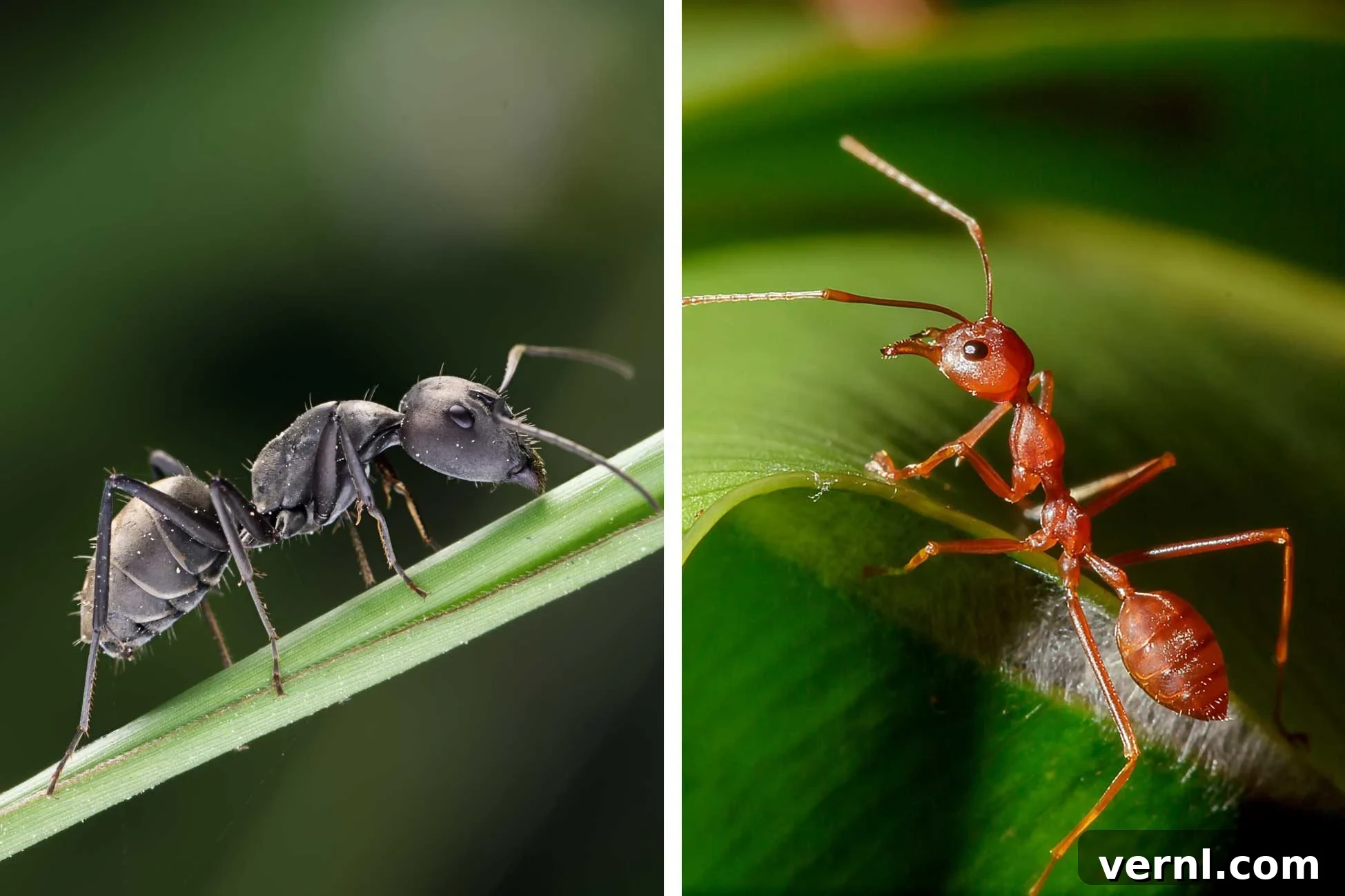
When it comes to common household pests, ants often top the list. Many people use the terms “red ants” and “fire ants” interchangeably, primarily due to their similar reddish coloration. However, this is a significant misconception that can have serious implications for identification and effective pest management. While both can be a nuisance in your home or garden, they possess distinct characteristics, particularly concerning their behavior and the potential harm they inflict. One of the most critical distinctions lies in their defensive mechanisms: fire ants are notorious for their intensely painful, fiery sting, which can lead to severe discomfort, localized swelling, and in some cases, more serious allergic reactions. In stark contrast, what are commonly referred to as red ants typically do not sting; while they may bite, the pain associated with it is generally minimal and short-lived. Regardless of whether they sting or bite, both species can undeniably cause significant problems, ranging from property damage to health risks, in your living spaces or outdoor environments.
“Fire ants and ants in general represent one of the most persistent challenges we face, especially within residential settings,” explains John Bell, a board-certified entomologist with Rentokil. Accurately identifying which of these troublesome insects is invading your property is the first crucial step toward implementing effective control measures. This comprehensive guide will delve into the key differences between these two common ant species, helping you to distinguish between them and understand the best approaches to tackle an infestation in your home or yard.
Red Ants vs. Fire Ants: Unraveling the Visual Differences
The nomenclature surrounding these ants can be quite confusing for the average homeowner, as both species share a common reddish hue. The term “red ant” itself often leads to misidentification because, ironically, many species that homeowners call “red ants” are actually other types, while fire ants are, indeed, red. Further adding to the complexity, some so-called “red ants” can even exhibit a mix of red and black coloration, blurring the lines of visual distinction even further.
“A multitude of ant species display a red coloration, making general identification challenging. This group includes well-known pests like Argentine ants, tawny crazy ants, and big-headed ants,” Bell clarifies. “However, it’s essential to understand that there is no officially recognized species known as ‘the red ant’ by entomologists. Many of these various red-colored species share a superficial resemblance to true fire ants, primarily because of their similar coloration and general body shape.”
He elaborates, “Most homeowners simply cannot discern the subtle differences that distinguish one species from another. When individuals observe red ants, they recognize them as ants and naturally label them ‘red ants.’ But from a scientific, entomological perspective, a single ‘true red ant’ species does not exist. Conversely, ‘fire ant’ refers to a distinct, scientifically recognized group of species, primarily from the genus Solenopsis, infamous for their aggressive behavior and painful stings.” This distinction underscores the importance of looking beyond general color when attempting to identify an ant problem.
Common Red Ants (General Description)
When people refer to “red ants,” they are often broadly describing various species that range in size, but many common red-colored ants typically measure between 1/4 inch to 1/2 inch in length. A key anatomical feature to look for, although difficult without magnification, is the petiole. Red ants generally possess a single, small segment or bump, known as a petiole, situated between their thorax (the middle section of their body) and their abdomen (the posterior section). Their bodies are typically segmented into a head, thorax, and abdomen, often appearing smooth or with minimal hair. Their antennae are usually elbowed, a common trait among many ant species.
Fire Ants (Solenopsis species)
Fire ants are generally smaller than many other red ant species, typically ranging from 1/8 inch to 1/4 inch in length. This size difference can be a subtle but helpful clue in identification. What truly sets fire ants apart anatomically, however, is their petiole structure. Unlike most other ants which have one petiole, fire ants possess two distinct petioles, or small bumps, located between their thorax and abdomen. This double-segmented waist is a definitive identifier for true fire ants. However, as Bell humorously but accurately points out, “If you’re close enough to clearly see the petioles on a fire ant, that fire ant is probably already stinging you at the time.” This highlights the practical difficulty of using this microscopic feature for casual identification and emphasizes the aggressive nature of these pests.
Red Ants vs. Fire Ants: Uncovering Their Habitats and Global Spread
Both red ants (broadly defined) and fire ants have managed to establish themselves across nearly every continent worldwide, with the notable exception of Antarctica. Their widespread distribution is often a testament to human activity and global trade. For instance, the infamous spread of fire ants across vast distances can be largely attributed to Spanish traders during the 16th century. These traders unwittingly transported fire ants by using soil as ballast in the cargo holds of their ships. Upon reaching new ports, this soil was often dumped to make room for new cargo, effectively disseminating these invasive pests to new ecosystems where they often thrived due to a lack of natural predators.
In the United States, both generalized red ants and specific fire ant species predominantly flourish in the warmer climates found south of the Mason-Dixon Line. However, climate change and increasing global trade routes are continually expanding their potential habitats northward, making their presence a concern for more regions than ever before.
Common Red Ants’ Dwellings
The various species commonly referred to as “red ants” are highly adaptable in their nesting preferences. They can establish colonies in a diverse range of outdoor environments, including beneath soil, under leaf litter, within decaying wood, in trees, and on various plants. Their opportunistic nature means they are constantly searching for new resources and shelter. When these ants invade homes, they typically gain entry through the smallest cracks and crevices in foundations, around windows, beneath doors, or through utility pipe entry points. Once inside, they may seek out food, water, or suitable nesting sites within wall voids, under flooring, or in other secluded areas.
Fire Ants’ Distinctive Mounds and Invasion Tactics
Fire ant colonies are most famously recognized by their distinctive and often messy mounds of excavated soil. These mounds can grow quite large, sometimes reaching up to one foot in diameter and several inches high, serving as visible indicators of an active colony. These structures are not just random piles of dirt; they are the external manifestation of an extensive network of intricate underground tunnels and chambers designed to house thousands of individual ants, including the queen, workers, and brood.
“Fire ants commonly construct their elaborate nests in the soil immediately surrounding building structures,” Bell explains. “During periods of increased rainfall, when the soil becomes saturated and their underground tunnels risk flooding, fire ants will instinctively relocate their mounds to higher, drier ground. This often means moving uncomfortably close to the home’s foundation or even directly against the structure itself. From these vantage points, they are more likely to breach the interior of the house, seeking not only drier conditions but also readily available food sources, especially those rich in protein.”
Once inside a home, fire ants become relentless foragers, primarily seeking protein-rich food items. Bell recounts alarming incidents where fire ants have been found in unexpected places: “I’ve personally responded to calls eight to 10 times where fire ants have infested a baby’s crib. They are intensely attracted to residual milk, which is a significant source of protein.”
The danger in such situations is profound. “When a fire ant discovers a food source, it immediately sends out powerful pheromone trails, signaling other ants in the colony to follow,” Bell elaborates. “This can quickly lead to hundreds, if not thousands, of ants swarming the area. If a baby, for instance, were to inadvertently roll over onto these ants, the ants would perceive this as an attack. Their immediate and aggressive response is to sting, causing distress and potential harm to the infant.” Given the severe nature of these calls, emergency response is paramount. “When we receive a call of this urgency, it’s not a matter of ‘We’ll be out there tomorrow.’ We mobilize and get there as quickly as possible,” Bell emphasizes.
Red Ants vs. Fire Ants: Understanding Their Behavior and Impact
The behavioral patterns of ants are crucial in both identification and determining the level of threat they pose. While many ant species share foraging habits, their defensive behaviors and nesting preferences can vary significantly.
Typical Red Ant Behavior
Many species broadly categorized as “red ants” exhibit behaviors that, while still problematic, are generally less aggressive towards humans. Some red ant species, particularly certain carpenter ants or related types, have the capability to tunnel into wooden structures within your home. Unlike termites, they don’t consume wood; instead, they excavate galleries to create nesting sites, potentially compromising the structural integrity of beams, floors, or window frames over time. Outdoors, you might notice small, conical piles of dirt on your lawn or emerging from cracks in sidewalks, indicating their nesting activity. A key behavioral difference is their general reluctance to bite or sting unless severely provoked. As Bell observes, “If I were to place my hand near common red ants, like Argentine ants, they would typically disperse and scoot away over it, showing little aggression.”
The Aggressive Nature of Fire Ants
Fire ants, true to their name, are renowned for their highly aggressive and painful stinging behavior. John Bell, with years of experience, vividly describes the encounter: “Fire ants have stung me countless times. The moment the stinger penetrates the skin, it injects a potent venom that instantly creates an intense burning sensation, making the affected body part literally feel ‘on fire.'” This initial sting triggers a chain reaction within the colony. “The stinging ant releases an alarm pheromone, which acts as a chemical signal to other fire ants in the vicinity. You then look down and see an alarming number of ants rapidly swarming and stinging you simultaneously,” Bell explains. The physical aftermath of multiple fire ant stings is severe: “Your entire hand or the affected area quickly swells, and within hours, characteristic pustules (small, pus-filled blisters) begin to form and harden. While these pustules typically resolve on their own, the most serious concern is the risk of anaphylactic shock, a severe and potentially deadly allergic reaction that requires immediate medical attention.”
Ants and Electronics: A Modern Menace
Beyond the direct threat to health, both red ants and particularly fire ants pose a unique and growing danger to electronic systems and utility boxes. “Ants are curiously attracted to magnetic fields and the warmth generated by electrical utility boxes and other electronic equipment,” Bell states. This attraction can lead to severe operational issues. “The soil excavated by ants, especially fire ants forming their mounds, can accumulate around electrical boxes, leading to disruptions in the circuitry. Their presence can cause short circuits, insulation damage, and even overheating, which can lead to equipment failure or fire hazards.” The economic impact of such infestations can be substantial. Bell recalls a specific incident: “A massive population of tawny crazy ants in Texas once caused a complete shutdown of a major refinery in Houston, highlighting the immense destructive potential of these tiny insects on critical infrastructure.” This attraction extends to residential electronics, air conditioning units, and even vehicle engines, making them a pervasive threat in modern environments.
Red Ants vs. Fire Ants: Effective Control and Prevention Strategies
While the identification of red ants versus fire ants is crucial for understanding the threat, the general principles for their control and eradication often share common approaches. The goal remains the same: to eliminate the colony and prevent future infestations.
DIY Control Methods
Homeowners have access to a variety of products and natural remedies that can be effective for short-term control or managing smaller infestations. “Many natural oils, such as peppermint oil, tea tree oil, or citrus oils, can act as natural deterrents due to their strong scents which ants dislike,” Bell notes. These can be used in sprays or applied to entry points. Additionally, commercial ant bait products like Amdro Ant Block Insect Killer are widely available and can be highly effective. These baits work by luring ants to collect the poisoned food and carry it back to their colony, eventually eliminating the queen and the entire nest. “It’s vital to use the product correctly,” Bell advises. “Rather than concentrating it on a single mound, you should aim to spread the entire recommended amount of the product across your entire yard to increase the chances of all foraging ants encountering it.” It’s also important to remember that stored products can lose their effectiveness over a couple of months, so always check expiration dates and store them properly.
Professional Extermination Services
For more severe, persistent, or widespread infestations, especially with aggressive fire ants, professional extermination companies offer superior and longer-lasting solutions. “Professionals have access to more potent, restricted-use chemicals that are not available to the general public, and these products maintain their efficacy for much longer periods,” Bell states. Beyond stronger chemicals, professionals also possess a deep understanding of ant biology, colony structures, and foraging behaviors, allowing them to implement targeted treatments. The University of Florida Institute of Food and Agricultural Sciences (UF/IFAS) has even explored innovative solutions, with scientists testing methods like releasing parasitic flies as a biological control agent specifically against fire ants, demonstrating the scientific complexity behind effective pest management.
Ultimately, while DIYers can achieve some level of ant control by meticulously following product instructions, Bell often recommends professional help. “I am biased, of course,” he concedes with a smile. “But when you hire a professional, you’re not just purchasing a product; you’re investing in experience, specialized knowledge, and often, guarantees that provide peace of mind.”
Prevention is Key
The most effective strategy against any ant infestation is proactive prevention. This involves a multi-faceted approach to make your home and yard less attractive to ants. Seal all visible cracks and crevices in your home’s foundation, around windows, and door frames using caulk. Ensure that food items are stored in airtight containers, and promptly clean up any spills or crumbs. Regularly sweep and vacuum floors, and avoid leaving pet food out for extended periods. Address any sources of moisture, such as leaky pipes or dripping faucets, as water is a strong ant attractant. Outdoors, keep vegetation trimmed away from your house, remove debris like leaf litter and fallen branches, and ensure proper drainage to prevent standing water. Regularly inspect your property for signs of ant activity, especially after rain, and address any potential nesting sites early.
FAQs
What attracts ants into my home?
Ants are primarily attracted into homes by three fundamental needs: readily available food sources, access to water, and suitable nesting materials or sheltered environments. The specific types of food that attract them can vary significantly depending on the ant species. Some ants, like pavement ants or odorous house ants, are strongly drawn to sugary substances, including fruit, syrup, and sugary drinks. Others, such as fire ants or carpenter ants, prefer proteins and fats found in meats, pet food, or grease. Water sources, even small droplets from leaky faucets or condensation, are vital for their survival. As for nesting, ants may seek out various materials inside your home, ranging from damp or rotted wood (favored by carpenter ants), to insulation, drywall, or even cluttered paper, providing them with safe, secluded places to establish their colonies.
Why are ants so hard to get rid of?
Ants are notoriously difficult to eradicate due to their highly complex and resilient colony structures. Unlike individual pests, you’re dealing with an entire social organization that can number in the tens of thousands. Many ant species have multiple queens within a single colony, meaning even if one queen is eliminated, others can continue to reproduce, rapidly replenishing the workforce. Their intricate networks of underground tunnels and hidden nesting sites can extend far beyond what is visible, making it challenging to locate and destroy the entire colony. Furthermore, ants communicate and forage through extensive chemical pheromone trails, allowing them to quickly adapt to changing conditions, find new food sources, and even relocate nests if threatened. This sophisticated social structure and adaptability make complete and permanent eradication a significant challenge for even experienced pest control professionals.
About the Expert
- John Bell is a highly respected board-certified entomologist with extensive experience in pest management, currently serving with Rentokil in Orlando, Florida. His expertise provides invaluable insights into the behavior, identification, and control of various ant species and other household pests.