
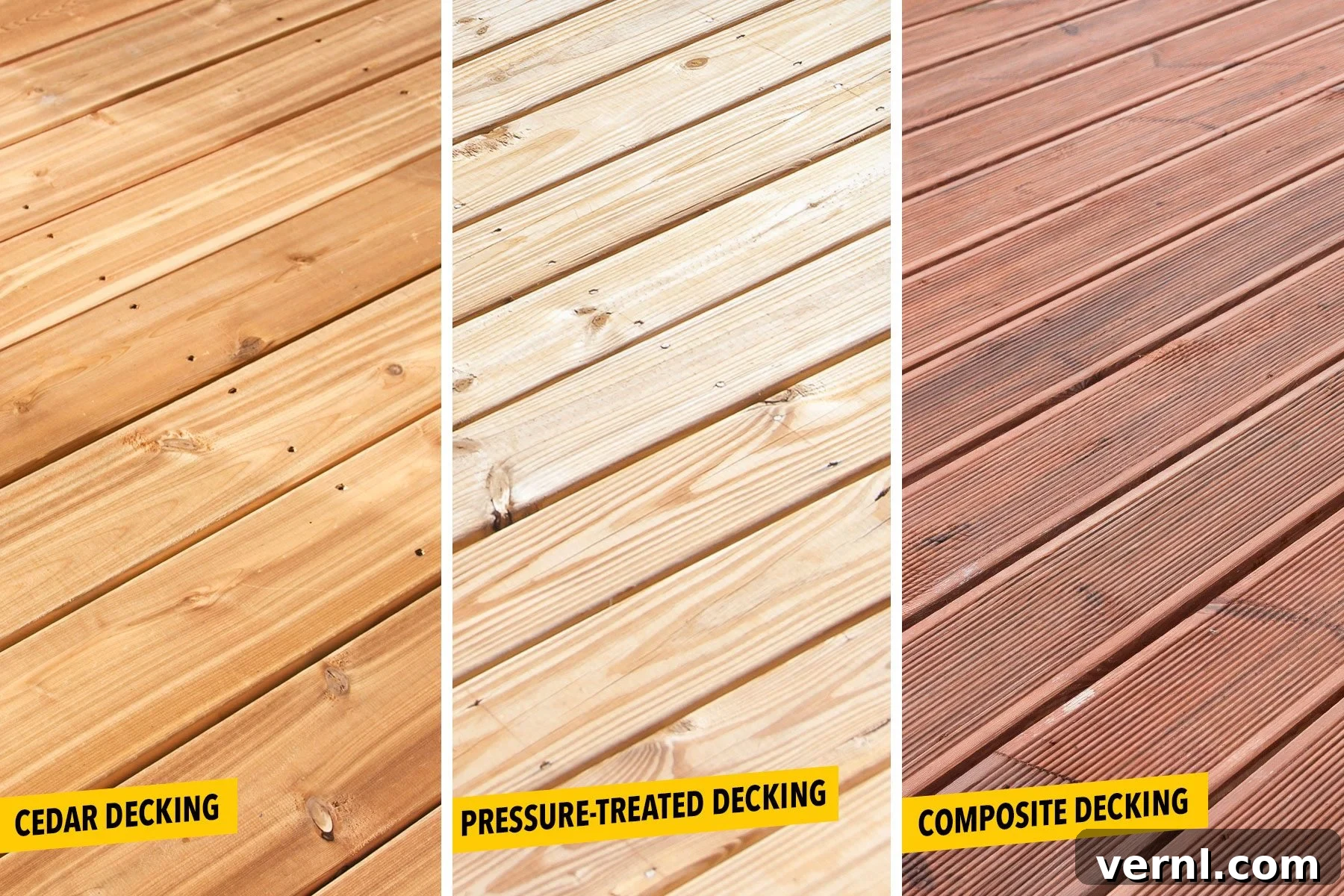
When embarking on a significant home improvement project like building or renovating a deck, the sheer number of material choices can be overwhelming. As experienced builders and homeowners alike understand, the decision often boils down to three core considerations: the aesthetic appeal, the longevity and resilience of the material, and naturally, the overall cost. While a myriad of options exist, from exotic hardwoods like ipé and black locust to innovative materials such as PVC or aluminum, the vast majority of standard deck constructions narrow the field to three primary categories: naturally weather-resistant softwoods (like redwood and cedar), chemically enhanced pressure-treated softwoods, and advanced composite materials. This article delves deep into these three popular decking choices, offering a comprehensive comparison to help you make an informed decision tailored to your specific needs and preferences.
In many parts of the country, especially in regions like Northern California where redwood flourishes, this robust and naturally beautiful wood is a top choice. However, in other areas, various species of cedar are equally prevalent. Given that both redwood and cedar share similar characteristics in terms of their natural weather resistance, appearance, and workability, we will often refer to them collectively as “cedar decking” throughout this guide, with redwood serving as a readily available and comparable substitute where applicable.
Beyond the initial material selection, two crucial questions await the homeowner: Do you intend to regularly stain or finish your deck, and are you prepared to commit to consistent maintenance throughout its lifespan? The answers to these questions will significantly influence which material truly offers the best value and satisfaction for your outdoor living space. Let’s explore the advantages and disadvantages of each of these prominent decking options.
Understanding Deck Material Costs: An Initial Investment Perspective
For any substantial home project, the financial outlay is often the first point of discussion. Deck construction is no exception, and understanding the deck material cost is paramount. It’s important to remember that these figures typically represent the material cost per square foot for the decking boards themselves, not including substructure, fasteners, labor, or finishes. Prices can also fluctuate based on brand, grade, region, and market demand.
- Composite Decking: The Premium Upfront Choice
Despite often being manufactured with a significant percentage of recycled materials, composites typically represent the highest initial investment among the three options. Their advanced manufacturing processes and superior performance characteristics contribute to this premium. Costs can vary widely, ranging from approximately $8 per square foot for entry-level products to over $18 per square foot for high-end, capped composite lines with advanced features and aesthetics. - Weather-Resistant Softwoods (Cedar/Redwood): The Mid-Range Investment
Natural softwoods like cedar and redwood fall into the middle of the price spectrum. These materials offer an excellent balance of natural beauty and durability. Standard 2×6 cedar decking boards, a common choice, generally cost between $4 and $8 per square foot, depending on the grade (e.g., knotty vs. clear heartwood) and regional availability. - Pressure-Treated Softwood (Pine): The Most Economical Option
Pressure-treated (PT) softwood, predominantly pine, stands out as the most budget-friendly decking material. Its cost-effectiveness makes it an attractive choice for homeowners working with tighter budgets. Prices typically range from $2 to $8 per square foot, making it significantly more accessible for many projects.
When evaluating cost, it’s crucial to consider not just the initial purchase price but also the long-term cost of ownership, including maintenance, repairs, and potential replacement over decades.
Pros and Cons of Composite Decking: Innovation Meets Low Maintenance
Composite decking has surged in popularity as a high-performance alternative to traditional wood. Typically manufactured from a blend of recycled plastics and wood fibers, these engineered boards offer a compelling mix of durability and convenience. The higher upfront cost of composite decking is frequently justified by its significantly reduced maintenance requirements over its lifespan, leading to potential long-term savings in time and money. Most composite products require little to no staining, sanding, or resealing, and they are engineered to resist color fading, rot, and insect damage, generally outlasting conventional wood decking. While most composites are designed to negate the need for staining, certain products may accept a stain after an initial period of weathering, usually around six months.
Advantages of Composite Decking:
- Exceptional Low Maintenance: This is arguably the biggest selling point. Say goodbye to annual sanding, staining, and sealing. A simple wash with soap and water is usually all that’s needed to keep it looking fresh. This saves homeowners significant time, effort, and expense over the years.
- Superior Durability and Longevity: Engineered to withstand the elements, composite decks are highly resistant to rot, decay, and insect infestation. Many brands offer extensive warranties, some covering decades, against material defects and performance issues. Modern capped composites feature an outer layer that provides enhanced protection against scratches, stains, and fading.
- Consistent Appearance and Aesthetic Versatility: Unlike natural wood, composite boards are uniform in color and texture from the factory. They come in a vast array of colors, grain patterns, and finishes, allowing for diverse design possibilities that can mimic various wood species or offer contemporary solid tones.
- No Warping, Splitting, or Cracking: Composite boards are engineered for structural stability. They are delivered straight and maintain their form after installation, eliminating common wood problems like curling, twisting, or splintering, which ensures a consistently smooth walking surface.
- Hidden Fastener Systems: Many composite manufacturers provide proprietary fastening systems that allow boards to be installed without visible screws on the surface. This creates a clean, sleek, and highly attractive finished deck surface.
- Eco-Friendly Credentials: A significant number of composite products incorporate recycled plastics and reclaimed wood fibers, making them a more sustainable choice compared to harvesting virgin timber. This contributes to waste reduction and less reliance on new natural resources.
Disadvantages of Composite Decking:
- Higher Upfront Cost: As noted, the initial material investment for composite decking is considerably higher than for natural or pressure-treated wood. This can be a barrier for budget-conscious projects.
- Heat Retention: Due to their plastic content, many composite decks, particularly darker colors, can absorb and retain a significant amount of heat on hot, sunny days. This can make the deck surface uncomfortably hot for bare feet.
- Susceptibility to Moisture (Historical Context): While significant advancements, particularly with capped composite technology, have largely addressed this issue, earlier generations of composite decking could absorb moisture through screw holes or surface defects, leading to swelling, mold, or mildew. Reputable brands like Trex have invested heavily in overcoming these challenges.
- Lacks Structural Rigidity: Composite decking is generally not as stiff as solid wood. This often necessitates closer joist spacing in the substructure (e.g., 16 inches on center instead of 24 inches for wood), which can add to the overall cost and complexity of the deck frame.
- Artificial Appearance: Despite advancements in mimicking wood grains, some homeowners still perceive composites as having a less natural or “plastic-y” look and feel compared to genuine wood.
- Difficult to Repair: If a composite board is significantly damaged, it can be challenging to replace it seamlessly. Color matching new boards to older, weathered ones can be difficult, and repairs might be more noticeable than with wood.
Pros and Cons of Cedar Decking: The Timeless Appeal of Natural Wood
Natural cedar and redwood decking materials are prized for their inherent beauty, workability, and natural resistance to decay and insects. These softwoods are structurally stable and available in various grades, from clear (select) boards free of knots and blemishes to more rustic knotty grades. For decking, lumber experts like Josh Kou, operations manager for North Castle Hardwoods, often recommend “heartwood common” (con heart) — a grade that strikes an excellent balance between appearance and cost-effectiveness, offering good durability without the premium price of select grades.
Advantages of Cedar Decking:
- Unmatched Natural Beauty: It’s difficult to replicate the authentic warmth, rich color variations, and distinctive grain patterns of natural wood. Cedar and redwood offer an organic aesthetic that beautifully complements outdoor environments and adds a touch of classic elegance.
- Naturally Durable and Resilient: As Josh Kou emphasizes, “Heartwood common cedar and redwood command a premium for their expected durability in the face of rot, insect attack and weathering.” These woods contain natural oils and tannins that provide inherent resistance to moisture, decay, and common wood-boring insects.
- Excellent Workability: Cedar is a relatively soft wood, making it easy to cut, saw, drill, and fasten. This ease of workability is beneficial for intricate designs, custom patterns, or on-site adjustments during installation, giving builders greater flexibility.
- Cooler Surface: Unlike plastic-heavy composites, natural wood surfaces generally remain cooler to the touch on hot, sunny days, making for a more comfortable walking surface.
- Restorable and Refinishable: One of the significant benefits of cedar is its ability to be renewed. A cedar deck can last 15-20 years or more, and when it starts to show its age, it can often be restored to an almost new condition by sanding off the old finish, cleaning, and applying fresh stain and sealant. This isn’t possible with composite materials.
- Sustainable Sourcing: When sourced from responsibly managed forests (look for FSC certification), cedar can be an eco-friendly choice, as it is a renewable resource.
Disadvantages of Cedar Decking:
- Requires Regular Maintenance: While naturally durable, cedar decking is not maintenance-free. To preserve its color, prevent splintering, and protect against the elements, it requires periodic cleaning, sanding, staining, or sealing. Without this care, its lifespan and appearance will diminish.
- Color Fading and Graying: Exposure to UV sunlight and weathering will naturally cause cedar and redwood to lose their vibrant color and turn a silvery-gray over a year or two. While regular sealing can slow this process, it’s ultimately a natural change that many homeowners choose to embrace.
- Quality Variability: As a natural product, individual cedar boards can vary in quality, straightness, and appearance. Josh Kou advises careful selection: “If you hold up the end of a board, look along its length, and immediately recall the banana you ate the day before, put it to one side and select the next board.” Boards that haven’t been properly dried can also be prone to warping and twisting after installation.
- Susceptibility to Splintering and Cracking: Over time, and especially with fluctuating temperatures and moisture levels, wood can develop surface cracks (checks) and splinters. Regular maintenance helps mitigate this, but it’s an inherent characteristic of natural wood.
- Vulnerability to Pests (if neglected): While naturally resistant, untreated or poorly maintained cedar can still become susceptible to rot, mildew, and certain insect infestations over extended periods, especially in consistently damp conditions.
Pros and Cons of Pressure-Treated Decking: The Economical Workhorse
Pressure-treated (PT) decking typically consists of pine boards infused with chemical preservatives under high pressure. This process significantly enhances the wood’s resistance to rot, fungal decay, and insect attacks, transforming an otherwise vulnerable wood into a robust and cost-effective decking material. Modern chemical treatments are considerably less toxic than historical formulations (which often contained arsenic), making contemporary PT decking safer for both the environment and human contact, though concerns about chemical leaching are not entirely “zero.”
Advantages of Pressure-Treated Decking:
- Most Economical Option: PT decking is consistently the lowest-cost material choice for deck boards, making it an excellent option for homeowners on a strict budget without compromising significantly on durability.
- Exceptional Durability and Longevity: The chemical treatment process gives PT wood an impressive lifespan, often outlasting untreated natural woods like cedar or redwood. As Josh Kou notes, “PT boards will also last longer than untreated cedar or redwood.” Many lumber retailers offer limited warranties against rot and decay, provided the decking is properly installed and maintained.
- Rated for Ground Contact: A significant advantage of many PT decking products is their suitability for direct ground contact. This makes them the ideal choice for low-profile decks, stair stringers, fence posts, and other structural components that have minimal or no clearance from the ground, where moisture and pest exposure are highest.
- Versatile in Finishing: While PT wood often has a distinctive greenish or brownish tint, it can be easily stained, painted, or sealed to achieve virtually any desired aesthetic. This allows homeowners to customize the deck’s appearance to match their home or landscape. A clear finish also helps protect the wood and enhance its natural look.
- Widespread Availability: PT lumber is readily available at almost any lumberyard or home improvement store, making it easy to source for projects of all sizes.
Disadvantages of Pressure-Treated Decking:
- Must Be Kiln-Dried After Treatment (KDAT): This is a critical factor. “Pressure-treated decking boards will shrink, split, crack and warp if they have not been properly kiln-dried,” warns Josh Kou. Many PT boards are sold still saturated with the treatment solution, known as “wet” PT. These boards need to dry out for several months before they can be stained or sealed and are more prone to warping. Always look for “KDAT” (Kiln Dried After Treatment) labels for optimal performance and stability.
- Requires Regular Maintenance: Like natural wood, PT decking is still susceptible to the damaging effects of UV radiation and weathering. Without periodic staining, sealing, or painting, the deck’s appearance can deteriorate significantly, leading to graying, checking, and general wear.
- Prone to Checks and Splintering: Even more so than natural wood, PT wood can be affected by moisture fluctuations and extreme temperature changes. This can result in numerous small surface splits called checks, as well as splinters, particularly if the wood was not properly kiln-dried or is left untreated.
- Can Corrode Standard Fasteners: The chemicals used in pressure treatment can be corrosive to standard galvanized fasteners. It is essential to use specific corrosion-resistant fasteners (e.g., hot-dipped galvanized or stainless steel) designed for use with PT lumber to prevent premature fastener failure and unsightly stains.
- Appearance: The natural greenish tint of PT wood may not appeal to everyone and can be challenging to cover completely with lighter stains. The wood grain can sometimes appear less refined than cedar or redwood.
- Environmental Considerations (Disposal): While modern PT chemicals are safer, proper disposal of old PT lumber is still important due to the embedded preservatives. It should not be burned or mixed with general waste in some areas.
FAQs: Common Questions About Decking Materials
Which decking material requires the least amount of maintenance?
Composite decking is unequivocally the lowest maintenance deck material available among the popular options. Brands like TimberTech and Trex offer advanced capped composite deck boards made from a sophisticated mix of high-performance and recycled polymers along with reclaimed wood fibers. These engineered boards are designed to be extremely durable and resistant to the common issues that plague wood, such as splintering, cracking, cupping, or peeling. Crucially, they eliminate the need for laborious tasks like staining, painting, or sealing. The minimal maintenance required for a composite deck typically involves regular sweeping to remove dirt and debris, clearing seasonal accumulations like leaves or snow, and an occasional wash with a deck cleaner and a soft brush or garden hose to remove grime. Power washing is generally not recommended due to its potential to damage the surface.
Which decking is the most eco-friendly?
According to organizations like Green America, the most eco-friendly decking material options are generally recycled-plastic lumber and sustainably sourced natural wood. When considering plastic lumber, prioritize products made from a high percentage of post-consumer recycled plastic to maximize their environmental benefit by diverting waste from landfills. For natural wood, always look for materials bearing the Forest Stewardship Council (FSC) logo. FSC certification guarantees that the wood has been harvested from forests managed according to strict environmental, social, and economic standards, ensuring long-term sustainability and responsible forestry practices. Composite decking also offers an eco-friendly angle due to its use of recycled materials, reducing the demand for virgin timber and plastic.
How long can I expect different decking materials to last?
The lifespan of your deck heavily depends on the material chosen, the quality of installation, and the level of maintenance provided.
- Composite Decking: Generally the longest-lasting, often coming with warranties ranging from 25 years to a lifetime. With proper care, many composite decks can easily last 30-50 years or more.
- Cedar/Redwood Decking: With consistent and diligent maintenance (regular cleaning, staining, and sealing), natural cedar or redwood decks can last between 15 and 25 years, sometimes longer. Without maintenance, their lifespan can drop significantly to 10-15 years as they succumb to weathering and decay.
- Pressure-Treated Decking: Thanks to chemical treatment, PT wood is highly resistant to rot and insects. With good maintenance, it typically lasts between 20 and 30 years. However, its aesthetic appearance might deteriorate faster than its structural integrity if neglected, leading to splintering and checks.
What are the best fasteners to use for each type of decking?
Selecting the correct fasteners is crucial for the longevity and safety of your deck.
- Composite Decking: Most composite manufacturers offer proprietary hidden fastening systems that clip into the side grooves of the boards, creating a clean, fastener-free surface. If using screws, pre-drilling is often recommended, and special “composite screws” designed to prevent mushrooming are preferred.
- Cedar/Redwood Decking: Stainless steel or high-quality coated deck screws are highly recommended to prevent staining (from tannin bleed) and corrosion. Hot-dipped galvanized fasteners are also an option. Avoid standard steel nails or screws, which can rust and leave unsightly marks.
- Pressure-Treated Decking: Due to the corrosive nature of modern chemical treatments, it is essential to use fasteners specifically rated for use with PT lumber. Hot-dipped galvanized screws (meeting ASTM A153 standards) or stainless steel fasteners (305 or 316 grade) are the safest choices. Regular galvanized or uncoated screws will corrode quickly and lead to premature failure.
About the Expert
- Josh Kou has dedicated his career to the lumber industry, bringing a wealth of practical experience and deep knowledge to the field. He serves as the operations manager for North Castle Hardwoods, a reputable lumber provider based in Chicago, IL. His insights provide invaluable guidance for both builders and homeowners navigating the complexities of wood and alternative decking materials.