
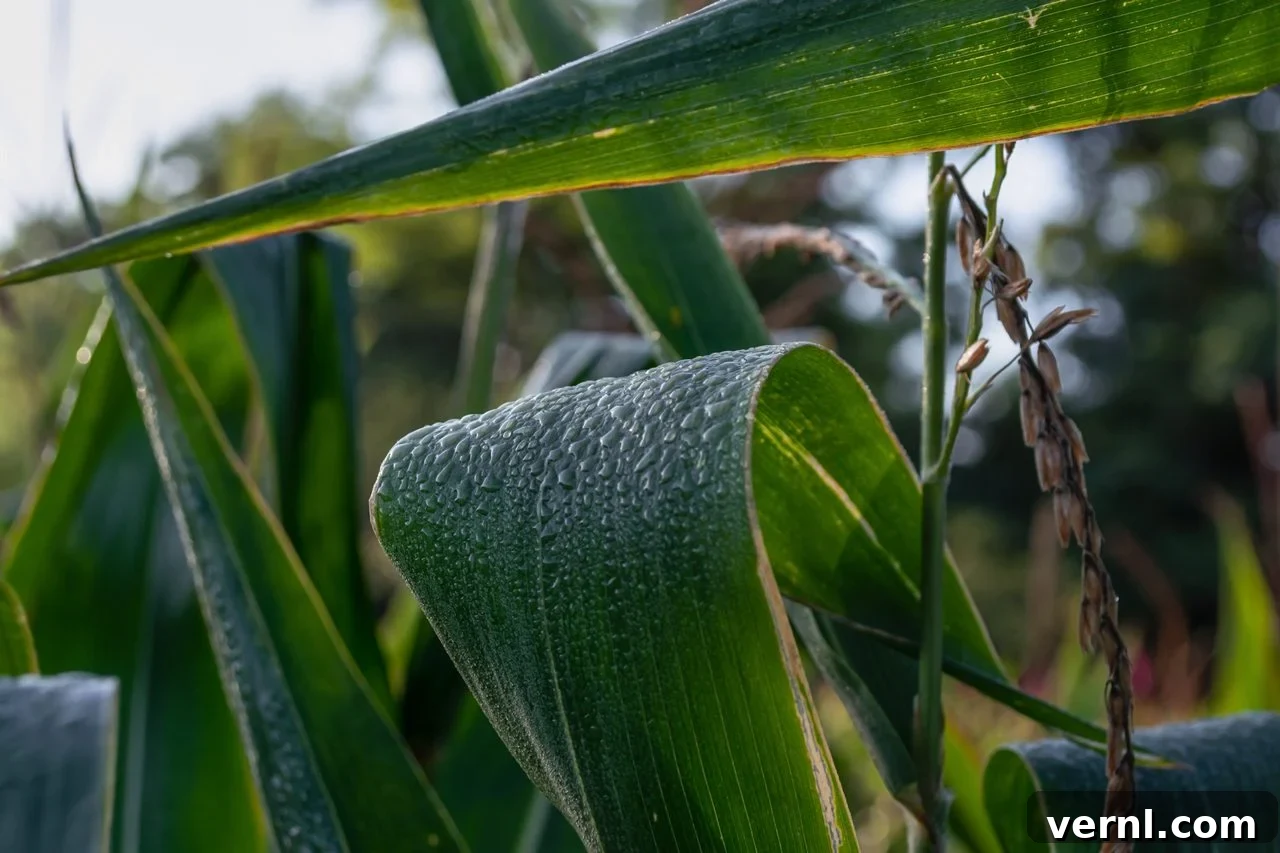
The Midwest is known for its friendly communities, expansive farmland, and a distinct seasonal rhythm. It’s also known for sticky, sweltering summer days. One contributor to that summertime muggy feeling that you may not have heard of is a process commonly referred to as “corn sweat.” While not solely responsible for oppressive humidity, corn sweat is a real phenomenon and can influence local moisture levels during the growing season.
What Is Corn Sweat?
Corn sweat describes the movement of water within a corn plant from the soil, up through the stem, and out into the air through tiny pores on the leaves called stomata. Scientists and extension specialists often describe this as part of plant transpiration, where water evaporates from leaf surfaces. In lay terms, during hot periods, healthy corn plants release water vapor into the atmosphere as part of their normal functioning. In large, dense fields this collective release of moisture can make the air immediately above and downwind of the crop modestly more humid.
This natural process serves several purposes for the plant: it helps transport nutrients, cools the plant through evaporative loss, and maintains physiological processes necessary for growth and reproduction. The volume of water moved and released varies with temperature, sunlight, soil moisture, and the plant’s growth stage.
When and Where Is Corn Sweat Strongest?
Corn sweats most intensely during the peak of the growing season, typically in mid to late summer when plants are tasseling and flowering. Those stages demand substantial water uptake to support rapid growth and kernel development. When soil moisture is abundant and temperatures are high, plants transpire at higher rates, and fields can be significant local sources of water vapor.
By contrast, toward the end of the season and during periods of moisture stress—such as drought or extremely dry soils—transpiration drops. Corn plants respond to stressful conditions by partially closing stomata to conserve water, which reduces the amount of moisture released to the atmosphere. Thus, corn sweat is most noticeable when the crop is actively growing and water is readily available.
Corn’s contribution to humidity is most apparent close to the ground and within or immediately downwind of large fields. In small plots or in areas where soil moisture is limited, the effect will be negligible.
How Much Does Corn Sweat Affect Regional Humidity?
While corn fields do add moisture to the air locally, they are only one piece of a larger picture that determines regional humidity. The Midwest’s muggy summer air is driven primarily by broader atmospheric conditions: warm temperatures that increase the air’s moisture capacity, persistent wind patterns that pull humid air inland from the Gulf of Mexico, and large-scale weather systems that concentrate moisture over wide regions.
Natural features such as lakes, rivers, and forests also contribute water vapor through evaporation and transpiration. Compared to those large-scale and regional drivers, the moisture added by corn fields is relatively small. Agricultural evapotranspiration is meaningful when considering local microclimates and water budgets, but it does not typically cause widespread regional humidity shifts on its own.
Experts emphasize that recent stretches of heavy humidity are best explained by prevailing atmospheric patterns rather than the presence of cornfields. Large-scale flows of air and associated moisture transport account for most of the noticeable changes in humidity and heat index that people experience across the Midwest.
Practical Considerations
For residents and visitors, understanding corn sweat helps explain why certain rural or field-adjacent locations feel especially muggy on hot summer days. Farmers, water managers, and researchers monitor evapotranspiration as part of irrigation planning and crop management, since it directly affects soil moisture and plant health. But for the general public, the most important factors in summer humidity remain broader weather systems, oceanic moisture sources, and regional climate patterns.
Sources
Ohio State University Extension, “Corn Sweat and Humidity: A Few Facts Explained.”
USDA, “Simulation of crop evapotranspiration and crop coefficients with data in weighing lysimeters.”
USDA, “Crop Progress & Condition.”
RELATED:
- The 5 States Where Winter Driving Is Most Dangerous
- Which States Have the Highest and Lowest Property Taxes?
- The Biggest Home in Each State That Will Stun You