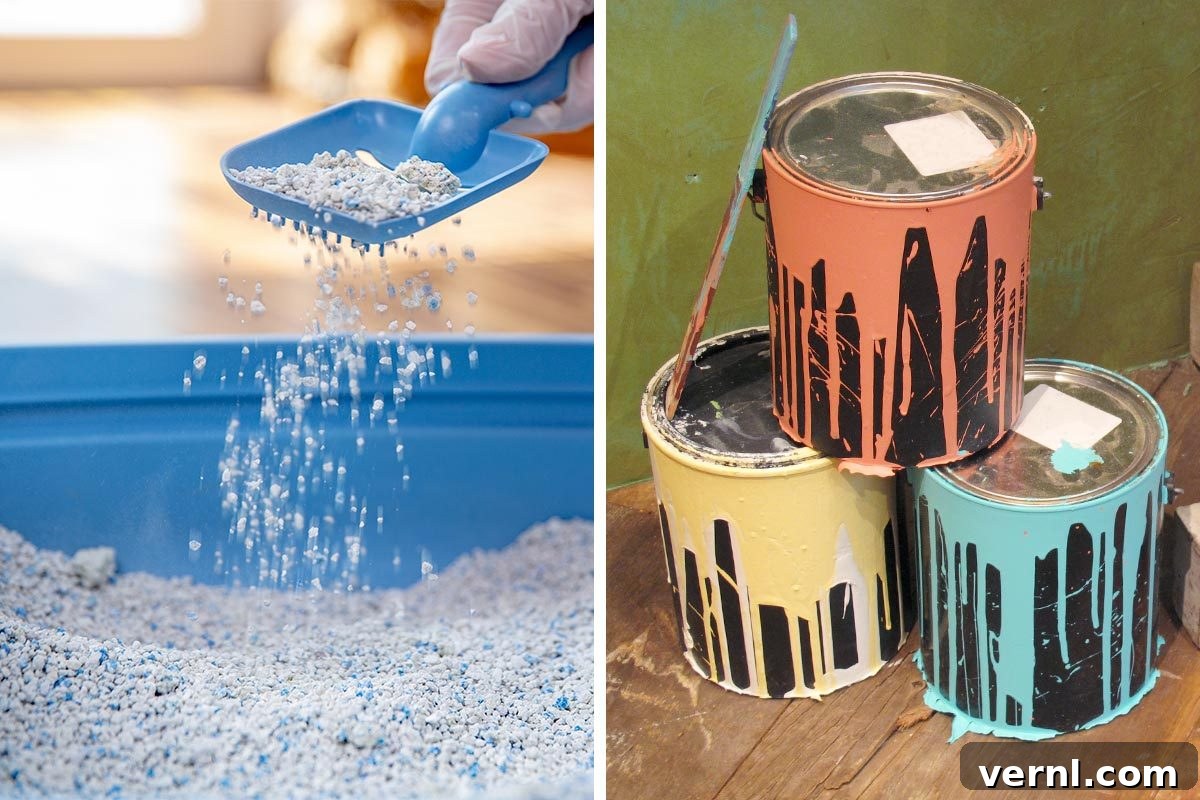
How many cans of old, half-used paint are currently cluttering your garage, basement, or garden shed? It’s a common scenario for many homeowners. When I recently moved from my old residence, I took stock of the situation and found myself staring at no less than nine forgotten paint cans. To my surprise, only two of them actually belonged to me.
Some of these cans were completely dried out, reducing their contents to solid, unusable chunks. Those were easily tossed into the regular trash. However, the majority contained varying amounts of liquid paint, necessitating a dutiful drive to the local recycling center for proper disposal. This experience left me wondering: Is there a simpler, more efficient way to tackle the often-daunting task of disposing of old paint?
As it turns out, there is! The internet, a treasure trove of innovative hacks, pointed me toward a surprisingly simple solution involving an everyday household item: kitty litter. This method has gained significant traction, especially after going viral on platforms like TikTok. But does this seemingly unconventional approach truly work? Determined to find out, I decided to put the theory to the test on some leftover paint that the previous owner of my new home had “helpfully” bequeathed to me.
Before diving into my own experiment, it’s always insightful to see the original inspiration. Take a moment to watch the viral TikTok video that brought this clever paint disposal trick into the spotlight. It provides a quick, visual demonstration of the process:
Understanding Paint Types: Latex vs. Oil-Based – A Crucial Distinction
Before attempting any paint disposal method, it’s paramount to understand the type of paint you’re dealing with. This isn’t just a minor detail; it’s a critical safety and environmental consideration that dictates how the paint can and should be disposed of. My research before trying the TikTok hack immediately highlighted this fundamental difference, a point often overlooked but essential for responsible waste management.
The Difference Between Latex and Oil-Based Paints
- Latex Paint (Water-Based): This is the most common type of paint used for interior and exterior walls. It’s characterized by its easy cleanup with water, quick drying time, and low volatile organic compound (VOC) content. Latex paint is generally considered non-hazardous once dry.
- Oil-Based Paint (Alkyd): Once a household staple, oil-based paints are now less common due to their higher VOC content and stricter environmental regulations. They offer a durable finish and are often used for trim, doors, and some exterior applications. Cleanup requires mineral spirits or paint thinner, not water. Crucially, oil-based paints are classified as hazardous waste even when dry, due to their chemical composition.
Why does this distinction matter so much? Because the kitty litter method, and most other DIY paint drying techniques, are strictly for latex paint only. Oil-based paints, solvents, thinners, and other similar products contain chemicals that are harmful to the environment and human health if improperly disposed of. They can never be simply tossed in the trash, even after drying. Identifying your paint type is the first and most critical step in responsible paint disposal. You can usually find this information clearly marked on the paint can label.
The Viral Kitty Litter Hack for Latex Paint Disposal: How It Works
The TikTok video made the process of solidifying latex paint seem remarkably straightforward, almost too good to be true. The principle is simple: use an absorbent material to soak up the liquid paint, turning it into a solid, non-hazardous mass suitable for regular trash disposal. Kitty litter, it turns out, is an excellent candidate for this task due to its highly absorbent properties.
Step-by-Step Guide to Using Kitty Litter for Paint Disposal
Here’s a detailed breakdown of the process, as demonstrated in the viral video and confirmed by expert recommendations:
- Identify Your Paint: As mentioned, ensure you are dealing with latex (water-based) paint. This method is unsafe and ineffective for oil-based paints.
- Prepare Your Workspace: Choose a well-ventilated area, preferably outdoors or in a garage with an open door. Lay down newspaper or a drop cloth to protect surfaces from spills.
- Open the Paint Can: Use a paint can opener or a flat-head screwdriver to carefully pry open the lid of the unwanted, partially full paint can.
- Add Kitty Litter: Scoop a generous amount of standard clumping or non-clumping kitty litter directly into the paint can. The general consensus, and what the TikToker appeared to use, is roughly a 1:1 ratio of kitty litter to liquid paint. If the can is a quarter full of paint, you might fill it to about halfway with litter. There’s no need to be exact, but aiming for enough litter to fully absorb the paint is key.
- Stir Thoroughly: Using a stir stick, paint stirrer, or even a sturdy branch from your yard, thoroughly mix the kitty litter into the paint. Stirring helps distribute the litter evenly, allowing it to absorb the paint much more effectively and accelerate the drying process. Continue stirring until the mixture becomes thick and uniform, resembling a clumpy paste or mud.
- Wait for Solidification: Once thoroughly mixed, allow the concoction to sit undisturbed. According to the video, the paint should harden significantly within 10 to 15 minutes. For larger quantities or particularly thick paint, it might take longer. The goal is for the mixture to become solid enough that it won’t spill or drip if the can is tipped over.
- Verify and Dispose: Before disposal, always confirm that the paint is completely dry and solid. If it’s still tacky or liquid, add more kitty litter and stir again, then wait. Once fully solidified, the can, along with its hardened contents, can typically be placed in your regular household trash. Remember to check your local waste disposal guidelines, as regulations can vary.
This method offers a quick, convenient, and environmentally sound way to manage small to medium quantities of leftover latex paint, preventing it from accumulating indefinitely in your storage spaces.
A Deeper Dive: My Hands-On Experiment and Observations
With the TikTok instructions in mind and a clear understanding of paint types, I was ready to conduct my own experiment. The previous owner’s generous contribution included several paint cans in varying states, none of which contained usable paint, thankfully sparing me the guilt of “wasting” good paint on a test. This provided the perfect opportunity to assess the efficacy of the kitty litter hack firsthand.
I selected two different cans from the garage. Each was approximately a quarter full of what I confirmed to be latex paint. To add an extra layer to the experiment, I decided to test two common types of kitty litter:
- Can 1: Clumping Kitty Litter. I scooped this into the first can until it was about half full, aiming for what looked like the 1:1 paint-to-litter ratio demonstrated in the TikTok.
- Can 2: Plain, Non-Clumping Kitty Litter. I repeated the same process for the second can, using the non-clumping variety.
Armed with a sturdy stick I found in the yard, I began stirring. The absorption process was almost instantaneous in both cans. The liquid paint quickly began to thicken as it combined with the litter. I stirred thoroughly until the mixtures appeared uniform and visibly denser. Following the TikTok’s suggested timeline, I set a timer for 15 minutes.
Initial Observations (15 Minutes)
After the 15-minute mark, both mixtures were significantly thicker than when I started, but neither had achieved the completely solid, hard consistency depicted in the viral video. The clumping litter mixture was very thick and pasty, almost like damp cement. The non-clumping litter mixture was also thick but had a slightly more granular, pebbly texture. While definitely not liquid, they weren’t yet firm enough to be confidently thrown into the trash without risk of spillage.
Extended Observations (1 Hour)
Recognizing that conditions, paint thickness, and litter type might affect drying times, I decided to extend the waiting period. After one hour, the difference between the two litter types became more apparent:
- Clumping Litter Can: This mixture had transformed dramatically. It was nearly solid, with a consistency akin to firm playdough or modeling clay. I could press my finger into it, but no liquid paint seeped out, and it held its shape perfectly.
- Non-Clumping Litter Can: While much firmer than at 15 minutes, this mixture retained more of its pebbly, granular texture. It was solid enough that it wouldn’t pour, but it wasn’t as uniformly hard as its clumping counterpart. It felt more like very dense, slightly damp sand. This might have been partly due to “operator error,” as I eyeballed the amounts rather than using precise measurements. However, it was clear that the non-clumping litter also effectively absorbed the paint, just with a slightly different final consistency.
My experiment unequivocally confirmed that the hack works. Both types of kitty litter effectively absorbed and solidified the latex paint, making it suitable for disposal. The clumping litter seemed to produce a more uniformly solid mass in a shorter time, but both methods were successful in rendering the paint non-liquid.
Expert Endorsement: What Industry Leaders and Authorities Recommend
While viral hacks can sometimes be dubious, this particular paint disposal method comes with significant backing from credible sources. It’s not just a social media phenomenon; it’s a recognized and recommended practice by key players in the paint industry and government agencies alike.
Confirmation from Major Paint Brands
Leading paint manufacturers, such as Sherwin-Williams and Benjamin Moore, openly advise homeowners to use absorbent materials like kitty litter to dry out leftover latex paint before disposal. Their recommendation carries substantial weight, as these companies are at the forefront of paint formulation and proper usage. Their guidelines often emphasize safety and environmental responsibility, so their endorsement of the kitty litter method speaks volumes about its effectiveness and safety for latex paints.
Government and Retailer Support
Beyond manufacturers, local and state government websites across the country frequently feature the kitty litter method in their waste management guidelines. For instance, Dallas County in Texas, where I reside, explicitly recommends this approach for drying latex paint. This widespread governmental acceptance reinforces the method’s credibility and aligns it with broader environmental protection efforts.
Furthermore, major home improvement retailers, such as Lowe’s, also detail this method on their websites as a legitimate way to prepare latex paint for disposal. This collective endorsement from manufacturers, government bodies, and retailers provides strong evidence that the kitty litter hack is not just a clever trick but a widely accepted and responsible practice for dealing with latex paint waste.
The consensus among experts is clear: kitty litter is an effective and efficient agent for accelerating the drying and solidification of latex-based paints, making them safe for regular trash disposal.
Beyond Kitty Litter: Comprehensive Paint Disposal Alternatives
While the kitty litter method is excellent for latex paint, it’s just one piece of the puzzle when it comes to responsible paint disposal. Depending on the type and quantity of paint, several other eco-friendly and practical options are available. The goal should always be to prevent paint from entering landfills in its liquid form, and ideally, to reuse or recycle it.
1. Donate Your Leftover Paint
One of the most sustainable options for usable leftover paint is to donate it. Many organizations can put your excess paint to good use, preventing it from becoming waste. This method is particularly beneficial if you have full or nearly full cans of good quality paint in standard colors.
- Local Charities and Non-Profits: Check with local charities, churches, and community centers. They often undertake renovation projects or have programs that benefit from donated building materials.
- Habitat for Humanity ReStore: Habitat for Humanity operates ReStore outlets across the country. These stores accept donations of new and gently used building materials, including paint, which are then sold to the public at discounted prices. The proceeds support Habitat for Humanity’s mission. Consult your local ReStore website for their specific acceptance policies, as they can vary by location.
- Schools and Theater Groups: Art departments in schools or local community theater groups may be in need of paint for various projects and sets.
- Community Projects: Keep an eye out for local community beautification projects or volunteer groups that might benefit from paint donations.
Before donating, ensure the paint is in good condition, tightly sealed, and clearly labeled. Most organizations prefer full or nearly full cans.
2. Air Dry for Small Quantities (Latex Paint Only)
For small amounts of latex paint, simply allowing it to air dry is a perfectly acceptable and straightforward method. This is a great alternative if you prefer not to use kitty litter or if you only have a thin layer of paint left in the can.
- Open the Can: Simply remove the lid and place the can in a well-ventilated area, away from children, pets, and sources of ignition.
- Accelerate Drying: To speed up the process, especially for cans that are more than an inch or two full, you can pour the paint onto absorbent materials. Old newspapers, cardboard, wood chips, or even an old towel spread out in a protected area will work. Once the paint has completely dried on these surfaces, they can be folded up and placed in the trash. For cans, a thin layer will solidify on its own.
- Verify Dryness: Ensure the paint is completely hard and dry before disposing of the can in your regular trash. It should not be tacky or liquid.
3. Hazardous Waste Facilities for Oil-Based Paints and Solvents
This is arguably the most critical method for safe and responsible disposal, especially for materials that are explicitly designated as hazardous. Oil-based paints, paint thinners, solvents, certain aerosols, and other household chemicals cannot be placed in regular trash or poured down drains due to their harmful components.
- Local Government Resources: Your local city or county government website is the best resource for finding hazardous waste drop-off sites. Many municipalities organize special collection events or have permanent facilities where residents can bring hazardous materials.
- Understanding Hazardous Waste: Be aware that items like automotive fluids, pesticides, certain cleaning products, and even some batteries also fall under hazardous waste categories and should be disposed of at designated facilities.
4. Paint Recycling and Product Stewardship Programs (e.g., PaintCare.org)
In a growing number of states, paint manufacturers have taken responsibility for the end-of-life management of their products through product stewardship programs. These initiatives make it much easier for consumers to recycle paint, including both latex and oil-based varieties.
- PaintCare.org: The industry-led organization PaintCare.org operates paint recycling and collection programs in several states. This program sets up convenient drop-off sites at paint retailers, hardware stores, and recycling centers. PaintCare accepts most house paint, primers, stains, sealers, and varnishes, regardless of whether they are latex or oil-based.
- Check Your State: Visit the PaintCare.org website to see if you live in a “PaintCare state.” If you do, this is often the easiest and most comprehensive option for disposing of almost all types of leftover paint, ensuring it gets recycled into new products or used for other beneficial purposes.
- Benefits of PaintCare: These programs simplify the recycling process for consumers, reduce the amount of paint going into landfills, and promote a circular economy for paint products.
Preparing Paint Cans for Disposal: General Tips
Regardless of the disposal method you choose, a few general best practices can make the process smoother and safer:
- Store Paint Properly: To minimize waste in the first place, always store your paint cans correctly. Ensure lids are tightly sealed, and store them in a climate-controlled area, away from extreme heat or freezing temperatures. Learn more about how to store paint to make it last longer.
- Label Clearly: If you keep leftover paint, always ensure cans are clearly labeled with the color, type (latex/oil), and date of purchase. This helps you identify what you have and whether it’s still usable.
- Clean Can Rims: Before resealing a can for storage, wipe excess paint from the rim and lid groove. This ensures a tight seal, prolonging the paint’s life.
- Remove Lids for Disposal: When disposing of dried paint cans in the trash, it’s often recommended to remove the lid. This allows waste collectors to see that the can’s contents are indeed solid and non-hazardous, ensuring it’s accepted.
- Use Up Small Amounts: Before considering disposal, try to use up small amounts of paint for touch-ups or small craft projects. This is the ultimate form of waste reduction.
The Verdict: Making Responsible Choices for Paint Disposal
After my hands-on experiment and extensive research, the verdict is clear: The kitty litter hack absolutely works for latex paint. Both clumping and regular kitty litter effectively absorbed and solidified the paint, turning a liquid hazard into a manageable solid. While my experiments didn’t harden quite as quickly or as uniformly as the hyper-speed TikTok versions, especially after just 15 minutes, the extended waiting time proved its efficacy.
After an hour, my can with clumping litter was nearly solid, providing a firm, non-liquid mass perfect for trash disposal. The non-clumping can, while having a more pebbly texture, was also safely solidified and no longer posed a liquid spill risk. Any minor differences in final texture or drying time can likely be attributed to variations in paint consistency, the amount of litter used, or even ambient conditions. Regardless, this hack definitely provides a practical and accessible solution for homeowners.
Ultimately, responsible paint disposal is about understanding the different types of paint and utilizing the most appropriate method for each. For latex paint, the kitty litter method offers a convenient DIY solution. For all types of paint, especially oil-based, exploring donation options, air drying small quantities, and leveraging official hazardous waste facilities or product stewardship programs like PaintCare.org are crucial steps.
By making informed choices, we can ensure that our leftover paint is managed safely, protecting both our environment and our communities from potential harm. So, the next time you find yourself with those forgotten cans, you’ll have a clear plan to dispose of them responsibly and efficiently.