
Sulfur for Lawns: Your Comprehensive Guide to a Healthier Yard
A lush, green lawn is the pride of many homeowners. But sometimes, despite your best efforts, your grass may appear lackluster. Several factors can contribute to this, from pests and drought to dull mower blades and weeds. Often, the issue lies beneath the surface, specifically in your soil’s composition. Understanding and addressing your soil’s needs is crucial for achieving a vibrant lawn. One key element in achieving optimal soil health is sulfur. This guide delves into the benefits of sulfur for lawns, how and when to apply it, and essential safety precautions, providing you with the knowledge to nurture a thriving, green space.
The foundation of any healthy lawn is the soil it grows in. Conducting a soil test is the most effective way to determine what your lawn requires. This analysis reveals the pH level and nutrient content of your soil, allowing you to make informed decisions about amendments, such as sulfur, to improve lawn health. In this article, we’ll cover everything you need to know about sulfur, with expert insights from Jay Worth, a seasoned turf care specialist with over 14 years of experience.
Why is Sulfur Good for Your Lawn?
Sulfur plays a vital role in lawn care, particularly in correcting overly alkaline soil. “Sulfur is used to correct the pH of very alkaline soils,” explains Worth. “Turfgrass of all species grows best when the soil pH is generally between 6.0 and 7.0.” When the soil pH is too high (above 7.5), it can hinder your grass’s ability to absorb essential nutrients, leading to patchy growth, yellowing, and an overall decline in your lawn’s health.
If your soil test indicates a pH level approaching or exceeding 7.5, a sulfur application may be necessary. Here’s a breakdown of the key benefits:
1. Corrects the Soil’s pH
In certain regions, especially in the South and Western United States, soils tend to be more alkaline due to their composition. “In some parts of the South and Western U.S., there are generally more alkaline soils, sandy or loamy soil, necessitating the application of sulfur to lower the pH,” Worth notes. A soil test is therefore the first and most critical step. You can easily purchase soil test kits online, at your local garden center, or at your favorite retailer. Prices for these kits range from approximately $8 to $100, depending on the scope of the test.
For more detailed and accurate soil pH correction recommendations, consult your state’s university extension service. You can locate their contact information through the United States Department of Agriculture’s National Institute of Food and Agriculture website. Simply select your state to access resources for soil testing services, including pricing and specific recommendations.
Worth emphasizes the importance of patience when implementing sulfur treatments: “If you’ve done a soil test and know your pH is above that ideal range, when to apply sulfur depends on the grass type you’re growing. If you’ve got a significant issue that needs correction, your best bet is to make these adjustments over a couple of growing seasons. The alternative is possibly destroying your lawn, so patience is key here.”
Note: In the Eastern United States, where clay soils are more prevalent, the soil tends to be more acidic. In this case, applying limestone helps raise the pH to a more neutral level.
2. Helps Grass Plants Produce Chlorophyll
Sulfur is an essential element for the process of photosynthesis. “Sulfur is necessary for photosynthesis,” says Worth. “Plants can’t grow and produce chlorophyll without it.” It plays a crucial role in enabling plants to convert sunlight into energy, and subsequently, produce the green pigment, chlorophyll, that gives your lawn its vibrant color and supports its overall health.
Many lawn fertilizers already include some sulfur in their ingredients list, often labeled as “sulfate,” such as ammonium sulfate or potassium sulfate. If your soil pH is only slightly elevated, the sulfur present in these fertilizers might be sufficient to help bring it into balance.
3. Helps Release Other Nutrients
Beyond correcting pH and aiding photosynthesis, sulfur facilitates the absorption of other vital nutrients. “When fertilizing your lawn, the plant doesn’t intake those nutrients,” Worth explains. “They first adhere to soil particles, and the plants draw nutrients from them.” Sandy and loamy soils, for instance, typically hold fewer nutrients than clay soils.
Soil bacteria convert sulfur into sulfuric acid, which then releases soil-bound nutrients, making them available for plant uptake. This conversion is particularly beneficial in soils that don’t readily retain nutrients, helping to ensure your grass has access to the nourishment it needs to thrive.
How Often Should You Apply Sulfur to Your Lawn?
The frequency of sulfur application depends heavily on your lawn’s specific health needs and the results of your soil test. It’s crucial not to over-apply sulfur, as excessive amounts can harm your grass.
Generally, a single sulfur application per year is recommended. Worth suggests applying sulfur during the fall for cool-season grasses like bluegrass, fescues, and perennial rye. For warm-season grasses such as Bermuda, zoysia, St. Augustine, and centipede, spring application is ideal, preferably before the onset of the summer heat.
“Soil permeability plays a huge part too,” Worth adds. “If your soil is extremely compacted and you’ve got standing water on your property, sulfur might cause damage. If you think this might be the case, core aerating your lawn before applying the sulfur treatment will help.” This process allows for better water and nutrient penetration.
Guide to Using Sulfur Safely
Your soil test results will provide specific recommendations on how much sulfur to apply to correct the pH. In some cases, simply using a turf fertilizer that contains sulfur might be sufficient. Other times, you may need to apply sulfur once per season over a period of up to three years, as part of a comprehensive lawn care strategy.
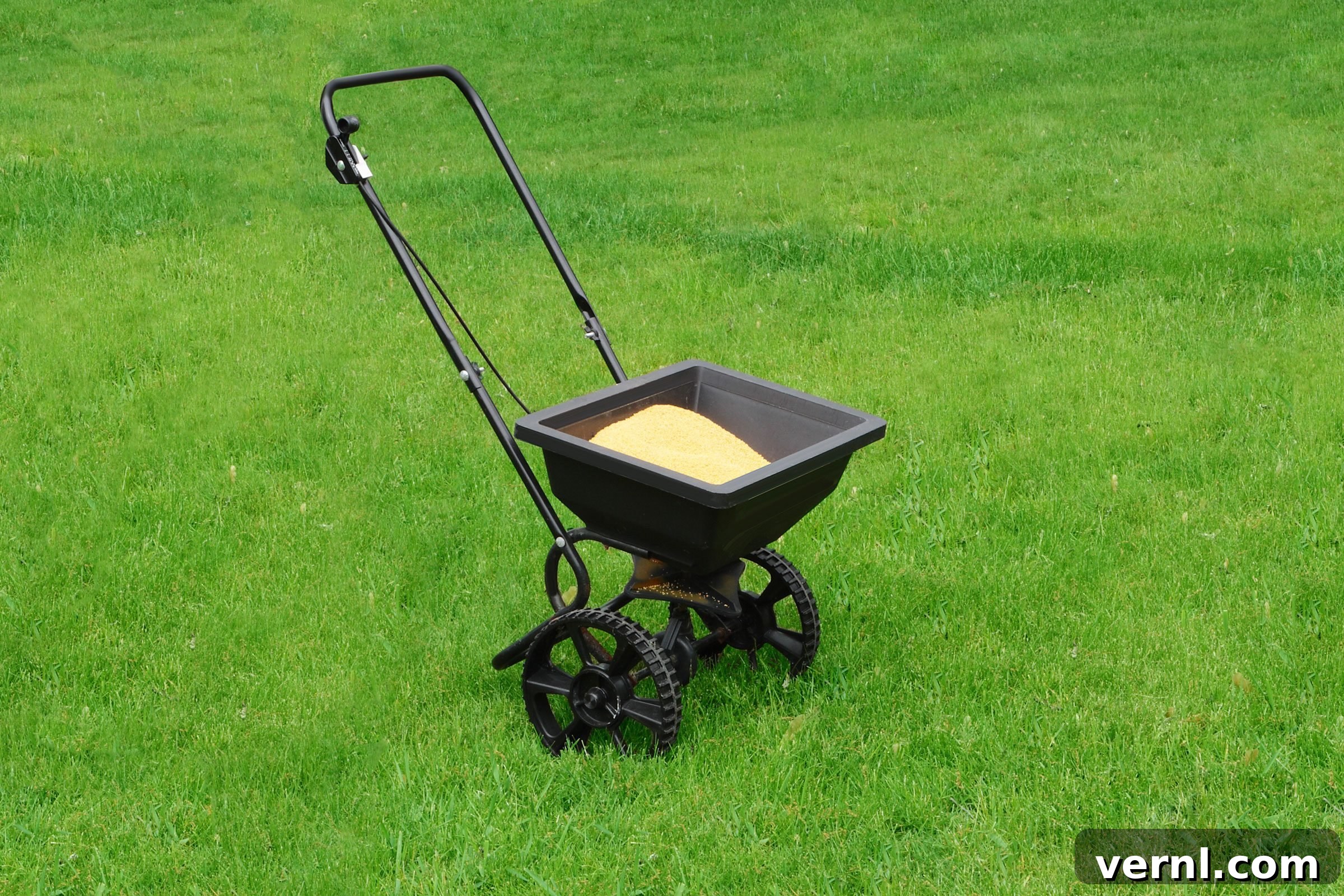
Sulfur for lawns is available in various forms, including dust, wettable powder, liquid, and pelletized formulations. Always carefully read and follow the instructions on the product packaging, as these will detail the recommended spreader gauge settings, the amount to use, and whether or not to water the sulfur into the soil. You can find lawn fertilizers containing sulfates as a liquid, often applied with a hose-end sprayer, or as granular fertilizer, which you can apply with a spreader. A broadcast spreader is suitable for lawns of 4,000 square feet or more, while a drop spreader is better suited for smaller yards or lawns with extensive landscaping.
Caution!
When applying sulfur, it is essential to keep children and pets away from the treated area until the sulfur has dissolved into the ground. Sulfur has been registered as a pesticide since the 1920s and can be harmful if ingested. It is effective in controlling insects, mites, rodents, and fungi, and this safety measure will ensure that no one is exposed to these effects.
FAQs
Is sulfur safe to use on all grass types?
Yes, sulfur is generally safe for most grass types when applied correctly and in proper amounts. Whether you have cold-season grass such as fescue or warm-season types like Bermuda or zoysia, sulfur lowers lawn pH to an ideal range for nutrient absorption. But do check the specific application instructions for your variety of grass.
How can you tell if you are using too much sulfur on a lawn?
Too much sulfur can cause grass to turn yellow, develop burnt spots, or create an overly acidic growing environment in the soil. These are all signs of over-application. To avoid this, stick to the recommendations based on your soil test results, and observe how your lawn reacts after the treatment. Less is often more when it comes to sulfur.
Should you apply sulfur in the summer?
While possible, applying sulfur during the summer months, especially during periods of extreme heat, can potentially damage your lawn. The best times to apply sulfur are in early spring or fall, when temperatures are cooler. If you must apply sulfur in summer, do so with caution and consider applying it to a moist lawn to aid its effectiveness and prevent any potential damage from heat.
About the Expert
- Jay Worth is a turf and lawn care expert with over 14 years in the green industry, beginning his career in landscaping and sales. He is currently the Marketing Manager at SingleOps and host of the Green Industry Perspectives podcast.
Source
- USDA: “Land-grant University Website Directory”