Dealing with a pest infestation is never pleasant, but few insects strike as much concern as carpenter ants. If you’ve ever witnessed the extensive damage these pests can inflict on wooden structures, you’ll understand why effective control is paramount. Many homeowners have stories of discovering carpenter ants causing structural issues that were initially attributed to other problems. For instance, a persistent roof leak might unexpectedly reveal a deep-seated carpenter ant colony that has silently eaten through vital wooden decking. Such experiences underscore the critical need for accurate identification and swift action.
Carpenter ants (Camponotus spp.) are a diverse group, and while not all species are black, the two most common in North America—the Eastern carpenter ant (Camponotus pennsylvanicus) and the Western carpenter ant (Camponotus modoc)—are predominantly dark-bodied and quite conspicuous. C. pennsylvanicus, in particular, is so prominent that it earned the distinction of being the first named ant species in North America. Their noticeable size and color often lead to them being mistaken for other large black ants.
However, the carpenter ant isn’t the only black ant you might encounter. They are frequently confused with the common black ant, also known as the black garden ant (Lasius niger), and other smaller black ant species. Distinguishing carpenter ants from their smaller, less destructive counterparts is crucial for effective pest management. While many ants are a nuisance, carpenter ants pose a unique threat to the structural integrity of your home. Understanding the subtle yet significant differences in their appearance, habitat, and behavior is the first step toward effective control and prevention.
Carpenter Ants vs. Black Ants: What Do They Look Like?
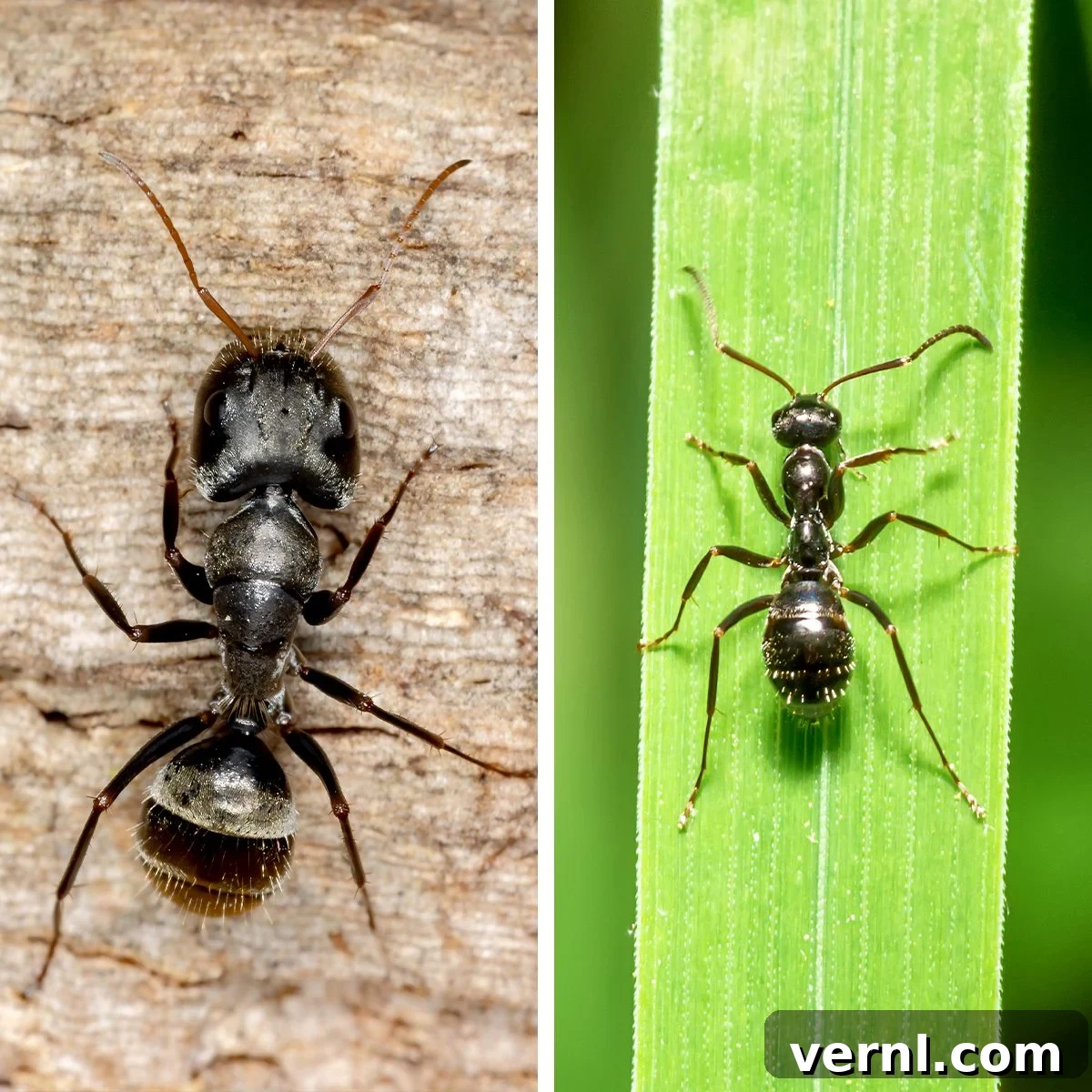
When it comes to distinguishing carpenter ants from other black ants, size is often the most immediate and noticeable difference. Carpenter ants are among the largest ant species, typically ranging from 1/2-inch to 5/8-inch in length. This substantial size makes them stand out significantly compared to most other black ants found in and around homes. The largest common black ant workers, for example, are usually only about half that size, measuring around 1/8 to 1/4 inch. While common black ant queens can reach up to 1/3 inch, encountering one is a rare occurrence, and even then, they are smaller than typical carpenter ant workers.
Beyond sheer size, a closer inspection of physical characteristics provides clear diagnostic markers. Carpenter ants possess a distinctive triangular-shaped head when viewed from the front, a stark contrast to the more rounded heads of most other black ant species. Their antennae also feature a unique bend or elbow, rather than being uniformly straight. Furthermore, the petiole—the narrow waist-like segment connecting the thorax (chest) to the abdomen—is singular in carpenter ants. Many other ant species, including the common black ant, have a two-segmented petiole. These specific anatomical features are reliable indicators for accurate identification.
Another significant visual cue relates to their reproductive cycle. During mating season, which often occurs in spring or early summer, carpenter ants develop wings. These winged reproductives, known as “swarmers,” are often the first visible sign of a hidden colony within a structure. While some other ant species also produce winged forms, carpenter ant swarmers are notably larger. It’s also quite common to confuse these flying carpenter ants with termites, as both bore into wood and produce winged forms of similar size. However, key distinctions exist: termites are typically brown (not black), have straight antennae, a broad waist, and wings of equal length, whereas carpenter ants have segmented bodies, bent antennae, a distinct narrow waist, and hind wings that are shorter than their front wings. Termites actually eat the wood they tunnel through, while carpenter ants merely excavate it to create nests, expelling the chewed wood material.
Carpenter Ants vs. Black Ants: Where Do They Live?
The “carpenter” in their name provides a strong clue about their preferred habitat. Carpenter ants specifically target wood, particularly wood that has been softened by moisture or decay. They do not eat the wood but rather chew through it, excavating intricate networks of smooth, clean tunnels and galleries to establish their nests. This excavating behavior leaves behind a tell-tale sign: a sawdust-like material known as “frass,” often containing wood shavings and insect body parts, which they expel from their tunnels.
Any wooden structure, especially one with a history of moisture issues or ongoing leaks, presents a potential nesting site for carpenter ants. This includes wooden framing, floor joists, wall voids, subflooring, window sills, and even insulation. If these ants have taken up residence in your home, you might spot small piles of frass on your floors or windowsills directly beneath their hidden colonies. Left unchecked, a carpenter ant infestation can cause significant structural damage, weakening support beams and framing components, which can necessitate costly repairs. They are particularly drawn to areas with water damage, such as leaky roofs, plumbing leaks, or poorly sealed windows.
In stark contrast, most other species of black ants do not nest within the structural wood of homes. These common black ants, including the black garden ant, generally prefer to live outdoors. Their colonies are typically found in soil mounds, under rocks, logs, pavement, or within decaying vegetation. The black garden ant, for instance, earned its “garden ant” moniker because of its tendency to establish colonies near aphid populations. Aphids excrete honeydew, a sugary substance that is a favorite food source for many ant species, including the common black ant. While these ants might forage indoors for food, their primary nesting sites are almost exclusively outside the home, posing less of a direct threat to structural integrity.
Carpenter Ants vs. Black Ants: Behavioral Differences
Understanding the behavioral distinctions between carpenter ants and other black ants is critical for effective pest management. When common black ants, or many other typical ant species, enter your home, it’s almost always in search of food. They are opportunistic scavengers drawn to crumbs, spills, and poorly stored food items. Once a food source is discovered, they lay down pheromone trails, creating visible lines of ants moving between the food and their outdoor colony. Occasionally, these ants might establish satellite colonies within the walls or voids of a building, but their primary nest is usually located outside. If you have houseplants, you might find them nesting underneath pots or containers, especially if aphids are present on the leaves, offering a readily available food source.
Carpenter ants, on the other hand, exhibit distinctly different behaviors that reflect their wood-nesting habits. While they do forage for food (primarily proteins and sugars, but not wood itself), their presence inside your home, especially as numerous individuals emerging from cracks or crevices, almost certainly indicates an active infestation within the structure. Seeing just a few carpenter ants can signify hundreds or even thousands more hidden within your rafters, wall framing, or floor joists. Unlike common foraging ants, carpenter ants do not typically form visible, well-defined trails indoors. Instead, individual ants might be seen wandering somewhat randomly, often at night, as they venture out from their nest to forage for food up to 300 feet away. They are primarily nocturnal, being most active from just before dusk until dawn, which can make their detection more challenging during daytime hours. Observing their activity patterns can therefore be a key diagnostic tool.
Their foraging behavior is also different. Carpenter ants will often forage individually or in small groups, collecting food and taking it back to their colony. Their diets vary, encompassing dead insects, other arthropods, honeydew, and various human foods. The presence of a significant number of carpenter ants congregating around a food source at once, especially during their peak activity hours, is another strong indicator of an nearby internal nest. Distinguishing these behavioral patterns—such as trail formation, foraging times, and the specific locations where ants are observed—is paramount for correctly identifying the type of ant and subsequently implementing the appropriate control strategies.
Carpenter Ants vs. Black Ants: How To Get Rid of Them
Effectively eliminating an ant infestation hinges on correct identification and a targeted approach. Baiting is one of the most widely recommended and effective methods for ant control. This strategy involves placing small amounts of a slow-acting insecticide mixed with an attractive food source (like a sugary syrup or an oily substance such as peanut butter). For the bait to be successful, it must be palatable to the ants, and the poison must act slowly enough for the foraging ants to carry it back to the colony and share it with other workers, larvae, and the queen, ultimately eradicating the entire colony.
Because carpenter ants are significantly larger than most other black ants, they require a higher dose of insecticide or a longer exposure time to succumb to the poison. This makes accurate identification crucial for selecting the right bait formulation and concentration. Another challenge with baiting is that some ant species, including carpenter ants, can be finicky eaters, cycling between preferences for sweet and oily foods. This might require homeowners to offer a variety of baits or switch bait types if initial attempts are unsuccessful. Furthermore, carpenter ants often establish multiple satellite colonies in addition to a main colony, meaning that eliminating just one nest might not fully resolve the infestation.
Alternative strategies can complement or replace baiting. If you can locate an ant trail or the precise entry point where ants are emerging from a wall, applying insecticidal dusts like boric acid or diatomaceous earth behind the wall void can be highly effective. Boric acid works as a stomach poison and abrasive, while diatomaceous earth desiccates the ants by absorbing their protective wax layer. These dusts can kill ants on contact or as they track through the powder, diverting their trails and reducing their numbers. Always apply dusts carefully and according to product instructions, particularly in areas inaccessible to children and pets.
Spraying visible ants with a contact insecticide can offer immediate gratification, but it’s generally not a long-term solution, especially for deeply entrenched carpenter ant colonies. Products like Orange Guard, a botanical insecticide, can be effective and safe enough for use around food preparation areas. However, sprays rarely reach the entire colony, particularly if the ants are nesting deep within structural wood. For widespread or persistent carpenter ant infestations, particularly those causing structural damage or when nests are inaccessible, the most prudent course of action is often to hire a professional pest exterminator. They possess the expertise, specialized equipment, and stronger-acting chemicals to locate and eliminate nests thoroughly.
Prevention: Keeping Your Home Ant-Free
Preventing ant infestations, especially by carpenter ants, is far easier and less costly than dealing with an active problem. A proactive approach focuses on eliminating conditions that attract ants and sealing off potential entry points.
Moisture Control is Key
Carpenter ants are strongly drawn to moist, decaying wood. Therefore, controlling moisture is your first line of defense:
- **Fix Leaks Promptly:** Repair any leaky roofs, pipes, faucets, or appliances immediately. Even small, chronic leaks can create the ideal conditions for carpenter ants.
- **Ensure Proper Drainage:** Make sure your gutters and downspouts are clear and direct water away from your home’s foundation.
- **Ventilate Properly:** Improve ventilation in basements, crawl spaces, and attics to reduce humidity and prevent condensation, which can lead to wood rot.
- **Seal Entry Points:** Caulk around windows, doors, and utility entry points where pipes and wires enter the house.
Maintain Your Property
Regular maintenance around your home can significantly reduce ant attraction:
- **Trim Vegetation:** Keep tree branches, shrubs, and other vegetation trimmed back and away from your house. Overhanging branches can provide a bridge for ants to access your roof and upper levels.
- **Store Firewood Away:** Store firewood off the ground and at least 20 feet away from your home. Carpenter ants can nest in firewood and easily transfer to your house.
- **Eliminate Wood-to-Soil Contact:** Ensure that no wooden elements of your home, such as siding or deck supports, are in direct contact with the soil.
Food Sanitation
While primarily a concern for common black ants, good sanitation also discourages carpenter ants seeking food:
- **Store Food Properly:** Keep all food, including pet food, in airtight containers.
- **Clean Up Spills Immediately:** Wipe up crumbs and food spills promptly.
- **Empty Trash Regularly:** Use trash cans with tight-fitting lids and empty them frequently.
Regular Inspections
Periodically inspect your home for signs of ant activity, especially in damp areas like bathrooms, kitchens, and basements. Look for frass, foraging ants, or damaged wood. Early detection can prevent a minor issue from becoming a major infestation.
FAQs
What attracts ants into my home?
What attracts ants largely depends on the specific species. Most common ants are drawn to readily available food sources, especially sugary, sticky substances like syrups, soda, and candy, as well as greasy foods like potato chips, cooking oil, and butter. Dry pet food is also a common attractant. For carpenter ants, in addition to food, their primary attraction is rotting or damp wood and humid conditions within your home, as these provide ideal nesting environments. Water leaks from roofs, pipes, or poorly sealed windows are significant drawcards for them.
Why are ants so hard to get rid of?
Ants can be notoriously difficult to eliminate for several reasons. They often live in large, complex colonies that can contain multiple queens, allowing them to reproduce and adapt rapidly. Many species use intricate pheromone trails to communicate and navigate, which makes it easy for them to re-establish paths even after cleaning efforts. Furthermore, ants can construct nests in hard-to-reach areas like wall voids, under floors, or deep within wood, making direct treatment challenging. Some ants can also develop resistance to certain chemical treatments over time, necessitating varied approaches for effective long-term control.
When are carpenter ants most active?
Carpenter ants are primarily nocturnal, meaning they are most active during the night, typically from dusk until dawn. This nocturnal behavior often makes infestations harder to detect during daylight hours. However, you might see them foraging during the day, especially if the colony is large or food sources are abundant. Their reproductive swarmers are often seen during late winter or early spring inside heated structures, and later in spring and summer outdoors.
Do carpenter ants bite or sting?
Carpenter ants are capable of biting, and their bites can be quite painful due especially to their large mandibles. They don’t have stingers like some other ant species, but they can spray formic acid into the wound after biting, which can increase the pain and irritation. While their bites are not typically dangerous to humans unless there’s an allergic reaction, they are certainly unpleasant. They usually only bite when they feel threatened or if their nest is disturbed.