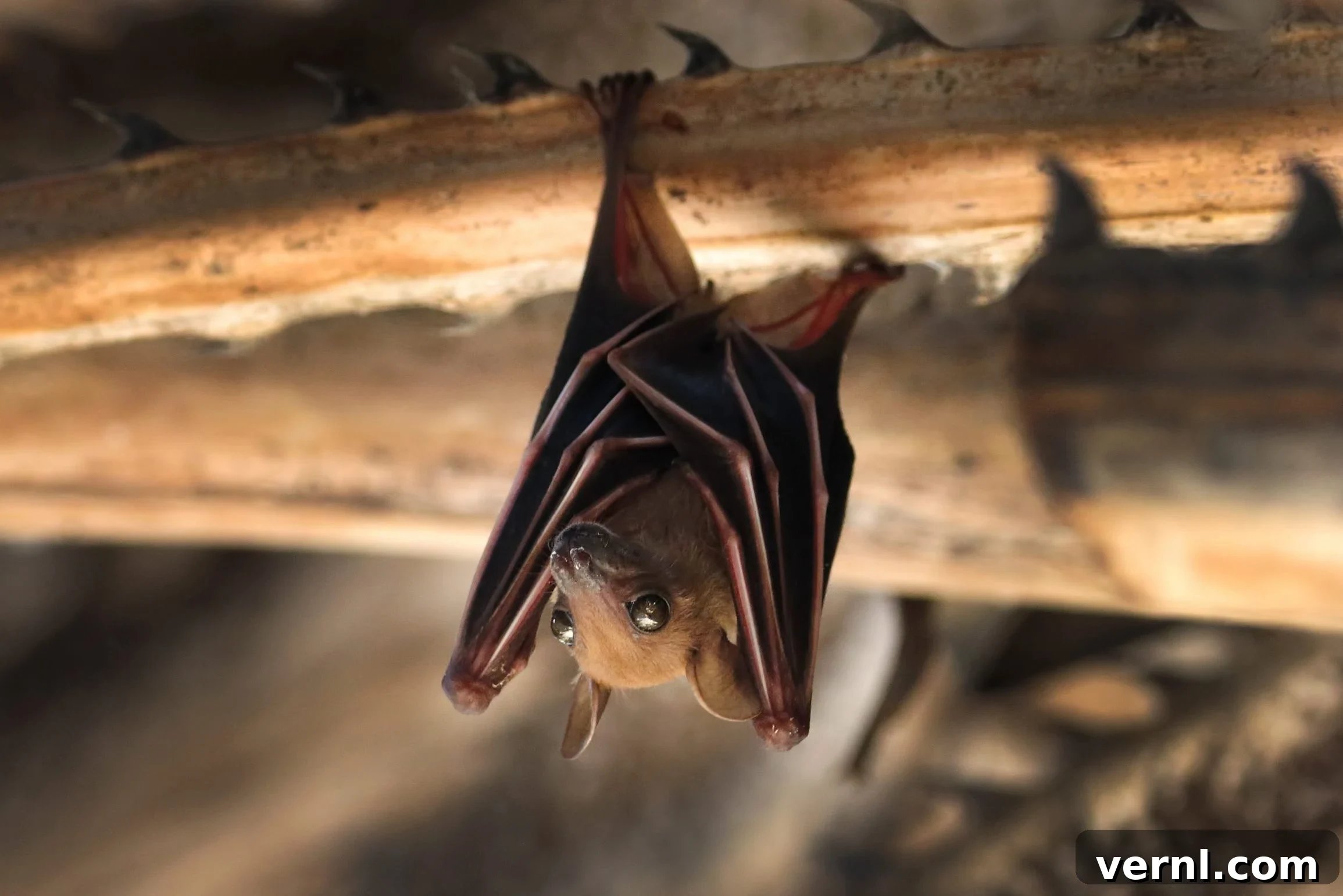
Each evening, as twilight descends upon my yard, I’m captivated by the spectacle of bats emerging. These acrobatic flyers dart through the air, diligently feasting on mosquitoes and a myriad of other potentially harmful insects. Beyond their invaluable role in curbing populations of these biting pests, bats are vital custodians of garden health, playing an indispensable part in maintaining a balanced ecosystem.
Thanks to our rapidly evolving understanding of bats and the profound benefits they offer, it’s time to shift our perspective from fear to celebration and conservation.
“The public perception of bats has truly come a long way,” observes John Griffin, senior director of Urban Wildlife Programs with The Humane Society of the United States (HSUS). “While we’re gaining a much-needed awareness of their critical ecological role, misperceptions still linger, particularly concerning what to do when an encounter occurs.”
Sometimes, these encounters can become quite intimate, such as when a colony decides to establish a nursery in an attic. In such instances, our initial, often panicked, reaction is to seek immediate removal of the bats. However, as Addison McCool, executive director of Bat World Sanctuary, highlights, poorly executed removal techniques—often referred to as bat exclusions—can tragically result in the death of bat pups, contributing significantly to the decline of bat populations.
“Unfortunately, many people are unaware of these risks, and some unscrupulous pest control companies simply disregard the welfare of these animals,” McCool states.
This comprehensive guide aims to shed light on what constitutes a humane bat exclusion, transforming what might seem like an inconvenience into an opportunity to benefit both your property and the broader neighborhood. (A crucial hint: consider installing a bat house!) For more detailed methods on managing their presence, you can also explore how to get rid of bats in the attic.
Understanding Humane Bat Exclusion: What It Is and Why It Matters
A bat exclusion is a specialized, non-lethal system designed to safely and humanely remove roosting bats from a man-made structure, such as a home or commercial building. This process is fundamentally distinct from extermination, focusing instead on guiding bats out of an unwanted space without causing them harm. The primary method involves installing temporary, one-way exit devices, typically tubes or netting, which allow bats to exit your home at dusk for foraging but prevent them from re-entering. Complementing these exit devices, exclusion also requires meticulously sealing all potential entry points—cracks, holes, and gaps in eaves, louvers, chimneys, and vents—to ensure bats cannot find alternative access routes back inside once the one-way devices are removed.
While it is possible to DIY a bat exclusion, successfully implementing a humane eviction can be surprisingly challenging. Bats are incredibly agile and can squeeze through openings as small as half an inch. Therefore, many homeowners opt to hire a professional who possesses a deep understanding of bat behavior, local bat species, and, crucially, both local and federal protection laws concerning these animals. The cost for professional services can range from a few hundred to several thousand dollars, depending on the scale of the infestation and the complexity of the exclusion process, but it often represents a wise investment in ensuring the safety of both bats and humans.
The Imperative for Humane Bat Control
The emphasis on humane bat exclusion stems from several critical factors. Firstly, bats are integral to ecological health. Many species are protected by law due to declining populations, making lethal removal illegal and detrimental to conservation efforts. Secondly, trapping or killing bats can lead to severe ethical issues and is often ineffective in the long run, as new bats may simply move into the vacant roost. Humane methods ensure that these beneficial creatures continue their vital work in the ecosystem, relocating to alternative, suitable habitats. This approach safeguards both the bats and the structural integrity of your home, preventing dead animals from decomposing within your walls or attic.
When Is a Bat Exclusion Necessary? Identifying the Signs
Not every bat encounter necessitates an exclusion. Often, these procedures are only required if bats are roosting in areas where they pose a direct risk to human health, such as inside living quarters, or if their guano (excrement) is accumulating in problematic locations. “Because of their small size and quiet habits, when bats do find their way into attic spaces, their seasonal presence, whether raising young or just loafing, can often go unnoticed for years,” explains Griffin. This stealthy nature means that by the time homeowners notice a problem, a significant colony might already be established.
Before deciding on an exclusion, it’s crucial to differentiate between a temporary roost and an established colony. Roosting bats are typically individuals or small groups resting and digesting between feeding bouts. They might temporarily occupy open structures like carports, outdoor umbrellas, sheds, gazebos, or even louvered window shutters. These bats are usually transient and will move on their own. Colonies, however, often establish themselves in late spring when female bats seek warm, secluded spaces to form maternity nurseries, where they give birth and raise their young. Identifying the signs of an established colony is key:
- Guano Accumulation: The most common indicator is the presence of bat droppings. Unlike rodent droppings, bat guano is crumbly and often contains shiny insect parts. You might find it near entry points, on attic floors, or even on exterior walls below a suspected entry point.
- Audible Sounds: During quiet hours, especially at dawn or dusk, you might hear scratching, squeaking, or chirping noises emanating from your attic or walls.
- Visual Sightings: Observing bats consistently entering or exiting a specific opening on your home around dusk or dawn is a definitive sign of a roost.
- Odor: A distinct ammonia-like smell, particularly noticeable in warm weather, can indicate a large accumulation of guano.
What to Do If a Bat Enters Your Living Space
Occasionally, a bat foraging near your exterior lights might accidentally find its way into your home through an open window or door. “You might first see one flying around a room, landing on curtains or furniture and then taking flight again,” says Griffin. “This is not cause for alarm and rarely indicates a colony within your house.” If a bat does enter your living space, it’s important to react calmly and cautiously:
- Remain calm and ensure children and pets are kept away from the room.
- Open all windows and exterior doors in the room to give the bat a clear exit path. Dim the lights to avoid disorienting the bat.
- Stand near a wall, as bats tend to fly in a U-shaped pattern, higher near the walls and lower in the center of the room.
- Close interior doors to confine the bat to one room, preventing it from flying deeper into your home.
- If the bat does not exit on its own after a few minutes, wait until it lands on a surface. Once it’s settled, gently cover it with a box or container, then slide a piece of cardboard underneath to trap it.
- Carefully take the bat outside and release it away from your home. Never attempt to catch a bat with your bare hands, even if wearing gloves, as bites can occur and may require rabies prophylaxis.
- Call animal control or a wildlife professional immediately if the bat has had direct contact with a person (especially a child, an incapacitated individual, or a pet) or if you cannot safely remove it. Follow these more detailed instructions from the Humane Society for such scenarios.
Implementing Humane Bat Exclusion: Best Practices for Success
If you’ve identified a problematic bat colony in your house, due diligence before engaging a removal service is paramount. “There are many pest control companies that are not properly trained in humane exclusions, and sometimes not even licensed, that undertake these jobs,” warns McCool. Always prioritize professionals specializing in humane wildlife removal. Bat Conservation International maintains a helpful list of professionals who evict bats humanely. Your state wildlife agency can also be an invaluable resource. Beyond selecting the right expert, here are critical best practices to ensure a successful and ethical bat exclusion:
Seasonal Timing is Absolutely Critical
The success and humanity of a bat exclusion hinge significantly on timing. The ideal period for bat exclusions is early autumn, typically from September to October, after the young bats are capable of flight and before hibernation begins. It is absolutely crucial to avoid evicting bats from May through early September, which is known as the “maternity season” across much of North America. “When pups are present in the roost, they are not yet able to fly, and an exclusion will only remove the adult female bats,” McCool emphasizes. “The building will then be sealed, tragically leaving mass numbers of helpless baby bats to die of starvation or dehydration.” Such an outcome is not only inhumane but can also create unpleasant odors and health hazards within your home.
Similarly, performing an exclusion during winter, when bats are hibernating, is highly discouraged. Hibernating bats are in a state of torpor, making them unable to exit exclusion devices. If discovered during winter, the recommendation is to wait until spring when they naturally become active again and can fend for themselves. Disrupting hibernating bats can lead to their death due to increased energy expenditure in cold conditions.
Never Immediately Seal Entrances: Utilize One-Way Devices
A common, yet severely flawed, mistake is to simply seal up all known openings to your attic or structure one night. This method is disastrous because not all bats will leave the roost every single night, especially if weather conditions are unfavorable or if they are nursing pups. Instead, the correct approach involves installing one-way exclusion devices—such as bat cones or netting—over the primary entry points. These devices are designed to allow bats to crawl out but prevent them from re-entering. These one-way tubes or nets should be left in place for at least a week, and sometimes longer, to ensure that every single bat has had ample opportunity to exit the structure. During this period, it’s vital to diligently watch the exterior of your house, particularly at dusk, to confirm that bats are indeed exiting and haven’t discovered a secondary, unsealed entry point.
“Botched exclusions are not only lethal to bats but can also create dangerous situations for people,” McCool warns. “When bats become trapped in a sealed space, they desperately begin searching for other ways to get out, and sometimes end up finding their way into people’s living spaces, leading to increased risk of direct human-bat contact.”
Install a Bat House: Turning a Problem into a Perk
One of the most effective and gratifying steps you can take after a successful bat exclusion is to install a bat house on your property. This thoughtful gesture transforms a temporary “problem” into a lasting environmental perk. As Griffin eloquently puts it, “Many homeowners who recognize the immense value of having bats at work for local insect control will put up a bat house to help support them in the area, hoping the bats will find and use it or occupy it upon their return the next spring.”
Providing an alternative, safe roosting site encourages the displaced colony to remain in your immediate vicinity, continuing their natural pest control services without inhabiting your home. A well-placed bat house can become a new, beneficial home for a colony, contributing significantly to local biodiversity. When selecting and installing a bat house, consider factors like sun exposure (facing south or east for warmth), height (12-20 feet high), and proximity to water sources and foraging areas. The positive impact on your garden and local ecosystem will be noticeable, with a significant reduction in insect pests. Furthermore, if handled correctly and responsibly, the guano collected from beneath a bat house makes an exceptionally rich and effective fertilizer for your garden, offering yet another compelling reason to foster a harmonious relationship with these remarkable creatures.