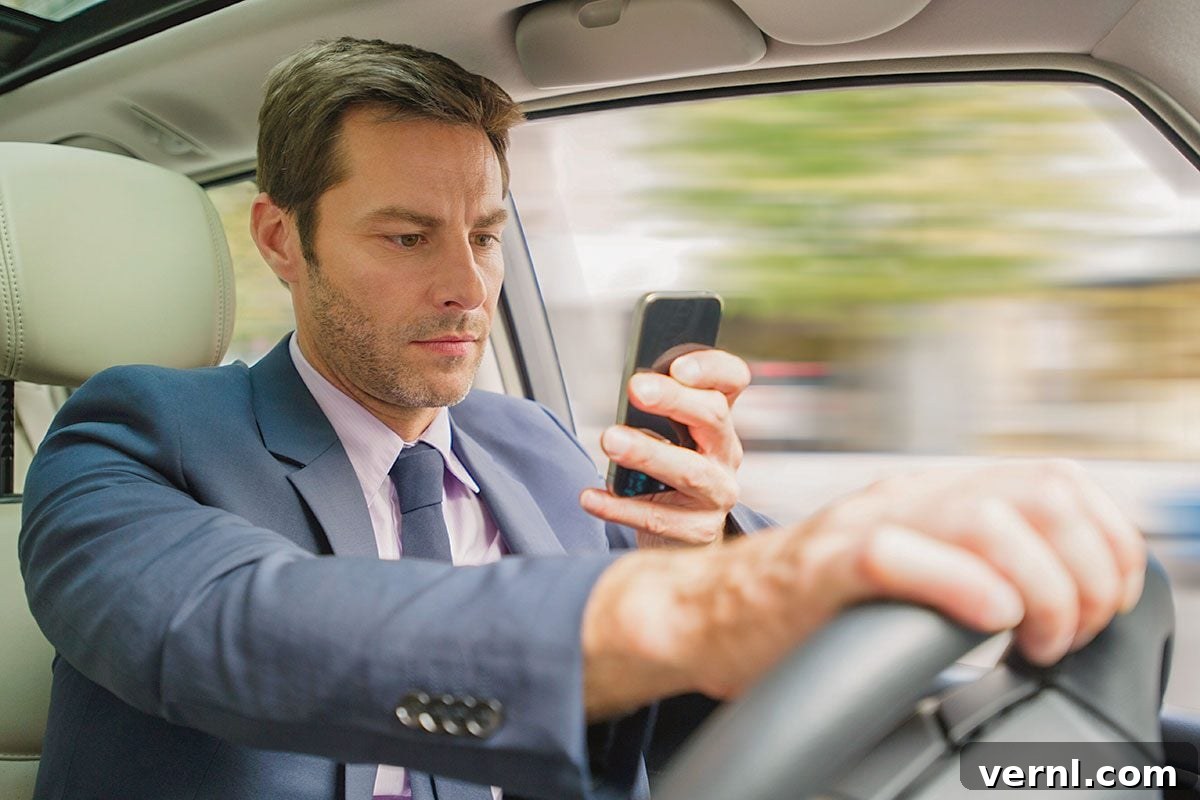
The Dangerous Link: New Research Reveals How Speeding and Phone Use Intersect on Our Roads
Ensuring road safety is a shared responsibility, a concern that resonates deeply with parents of new drivers and cautious individuals alike. We all hope that fellow motorists prioritize safe driving practices, fostering an environment where everyone can reach their destination without incident. However, in an era where advanced technology converges with driver impatience, this ideal is not always a guarantee. Recent findings from insurance companies have shed light on a concerning correlation, establishing a clear link between excessive speed and increased phone usage while behind the wheel.
Unveiling Driver Behavior: How the Study Was Conducted
In today’s digital landscape, numerous insurance providers offer sophisticated smartphone applications designed to encourage safer driving. These innovative apps often entice users with promises of cost savings, rewarding drivers who opt-in and consistently demonstrate what the insurer classifies as responsible driving behavior. The Insurance Institute for Highway Safety (IIHS), as reported by The Drive, capitalized on this burgeoning trend, leveraging the vast and granular data generated by these very applications to conduct a comprehensive study on driver habits.
To ensure robust and relevant insights, the IIHS researchers meticulously focused their analysis on specific trip segments. Each evaluated trip was required to be at least “18 minutes in duration, including a minimum of two minutes spent on an Interstate highway.” The technology at the heart of these insurance apps is remarkably advanced. They ingeniously utilize a combination of the phone’s internal sensors and Global Positioning System (GPS) capabilities to meticulously log a wide array of driving data. To precisely determine if a driver was exceeding the posted speed limit, the GPS data was cross-referenced against an extensive, real-time speed-limit database. Simultaneously, indicators of “phone use were determined based on ‘significant rotation’ registered by the phone’s gyroscope while the screen was actively unlocked.” This precise methodology allowed the researchers to capture real-world instances of distracted driving in conjunction with speed.
The Revealing Outcomes: Speeding’s Influence on Phone Use
The study’s findings presented a stark picture, with slightly varied statistics for highways versus conventional roads, yet a consistent underlying trend. In both environments, a definitive positive correlation emerged between speeding and the propensity for phone usage. This means that as driver speeds increased beyond the legal limit, so did the likelihood and duration of phone interaction.
Specifically, The Drive’s report highlighted some compelling figures from the IIHS research. On limited-access highways, which typically permit higher speeds, “researchers found that phone use rose by 12% for every 5 mph drivers went over the speed limit.” This is a significant escalation, indicating that drivers who push the speed envelope on highways are considerably more prone to also engaging with their phones. When the focus shifted to other, non-highway roads, the increase was still present but slightly less pronounced; here, researchers reported that “phone use rose by a smaller amount—3%—for every 5 mph over the limit.” While numerically smaller, this still represents a concerning uptick in distracted driving on local roads, where hazards and interactions with pedestrians or cyclists are often more frequent.
Furthermore, the study delved into how speed limits themselves influenced the rate of phone use. It was observed that faster roads inherently saw a greater increase in phone usage per unit of speed over the limit. For instance, on limited-access highways with a 70 mph speed limit, researchers discovered “a 9% larger increase in phone use per 5 mph over the limit than on similar roads with a 55-mph limit.” This suggests that the perceived freedom or reduced complexity of higher-speed environments might embolden drivers to multitask. A similar pattern was observed on other roads: “the increase in phone use was 3% larger (again, per 5 mph over the posted limit) on roads with a 45-50-mph limit than on roads with a posted limit between 25 and 30 mph, and 7% larger on roads with a 55-mph limit.” These nuanced findings underscore that the risk of distracted driving isn’t static but is dynamically influenced by both actual speed and the speed limit of the roadway.
Understanding the Connection: Why Risk-Taking Behaviors Converge
While the notion of simultaneously speeding and using a phone feels inherently dangerous, the overall findings of the IIHS study are logical when considering human behavior. Individuals who choose to exceed the speed limit are, by definition, engaging in a risk-taking activity while driving. Similarly, those who actively use their phones while operating a vehicle are also embracing a significant risk, diverting their attention from the critical task of driving. It stands to reason that these two forms of risky behaviors would often coalesce within the same individual.
This correlation doesn’t imply that every single driver who speeds is also heavily engaged with their phone. Rather, it indicates a statistical tendency: the odds show that drivers who are prone to one form of risky behavior are more likely to exhibit others. This could stem from a variety of psychological factors, including an overestimation of one’s driving abilities, an underestimation of the dangers involved, a general disregard for traffic laws, or simply a habitual impatience that manifests in multiple ways. The combined effect of these behaviors dramatically amplifies the potential for accidents, increasing both their frequency and severity. Distracted drivers have slower reaction times, reduced situational awareness, and impaired decision-making, while speeding drivers have less time to react, longer stopping distances, and less control over their vehicle. When these two dangerous actions merge, the margin for error effectively vanishes, placing everyone on the road in greater peril.
Source
Drivers Use Their Phones More When Speeding, IIHS Says, The Drive, 2026.
RELATED:
- Do You Know What That Little Button on Your Seat Belt Is For?
- What Those Lines on Your Backup Camera Really Tell You
- Here’s What The Small Panel On Your Car’s Front Bumper Is For