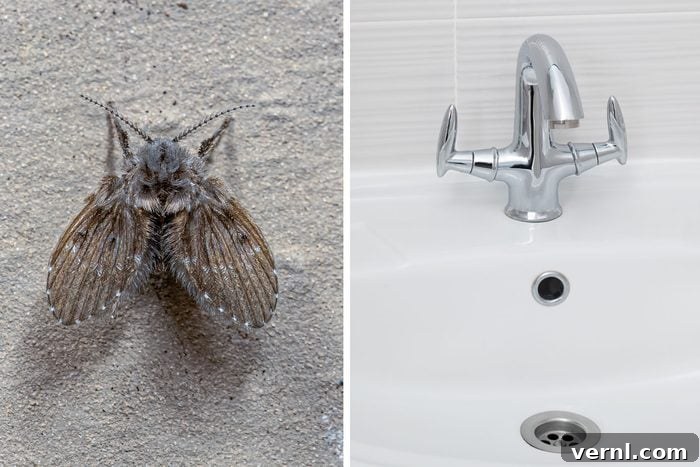
There’s a unique frustration that comes with spotting tiny, dark specks flitting around your bathroom or kitchen. Initially, you might dismiss them as pesky fruit flies, only to find that traditional methods of fruit fly eradication prove useless. This was certainly my experience; I diligently removed all fresh produce, yet the swarm of minuscule winged insects persisted, even multiplied. It was then that I first learned about an entirely different adversary: drain flies.
These incredibly small creatures, often mistaken for other household pests, are so tiny you won’t hear their characteristic buzz. Instead, they appear as phantom-like specks, seemingly materializing out of nowhere to annoyingly entangle themselves in your eyelashes or nostrils. Drain flies have a particular affinity for damp, organic-rich environments, making sinks, toilets, floor drains, and bathtubs their preferred congregating spots. They are a common nuisance, yet many homeowners remain unaware of their existence until an infestation becomes noticeable.
“Regardless of how meticulous your cleaning routine is, everything that flows down your drains leaves behind a thin coating of organic material,” explains Eric Braun, a distinguished entomologist with Terminix. “Small flies, particularly drain flies, are powerfully drawn to this odorous, decaying matter. The slimy biofilm that inevitably builds up within your drains creates an ideal, nutrient-rich breeding ground where drain fly larvae can thrive and mature.”
Once established, drain flies possess an alarming capacity for rapid reproduction, quickly turning a few stray individuals into a significant infestation. This makes early detection and swift action paramount. Addressing the problem as soon as you first spot these tiny invaders can save you considerable time and effort down the line. This comprehensive guide will equip you with essential knowledge about drain flies, including how to identify them, understand their behavior, and implement effective strategies to permanently remove them from your home.
Meet Our Experts on Pest Control and Environmental Health
To bring you the most accurate and actionable advice, we’ve consulted leading professionals in entomology and environmental health:
- Jonathan Larson: An esteemed entomologist, assistant professor, and extension professional at the University of Kentucky. Dr. Larson is a go-to authority for expert insights into a wide array of household and urban landscape insect issues, providing research-backed solutions.
- Eric Braun: A board-certified entomologist with an impressive career spanning nearly three decades. As a technical service manager for Terminix, Eric brings extensive practical experience and deep scientific knowledge to the challenges of pest management.
- Tonya Harris: An award-winning environmental toxin expert, the visionary founder of Slightly Greener, and the author of the critically acclaimed book The Slightly Greener Method. Tonya offers practical, accessible solutions for busy families looking to reduce environmental toxins in their homes. She holds a master’s degree in holistic nutrition, numerous environmental health certifications, and has been featured on various national television programs, solidifying her reputation as a trusted voice in holistic living and environmental health.
Understanding Drain Flies: Identification, Life Cycle, and Habitat
Drain flies, scientifically known as Psychodidae, are small, often overlooked insects that primarily inhabit drains, pipes, and areas with stagnant water. Their larvae, commonly referred to as maggots, play a crucial role in breaking down the slimy organic growth found in these damp, dark environments. “They are sometimes called moth flies,” explains Dr. Larson, “owing to their distinctive wings, which are covered with fine scales, and their slightly fuzzy antennae, which give them a somewhat moth-like appearance. If you happen to squash one, you might notice gray, powdery scales from their wings left on your hand or the surface you used.”
The life cycle of a drain fly typically spans one to three weeks, passing through four distinct stages: egg, larva, pupa, and adult. The eggs are laid in the gelatinous biofilm inside drains and pipes. Once hatched, the larvae feed on this organic matter, developing into pupae before emerging as adult flies. While the larvae are notoriously difficult to spot within the dark recesses of your drain, the sudden appearance of small, slow-flying insects hovering around your home – particularly in bathrooms, kitchens, and utility rooms – is a strong indicator of an active infestation.
Identifying the specific drain or source of the infestation is the crucial first step in effective eradication. Tonya Harris offers a simple yet highly effective method for this: “To definitively test for drain flies, place a strip of adhesive tape, sticky-side down, securely over the drain where you’ve been observing the small insects. Leave the tape in place overnight or for at least a few hours. Drain flies, attempting to emerge from the drain, will become trapped on the tape. This allows you to clearly see if that particular drain is indeed the breeding ground for your drain fly problem.” This localized testing prevents unnecessary treatment of unaffected drains and helps pinpoint the core issue.
Are Drain Flies a Harmful Pest? Understanding Their Impact
Fortunately, despite their nuisance factor, drain flies are generally not considered harmful to humans or pets. They are not known to bite, sting, or transmit diseases in the same way that mosquitoes or house flies might. While any insect that travels from one surface to another technically has the potential to transfer pathogens, the specific habits and biology of drain flies make them low-risk for disease transmission in a residential setting. Dr. Larson reassures homeowners, stating, “Drain flies are not harmful pests. In fact, some might even argue that they are beneficial decomposers, performing a rudimentary, albeit minor, ‘cleaning’ service by breaking down organic matter within your pipes.”
However, their presence can certainly be a considerable nuisance. A persistent swarm of drain flies can be unsettling, creating a sense of uncleanliness and discomfort in your home. Their tendency to fly into faces and hover around sinks can be irritating, prompting a strong desire for their swift removal, even if the primary concern is not health-related. Understanding that they are more of a symptom of a larger issue – the accumulation of organic matter – rather than a direct threat, helps in approaching the problem strategically.
What Exactly Causes Drain Flies to Appear in Your Bathroom?
The primary culprit behind a drain fly infestation is the accumulation of organic matter and stagnant water, which combine to create the perfect breeding environment. Drain flies frequently originate in drains that experience infrequent use, such as a seldom-used guest bathroom sink, a basement utility sink, or a shower in an unused part of the house. “Infrequent use allows for a significant breeding ground to develop unimpeded,” explains Dr. Larson. “The best and most proactive way to prevent drain flies is to ensure the normal and regular use of all drains in your home, and to promptly address any leaks or blockages that could contribute to standing water or excessive moisture.”
Beyond simply using your drains, proactive cleaning is paramount. Regularly running water through all drains, even those used infrequently, helps to flush away accumulating organic material. Employing long-handled drain brushes can physically scrub away the biofilm that lines pipes, destroying existing larvae and pupae. Following this with boiling water can further sanitize the pipes. In more severe cases, removing and thoroughly scrubbing the S-trap (the U-shaped bend in the pipe beneath your sink) may be necessary, as this is a prime location for biofilm accumulation and larval development. Additionally, it’s crucial to empty any standing water sources around your home, such as forgotten mop buckets, pet water dishes, or garbage cans that collect moisture, as these can also serve as alternative breeding sites.
Tonya Harris also emphasizes a simple preventative measure for less-used drains: “Placing a stopper or a tight-fitting cap over drains that are used infrequently can significantly help in preventing drain flies from accessing the drain and establishing a breeding colony in the first place.” This physical barrier cuts off access to the moist, nutrient-rich environment they seek.
Effective Strategies: How To Get Rid of Drain Flies Permanently
The key to successful drain fly eradication lies in a systematic approach that targets the source of the problem – the breeding grounds – rather than just the adult flies. As Eric Braun succinctly puts it, “First, identify which drains are an issue by using the simple tape method mentioned above. Then, it’s all about ‘clean, clean, clean.'” He strongly cautions against relying on conventional cleaning chemicals like bleach. “Most standard cleaning products will do absolutely nothing to eliminate drain flies or their larvae,” Braun emphasizes. “Your focus must not be on killing the adult flies; you absolutely must remove the breeding area. For every adult fly you manage to kill, there could be countless more breeding and developing deep inside the drain.”
Here’s a multi-pronged approach to effectively clean your drains and eliminate drain flies:
1. Mechanical Cleaning: The Drain Brush Method
- The Right Tool: Invest in a high-quality, long-handled brush specifically designed for drain cleaning. These brushes typically feature stiff bristles capable of scraping away stubborn biofilm.
- Technique: Insert the brush deep into the drain opening and vigorously scrub the interior walls of the pipe as far as it can reach. This physical action is crucial for dislodging the gelatinous film that serves as both food and habitat for drain fly larvae and pupae. Work the brush back and forth, rotating it to ensure maximum contact with the pipe surfaces.
- Why it Works: This method directly disrupts the drain flies’ life cycle by physically removing their food source and destroying existing larvae and pupae before they can mature into adult flies.
2. Natural Cleaning Solution: Salt, Baking Soda, and Vinegar
Tonya Harris recommends a powerful and eco-friendly homemade cleaning concoction:
- Preparation: In a large, non-reactive bowl, combine ½ cup of coarse salt with ½ cup of baking soda. Then, carefully add 1 cup of white vinegar.
- Application: “Be ready to quickly pour this combination down the problematic drain as soon as you add the vinegar,” Harris advises. “Once the vinegar is introduced, the mixture will immediately begin to gently bubble and fizz vigorously.” This effervescent reaction helps to agitate and break down the organic material within the drain. The salt acts as an abrasive, scrubbing the pipe walls, while the baking soda and vinegar create a cleaning action that dislodges the biofilm.
- Soaking Time: Allow this powerful mixture to sit in the drain overnight, or for at least 8-10 hours, to maximize its cleaning effectiveness.
3. The Boiling Water Flush
- The Next Day: On the following day, after the salt, baking soda, and vinegar mixture has had ample time to work, carefully pour a kettle of boiling water down the treated drain.
- Purpose: The boiling water serves multiple purposes: it flushes away any remaining residue, dislodged organic material, and any lingering larvae or eggs that may have survived the previous treatment. The heat also helps to further sanitize the drain.
- Repetition: If the drain fly problem persists, or if the initial infestation was severe, repeat the entire salt, baking soda, vinegar, and boiling water sequence as necessary over several consecutive days. Consistency is key to breaking the breeding cycle.
Dr. Larson confirms the efficacy of these targeted cleaning efforts: “Once the drain has been thoroughly cleaned and its primary breeding ground eliminated, the remaining adult flies will naturally dissipate. Without a place to lay eggs and feed their offspring, their population will quickly dwindle and disappear.”
Addressing Lingering Adult Flies: The Apple Cider Vinegar Trap
Even after the breeding source has been successfully eliminated, you might still encounter a few adult drain flies lingering in your home. These are typically the survivors of the previous generation, searching for a new place to lay eggs or simply flying around before their natural lifespan ends. For these remaining adult flies, Tonya Harris offers an excellent, non-toxic trapping method:
- Setup: Pour a small amount of apple cider vinegar into a shallow bowl. Tightly wrap the top of the bowl with plastic wrap, ensuring a secure seal.
- Creating Access: Using a toothpick or a small fork, poke several tiny holes in the plastic wrap. These holes should be just large enough for the drain flies to enter.
- Placement: Position this trap near the problematic drain or wherever you observe the lingering adult flies.
- How it Works: “The flies will be irresistibly attracted to the sweet, fermenting scent of the apple cider vinegar,” Harris explains. “They will crawl through the small holes into the bowl, but due to the design, they will find it extremely difficult to get back out, effectively trapping them.” This method helps to capture and eliminate the final remnants of the adult population, preventing any further egg-laying attempts.
Ongoing Prevention and Maintenance
Once you’ve successfully eradicated drain flies, the real battle begins with prevention. To ensure they don’t return:
- Regular Drain Usage: Ensure all drains, especially those in guest bathrooms or utility areas, are used regularly. If a drain isn’t used for a few days, run water through it for a minute or two.
- Consistent Cleaning: Integrate drain cleaning into your regular household maintenance routine. A monthly flush with boiling water or a natural cleaning solution can prevent biofilm buildup.
- Address Leaks: Promptly repair any leaky pipes under sinks or around toilets. Even small drips can create the constant moisture drain flies crave.
- Clean Overflow Drains: Don’t forget the overflow drains in sinks and bathtubs. These small openings also accumulate biofilm and can be a hidden breeding ground. Use a small brush or a cotton swab dipped in cleaning solution to clear them.
- Maintain Dryness: Wipe down sinks, tubs, and showers after use to minimize residual moisture.
- Use Drain Stoppers: For infrequently used drains, keep them covered with a tight-fitting stopper when not in use.
- Check S-Traps: Periodically inspect and clean S-traps. These are the prime areas for organic material to collect.
By understanding the habits of drain flies and implementing these comprehensive cleaning and prevention strategies, you can effectively eliminate these annoying pests and maintain a healthier, fly-free home environment. The key is persistence, thoroughness, and a commitment to addressing the root cause: the organic biofilm within your plumbing.