
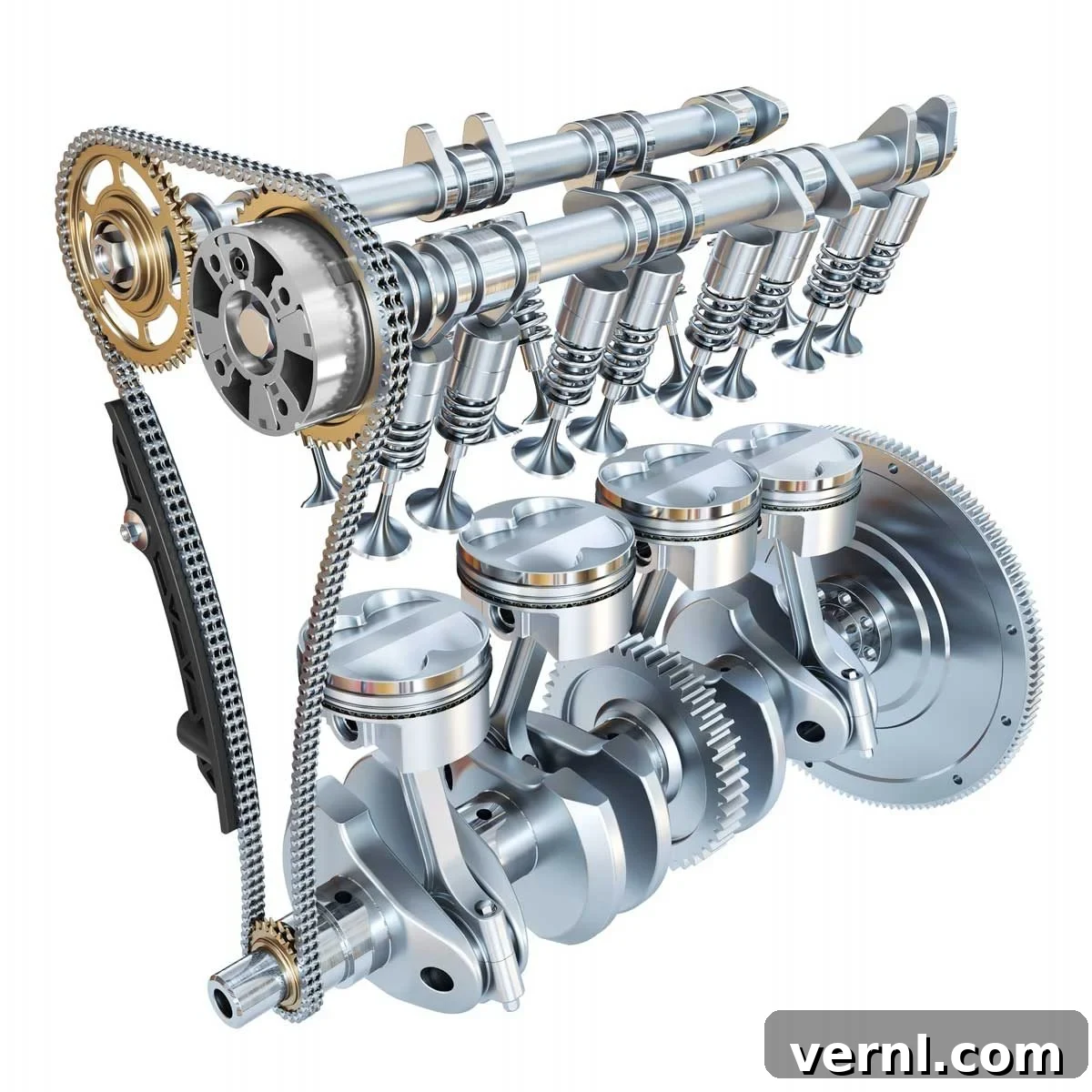
At the very heart of an internal combustion engine, two vital components, the camshaft and the crankshaft, orchestrate a precise mechanical ballet that transforms the potential energy of fuel into the kinetic energy of motion. While a camshaft meticulously uses its egg-shaped “cams” or lobes to open and close engine valves with impeccable timing—one cam per valve—the crankshaft stands ready to convert the powerful up-and-down (reciprocating) motion of the pistons into continuous rotational force. This intricate partnership is fundamental to how an engine breathes, combusts, and ultimately drives a vehicle forward.
Understanding the Camshaft: The Engine’s Master of Breath
Positioned typically in the “top end” of an engine, often within the cylinder head, the camshaft serves as a critical conductor within the intricate valve train system. Its primary responsibility is to regulate the flow of gases in and out of the engine’s combustion chambers. This means precisely controlling when fresh air and fuel are admitted for combustion and when spent exhaust gases are expelled after their energetic work is done. Without a functioning camshaft, an engine would be unable to draw in its lifeblood or clear out its waste products, effectively halting its operation.
Types and Configurations of Camshafts
Modern internal combustion (IC) engines showcase various camshaft configurations, each designed to optimize performance, efficiency, or packaging. While older, simpler engines might employ a single-cam setup, where one camshaft operates both intake and exhaust valves for a cylinder, contemporary designs frequently utilize more advanced architectures.
- Single Overhead Cam (SOHC): In this common configuration, a single camshaft is located above the cylinder head and uses rocker arms to operate both the intake and exhaust valves for each cylinder. SOHC engines are known for their relative simplicity and good balance of performance and fuel efficiency.
- Double Overhead Cam (DOHC): Often found in high-performance or modern efficient engines, DOHC setups feature two camshafts per cylinder bank. One camshaft is dedicated to operating the intake valves, and the other handles the exhaust valves. This allows for more precise control over valve timing and lift, often leading to increased power and better fuel economy, especially at higher RPMs. A DOHC engine can easily accommodate four valves per cylinder (two intake and two exhaust), providing superior gas flow compared to a two-valve-per-cylinder SOHC design.
The number of valves per cylinder also plays a crucial role. More valves, typically four (two intake, two exhaust), allow for a larger total area for gases to flow through, significantly improving engine “breathing.” This enhanced gas exchange directly translates to greater volumetric efficiency, meaning the engine can draw in more air-fuel mixture and expel exhaust gases more effectively, ultimately boosting power output and responsiveness.
How the Camshaft Executes its Role
The camshaft doesn’t act in isolation; it’s a vital link in a chain of mechanical events, constantly driven by the crankshaft. Through a precise mechanical connection—typically a timing chain or timing belt—the crankshaft’s rotation is transferred to the camshaft. As the camshaft spins, its uniquely shaped lobes (the “cams”) push against components such as lifters (tappets) and rocker arms, which in turn act upon the valve stems. This action overcomes the spring tension holding the valves closed, causing them to open at precise moments.
The design of these cam lobes is a marvel of engineering. They come in an array of shapes and sizes, each meticulously profiled to dictate not only when a valve opens and closes, but also how much it opens (valve lift) and for how long it remains open (valve duration). A specific cam profile can be designed to optimize for low-end torque, high-end horsepower, or a balance of both, significantly influencing the engine’s character. For instance, a cam with higher lift and longer duration might be ideal for maximizing power at high RPMs, while a cam with lower lift and shorter duration might prioritize fuel efficiency and smoother idle.
In configurations with multiple camshafts, such as the aforementioned four-camshaft setup (common in V-type DOHC engines), the enhanced control over each set of valves (intake and exhaust) allows for even finer tuning of gas flow. This ability to move more intake and exhaust gases more easily, because there is simply more space for them to flow through, directly contributes to greater engine power and efficiency across the RPM range.
The Crankshaft: The Engine’s Powerhouse
While the camshaft manages the engine’s breathing, the crankshaft, nestled in the “bottom end” of an engine block, is where the raw power of combustion is converted into usable mechanical energy. It’s the central rotating component that harnesses the tremendous, momentary force generated by the combustion of the air-fuel mixture, thrusting the pistons downward. This powerful downward thrust causes the crankshaft to rotate continuously, making it the fundamental power source of the engine. Think of it as the backbone of the engine, translating linear motion into the rotational motion that ultimately drives the wheels of a vehicle.
The Mechanics of Crankshaft Operation
The crankshaft’s operation is elegantly simple yet incredibly robust. Connecting rods serve as the crucial link, attaching the pistons directly to the crankshaft’s offset journals (crankpins). When the precisely controlled ignition system sparks the compressed air-fuel mixture within the combustion chamber, a massive, instantaneous downward pressure is exerted on the piston. This force pushes the piston downwards, which in turn pushes on the connecting rod, causing the crankshaft to rotate.
Each time a piston completes a downward power stroke, it imparts energy to the crankshaft, helping it to maintain its rotational momentum. The crankshaft’s design, including its counterweights, ensures that this rotation is as smooth and balanced as possible, minimizing vibrations and stresses on the engine components. The continuous sequence of power strokes from multiple cylinders ensures a steady rotational output from the crankshaft, which is then transmitted through the drivetrain to move the vehicle.
The Synchronized Dance: How Camshafts and Crankshafts Work Together
The marvel of an internal combustion engine lies in the perfectly synchronized operation of its components, none more critical than the camshaft and crankshaft. Their gears or sprockets are interconnected by a vital timing mechanism—be it a timing chain, a timing belt (which, unlike a typical drive belt, features teeth for precise engagement), or a mesh gear set (two interlocking gears). This critical connection is typically located at the “front end” of the engine, behind a timing cover.
For the engine to function optimally, controlling combustion and ensuring maximum efficiency, these components must be “indexed” or aligned perfectly according to the manufacturer’s specifications. This precise alignment ensures that they work in perfect harmony, a concept universally known as valve timing. If the timing is even slightly off, the engine’s performance will suffer dramatically, and in severe cases, significant internal damage can occur.
The Four-Stroke Combustion Cycle and the 2:1 Ratio
The intricate relationship between the camshaft and crankshaft is best understood by examining their actions during the four-stroke combustion cycle: intake, compression, power (or combustion), and exhaust. During one complete cycle for a single cylinder, the crankshaft undergoes two full revolutions, meaning each piston moves up and down twice. Simultaneously, the camshaft completes just one full revolution. This establishes a fundamental 2:1 ratio: the crankshaft turns twice for every single rotation of the camshaft.
This precise ratio ensures that each valve opens exactly once for every two crankshaft revolutions in relation to its corresponding piston, precisely when needed:
- Intake Stroke: As the piston moves downward, the camshaft’s intake lobe opens the intake valve(s), allowing the air-fuel mixture to be drawn into the combustion chamber.
- Compression Stroke: Both the intake and exhaust valves remain tightly closed as the piston moves upward, compressing the air-fuel mixture to prepare it for ignition.
- Power/Combustion Stroke: With both valves still closed, the spark plug ignites the compressed mixture, forcing the piston powerfully downward. This is where the crankshaft receives its primary input of rotational energy.
- Exhaust Stroke: As the piston moves upward again, the camshaft’s exhaust lobe opens the exhaust valve(s), allowing the spent combustion gases to be pushed out of the cylinder and into the exhaust system.
This continuous, perfectly timed sequence for each cylinder is what gives the engine its continuous power output. Any deviation from this precise timing, even by a fraction of a degree, can lead to inefficiencies, misfires, reduced power, increased emissions, and potential engine damage due to valves striking pistons.
Maintenance and Longevity of Timing Components
Given the absolute criticality of the timing mechanism, the components responsible for linking the camshaft and crankshaft—namely timing belts, timing chains, and their associated tensioners and guides—are subject to wear and tear over time. Timing belts, typically made of reinforced rubber, are known to degrade and stretch, while timing chains, made of metal, can also stretch and wear down their links and sprockets. Regular maintenance is therefore paramount.
It is essential for vehicle owners to consult their owner’s manual for the suggested replacement intervals for these crucial components. Neglecting to replace a worn timing belt or chain at the recommended mileage or age can have catastrophic consequences. A broken timing belt or a severely stretched chain can cause the camshaft and crankshaft to lose their synchronization, leading to valves striking pistons—a scenario that typically results in severe, expensive engine damage, often requiring a complete engine rebuild or replacement. Proactive replacement of these components, along with related parts like water pumps (if driven by the timing belt) and tensioners, is a wise investment in the longevity and reliability of your engine.
In summary, the camshaft and crankshaft are more than just individual parts; they are intrinsically linked partners in the engineering marvel that is the internal combustion engine. Their precise, synchronized operation ensures that an engine can efficiently convert the explosive energy of fuel into the continuous motion that powers our vehicles. Understanding their roles and maintaining their integrity is key to appreciating the sophistication of modern automotive technology and ensuring the enduring performance of any engine.