
Helical Piers: The Modern Solution for Stable Foundations
Every homeowner dreads the tell-tale signs: sticking windows and doors, noticeable cracks in walls, or uneven floors. These aren’t just aesthetic annoyances; they are critical indicators of potential foundation problems. Often, these issues stem from dynamic soil conditions beneath the structure. Settling soil, erosion, expansive clays, or a high water table can compromise the integrity of a foundation, leading to cracked concrete slabs, leaning piers, or sinking footings. Addressing these problems swiftly is paramount to preventing more severe structural damage and ensuring the long-term safety and value of your property.
When faced with such challenges, property owners seek reliable, durable, and efficient solutions. While traditional methods have long been employed, modern engineering has introduced advanced techniques that offer superior performance and less disruption. One increasingly popular and highly effective solution gaining traction in the industry is the use of helical piers.
Mike Powell, owner of Tampa-based Red Flag Home Inspection, champions helical piers as “a proven and effective solution for foundation construction and repair that have been used since the 1800s.” Their historical efficacy combined with contemporary advancements makes them a go-to choice for many. However, it’s essential to understand that while helical piers are excellent, they are not the sole answer for every scenario, nor are they always the least expensive option. Aaron Goucher of Olshan Foundation Repair points out, “As far as a repair pier to existing structures, a helical pier is a good repair. However, there are other types of support systems that can perform just as well at a much lower cost to the consumer.” This underscores the importance of a thorough assessment and expert consultation to determine the best approach for specific foundation issues.
What Are Helical Piers? Understanding This Innovative Foundation System
At its core, a helical pier is a type of deep foundation system engineered to support various structures, from residential homes and commercial buildings to decks and even fences. Unlike conventional concrete piers that rely on deep excavation and mass, helical piers — also known as helical piles, screw piles, or ground anchors — are mechanically screwed into the earth. This method distinguishes them significantly from traditional foundations that are either buried or rammed into the ground.
To grasp the fundamental concept, consider the difference between a screw and a nail. As any experienced carpenter knows, a screw’s threaded shank provides substantially more holding strength and resistance to pull-out forces compared to the smooth shank of a nail. This same principle applies to helical piers. Their distinctive design allows them to penetrate challenging soil conditions and achieve substantial load-bearing capacity.
The Anatomy of a Helical Pier
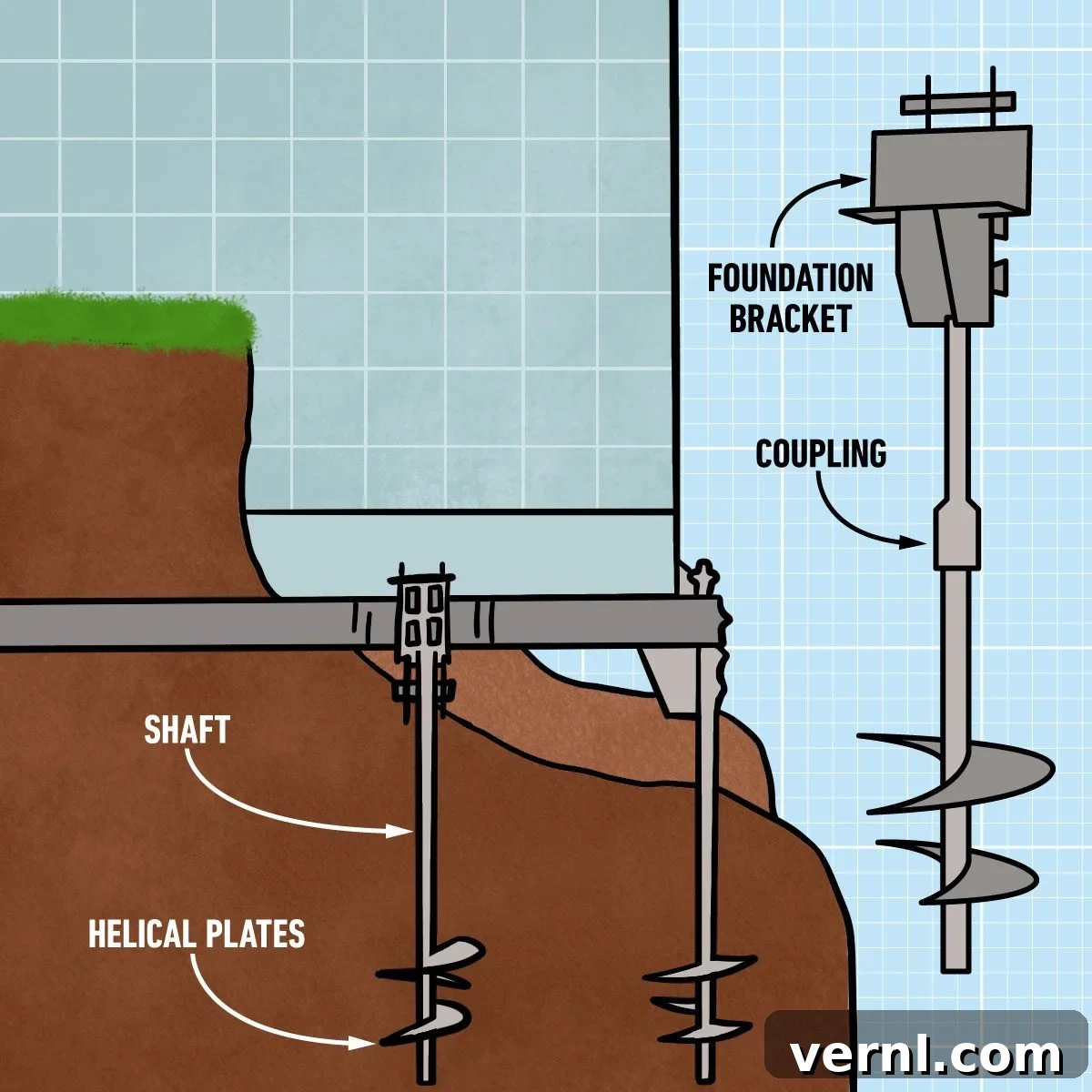
A typical helical pier consists of a robust steel shaft, often galvanized or coated with epoxy to prevent corrosion, which is crucial for its longevity when buried underground. Attached to this shaft are one or more metal spirals or ‘helices’ that strikingly resemble the threads of a giant screw. These helices are precisely engineered to not only facilitate the screwing action into the soil but also to efficiently transfer the structural load to deeper, more stable soil strata.
- Shaft Design: The length and diameter of the steel shaft are critical variables, meticulously chosen based on the specific soil conditions encountered at the site and the anticipated structural load it needs to support. Shafts can be round or square, each offering distinct advantages in terms of torque capacity and load transfer.
- Helix Configuration: The number, size, and pitch of the helices are customized. Multiple helices distribute the load more effectively over a greater area within the soil, enhancing stability and load capacity. The design ensures efficient penetration with minimal soil disturbance during installation.
- Corrosion Protection: Given their subterranean placement, helical piers are typically made from high-strength steel and treated with protective coatings. Hot-dip galvanization is a common method, creating a durable zinc layer that resists rust and extends the pier’s lifespan in various soil chemistries.
- Termination: The above-ground termination of a helical pier is designed to integrate seamlessly with the structure it supports. This might involve a flat base plate for supporting posts, or a bracket that can be bolted directly to an existing foundation, new concrete footings, or beams.
Optimal Soil Conditions for Helical Piers
Helical piers exhibit exceptional performance in specific soil types. They are particularly effective in loose, soft, or water-saturated soils where traditional shallow foundations would struggle with settlement. Their ability to “screw” past problematic superficial layers and anchor into denser, more stable soil or even bedrock makes them ideal for such challenging environments. The installation process also results in minimal impact on the surrounding landscape, a significant advantage in many repair scenarios.
However, it’s important to acknowledge their limitations. Driving helical piers into extremely rocky or highly consolidated soil can be challenging and less cost-effective. In these situations, alternative deep foundation solutions, such as pressed piles (which are pounded into the ground), might be more suitable, as suggested by Goucher. A comprehensive geotechnical survey is always recommended to determine the most appropriate foundation system for a given site.
Versatility in Application
The adaptability of helical piers has led to their widespread adoption in both new construction and repair projects. They are increasingly common in:
- New Residential and Commercial Construction: Providing stable, deep foundations quickly.
- Foundation Repair: Underpinning existing structures experiencing settlement.
- Decks and Outbuildings: Offering reliable support without extensive concrete work.
- Infrastructure: Supporting light poles, sign structures, and utility towers.
- Specialized Applications: Even used to support posts for fences and solar panel arrays due to their ease of installation and stability.
What Are the Advantages of Helical Piers? Unpacking Their Core Benefits
Helical piers have carved out a significant niche in the foundation industry due to their distinct advantages over many conventional methods. Their design and installation process offer several compelling benefits for both new construction and crucial repair work, particularly in challenging soil conditions.
1. Efficient and Minimally Invasive Installation
One of the most praised aspects of helical piers is their installation process. Unlike traditional buried concrete footings, helical piles require no extensive excavation. This eliminates the need for large-scale digging, reducing site disturbance, labor costs, and project timelines. There’s also no concrete to pour and cure, which means no waiting periods for materials to gain strength.
- Quick Setup: Installation involves applying torque to the pier shaft using a drive head attached to an impact wrench for smaller piers or an excavator for larger, heavier-duty applications. This mechanical process is remarkably fast compared to digging and pouring concrete.
- Immediate Load-Bearing Capacity: As Mike Powell emphasizes, “These piers provide immediate load-bearing capacity, allowing for prompt continuation of construction or repair work. Other options tend to require curing or stabilization periods.” This immediate readiness significantly shortens construction schedules and minimizes downtime for repair projects.
- Minimal Site Disturbance: The helical pier installation process generates very little spoils, meaning less dirt to remove from the site. This is particularly beneficial for projects where preserving existing landscaping, driveways, or adjacent structures is a priority. It also makes them ideal for confined spaces or sites with limited access.
- Installation in Any Weather: Unlike concrete, which is sensitive to temperature and moisture during curing, helical piers can be installed in nearly all weather conditions, from freezing temperatures to wet environments, further enhancing project flexibility.
2. Superior Stability and Long-Term Structural Support
Helical piers are engineered for enduring performance. Powell notes that they “prevent settlement issues and offer long-term structural support.” Their unique design allows them to effectively transfer structural loads past problematic shallow soils directly to stable, deeper bearing strata.
- Resistance to Settlement: By anchoring into competent soil, helical piers effectively resist downward settlement caused by unstable surface layers, expansive clays, or soil erosion.
- Uplift Resistance: The helices provide excellent resistance not only to compression (downward forces) but also to uplift forces, making them suitable for structures in areas prone to high winds or seismic activity, or for anchoring tension piles.
- Durability: Constructed from high-strength galvanized steel, helical piers are designed to withstand corrosive soil environments and maintain their structural integrity for decades, often exceeding the lifespan of the structure they support.
- Precise Load Transfer: The torque-to-capacity relationship used during installation allows engineers to precisely predict and verify the load-bearing capacity of each pier, ensuring a robust and reliable foundation.
3. Cost-Effectiveness and Environmental Benefits
While the initial unit cost of a helical pier might sometimes be higher than a simple concrete footing, their overall cost-effectiveness often shines through, especially in the long run and for complex projects.
- Reduced Labor and Equipment Costs: The rapid, straightforward installation process significantly cuts down on labor hours and the need for heavy, expensive excavation equipment. “Helical piers are more cost-effective than end bearing pile, auger cast, and drilled concrete piles,” says Powell. “Installing them can often be done with smaller equipment.”
- Less Material Waste: The precision of helical pier installation means less material waste compared to over-excavating for concrete.
- Sustainable Choice: With minimal soil displacement and reduced concrete usage, helical piers offer a more environmentally friendly foundation solution, contributing to greener construction practices. They are also often reusable in temporary applications.
Despite these extensive advantages, Powell rightly advises caution: “Helical piers may not be suitable for heavy structures or extremely rocky soils.” He strongly recommends “consulting with a structural engineer to determine their viability for a specific project,” as professional assessment is crucial for optimal results.
Do Helical Piers Really Work? A Proven History of Performance
The effectiveness of helical piers is not a matter of debate; it’s a historically proven engineering solution. Patented by Alexander Mitchell in the mid-1800s, these innovative piles have been used for nearly two centuries to reinforce and stabilize foundations across the globe. Their track record in diverse environments and under various structural loads speaks volumes about their reliability.
Engineers worldwide continue to specify helical piers for their ability to provide robust and lasting support, particularly in challenging geotechnical conditions. They are especially effective in loose and water-saturated soils. In such conditions, traditional shallow foundations are prone to settlement and failure. Helical piers bypass these problematic layers by screwing down to transfer structural loads directly to stable bedrock or deep, dense soil strata, ensuring unparalleled stability.
While helical piers are highly effective, it’s also important to acknowledge that the foundation repair industry offers a range of excellent solutions. Aaron Goucher, from a company that utilizes multiple methods, adds, “As a company that does both helical and pressed piling, Olshan believes that a pressed pile system is a better system for the consumer in most markets.” This perspective highlights that the “best” solution is always context-dependent. Factors such as regional soil characteristics, specific structural loads, accessibility, and budget all play a role in determining the most appropriate and cost-effective foundation repair strategy.
How Many Helical Piers Do I Need? Factors Influencing Quantity
Determining the precise number of helical piers required for a foundation project is a critical engineering task that cannot be generalized. It’s a complex calculation that hinges on several key factors to ensure adequate and safe support for the structure.
“The number of piers will depend on the building components being supported,” explains Mike Powell. “A typical residential building may require one every six to nine feet, whereas a four-story building may need them every four feet to get the required Factor of Safety.” This “Factor of Safety” is a fundamental engineering concept, meaning that the foundation system is designed to provide significantly more support than the structure actually requires, offering a margin of error and long-term resilience.
Key Factors That Influence Pier Quantity:
- Structural Load: The heavier the building or the specific section requiring support, the more piers will be needed. This includes the weight of the structure itself (dead load) and any variable loads like furniture, occupants, snow, or wind (live load).
- Soil Bearing Capacity: The load-bearing capacity of the soil at the desired depth is paramount. Weaker soils will require more piers or piers of larger diameter and length to distribute the load effectively. A geotechnical report is indispensable for this assessment.
- Building Size and Type: Larger buildings, multi-story structures, or those with complex architectural designs will naturally require a greater number of piers compared to smaller, simpler structures.
- Pier Spacing Requirements: Structural engineers determine the optimal spacing between piers based on the slab or footing design, ensuring even load distribution and preventing localized stress points.
- Foundation Condition: For existing foundation repair, the extent and location of damage will dictate where piers are most critically needed to underpin and stabilize the failing sections.
- Code Requirements: Local building codes and engineering standards often stipulate minimum requirements for foundation support, which must be strictly adhered to.
Ultimately, the exact number and configuration of helical piers must be determined by a qualified structural engineer. They will perform detailed calculations, often leveraging a geotechnical report, to design a foundation system that is safe, effective, and compliant with all relevant standards. Never attempt to guess the number of piers needed for a significant structural repair or new construction.
How Far Down Can Helical Piers Go? Exploring Depth and Stability
The installation depth of helical piers is not arbitrary; it’s a strategically determined parameter critical for achieving optimal structural stability. The primary goal is to bypass superficial, unstable soil layers and anchor the piers firmly into a competent, load-bearing stratum.
“The depth of installation depends on the load and soil conditions,” Powell clarifies. While most helical piers for typical residential applications are installed between 10 to 25 feet deep, some projects, particularly those involving heavy commercial structures or extremely challenging soil profiles, may require them to go as deep as 100 feet or even more. Powell notes, “There’s no maximum depth,” emphasizing that the piers are driven as deep as necessary to achieve the required support.
The Science Behind the Depth:
- Bypassing Unstable Soils: The fundamental reason for deep installation is to penetrate through problematic near-surface issues such as loose organics, soft clays, unconsolidated fill, or highly expansive soils. These layers lack the strength to adequately support a structure and are prone to settlement, heave, or liquefaction.
- Reaching Competent Bearing Strata: Helical piers are advanced until they reach a soil layer or bedrock with sufficient bearing capacity to support the structural load with the required factor of safety. This can be dense sand, stiff clay, shale, or solid rock.
- Torque Correlation: During installation, the torque applied to the pier is continuously monitored. Engineers correlate this installation torque to the ultimate load capacity of the pier. When the measured torque reaches a predetermined value, it indicates that the pier has reached adequate bearing depth.
- Uplift Resistance: For structures subjected to uplift forces (e.g., wind, seismic activity), the depth also contributes significantly to the pier’s ability to resist pull-out. The weight of the soil above the helices, combined with the adhesion and friction, provides substantial uplift resistance.
“They are installed to get foundation loads beyond near-surface issues, like organics, or very loose soils,” Powell reiterates. This ability to transfer loads to deep, stable ground is what makes helical piers such a reliable and permanent solution for foundation stabilization and new construction in diverse geological settings.
How Much Do Helical Piers Cost? An Investment in Foundation Stability
Understanding the cost of helical piers is essential for budgeting any foundation repair or construction project. The pricing can vary significantly based on several factors, including the pier’s specifications, installation complexity, and regional market rates.
Generally, helical piers are priced between $10 and $30 per linear foot. Given that most piers range from five to 20 feet in length for typical applications, the cost per pier can be estimated. Aaron Goucher of Olshan Foundation Repair places the average cost per pier between $900 and $1,300, which includes both the material and installation for a standard repair. However, this is an average, and actual costs can deviate.
Factors Influencing the Total Cost:
- Pier Size and Length: Larger diameter shafts and more helices designed for heavier loads, as well as greater installation depths, will increase the material cost per pier.
- Number of Piers: As discussed, the total number of piers needed is directly proportional to the overall cost.
- Soil Conditions: Difficult soil (e.g., very dense, rocky, or requiring specialized drilling) can increase installation time and labor costs.
- Accessibility: Sites with limited access for equipment can drive up labor costs due to manual handling or the need for smaller, specialized machinery.
- Labor Rates: Regional differences in labor costs and contractor overheads will affect the final price.
- Permits and Engineering: The cost of obtaining necessary permits and the fees for a structural engineer’s design and oversight are additional, but crucial, components of the overall project cost.
DIY vs. Professional Installation:
It’s possible for skilled individuals to DIY the installation of smaller helical piers for lighter structures like decks, stairs, and fence footings. These are typically smaller, off-the-shelf units. However, for large foundation piers that support entire buildings, professional installation is almost always necessary. This requires specialized heavy equipment (e.g., skid steers, excavators with hydraulic drive heads) and the expertise to accurately assess soil conditions and achieve the correct torque-to-capacity. For these larger, structural piers, the cost can range from $2,000 to $3,000 per pier, due to the complexity and specialized labor involved.
For most residential foundations experiencing settlement issues, five to 10 piers might be required, depending on the structure’s square footage and the extent of the damage. Consequently, a comprehensive foundation repair project utilizing helical piers can range anywhere from $5,000 to $30,000 or more, representing a significant but necessary investment in the home’s stability and safety.
Are Helical Piers Cheaper Than Concrete? A Comparative Analysis
When considering foundation solutions, a common question arises: how do helical piers compare in cost to traditional concrete foundations or repair methods? The answer isn’t always straightforward and depends on the scope and nature of the project.
In a direct comparison, one helical pier is generally more expensive than a comparable concrete footing. The cost of materials for a single helical pier (high-strength galvanized steel, specialized fabrication) often exceeds that of the raw concrete and rebar required for a single footing. However, this initial per-unit cost doesn’t tell the whole story.
When Helical Piers Can Be More Cost-Effective:
- Reduced Labor Costs: Helical pier installation requires significantly less labor. There’s no extensive excavation, no forming, no rebar tying, and no concrete pouring or curing time. This reduction in labor hours can lead to substantial savings, especially on large-scale projects or in areas with high labor rates.
- Faster Project Completion: The speed of installation and immediate load-bearing capacity of helical piers mean projects can be completed much faster. This reduces overall project management costs, minimizes disruption for homeowners, and can translate to earlier occupancy for new constructions.
- Minimal Site Preparation: Avoiding large excavations means less site preparation, less soil removal, and less restoration of landscaping, which can add up to considerable savings.
- Difficult Soil Conditions: In challenging soil conditions (e.g., soft clays, high water tables, expansive soils) where concrete foundations might require extensive over-excavation, dewatering, or specialized piling techniques, helical piers often present a more straightforward and less costly solution.
- Tight Access Areas: For projects with limited access, small installation equipment used for helical piers is often more practical and cost-effective than bringing in large excavation and concrete pouring machinery.
Therefore, while the individual unit cost of a helical pier might be higher, the overall project cost for helical pier installation can often even out, or even be lower, than a comparable large concrete foundation project, especially when factoring in labor, time, and site-specific complexities. It’s crucial to obtain detailed quotes for both options from qualified contractors and have an engineer assess which system is truly the most appropriate and economical for your specific needs.
Where Can I Buy Helical Piers? Sourcing Your Foundation Solution
The procurement of helical piers depends largely on their intended application. For smaller, non-structural projects, acquiring these versatile components is relatively straightforward, while larger, structural applications necessitate a more specialized approach.
For Smaller Projects (Decks, Fences, Outbuildings):
If you’re embarking on a DIY project such as building a new deck, installing a fence, or constructing a small shed, you can typically purchase helical piers designed for these lighter loads. These are often readily available at:
- Building and Landscaping Supply Outlets: Many major hardware stores and construction material suppliers stock a range of helical piers suitable for common backyard projects.
- Online Retailers: E-commerce platforms like Amazon and specialized construction supply websites offer various sizes and types of helical piers, often with delivery options. When buying online, ensure you verify the load capacity and dimensions match your project requirements.
When purchasing for these applications, it’s still wise to have a basic understanding of the load you need to support and the soil conditions, even if formal engineering isn’t required by code.
For Foundation Repair and New Construction (Structural Applications):
For critical applications, such as underpinning an existing home’s foundation, supporting a new residential or commercial building, or any project where the piers will bear significant structural loads, the procurement process is different and more specialized. These helical piers must be precisely sized and engineered for the specific load requirements and the unique soil conditions of your site.
Therefore, it is highly recommended that helical piers for supporting foundations be purchased directly from or through the contractor you hire to install them. Here’s why:
- Engineered Design: A qualified structural engineer will design the specific type, size, length, and number of piers required based on a geotechnical report and the building’s structural plans.
- Specialized Manufacturers: Reputable foundation contractors have established relationships with specialized manufacturers of high-quality, engineered helical pier systems. They can ensure the piers meet all technical specifications and industry standards.
- Warranty and Expertise: Purchasing through your contractor ensures that the piers are compatible with their installation equipment and methods, and often comes with a comprehensive warranty covering both the materials and the installation.
- Correct Sizing and Delivery: The contractor will handle the logistics of ordering the correct piers and arranging delivery to the job site, ensuring the right materials are available when needed.
Attempting to source structural helical piers independently without expert guidance can lead to incorrect sizing, compatibility issues, and potentially compromise the structural integrity and safety of your project. Always rely on the expertise of your hired foundation professional for these critical components.
Expert Insights: Guiding You Through Foundation Solutions
Navigating the complexities of foundation repair and new construction requires knowledge, experience, and an understanding of the latest engineering solutions. Our comprehensive guide on helical piers has been informed by the insights of leading professionals in the field.
Mike Powell is a distinguished professional engineer and certified home inspector. As the owner of Red Flag Home Inspection in Tampa, Florida, Mike brings over two decades of experience as a forensic engineer specializing in buildings and building components. His deep understanding of structural integrity and building performance provides invaluable perspectives on foundation issues and their effective remedies.
Aaron Goucher serves as a structural technician for Olshan Foundation Repair in Denver, Colorado. With a focus on structural and waterproofing challenges, Aaron is a recognized expert who frequently shares his insights with television, podcast, and local media outlets. His practical experience in the field offers a crucial perspective on the application and comparison of various foundation support systems.
Their combined expertise underscores the importance of professional assessment and tailored solutions when addressing foundation stability, ensuring homeowners and builders make informed decisions for lasting structural integrity.