
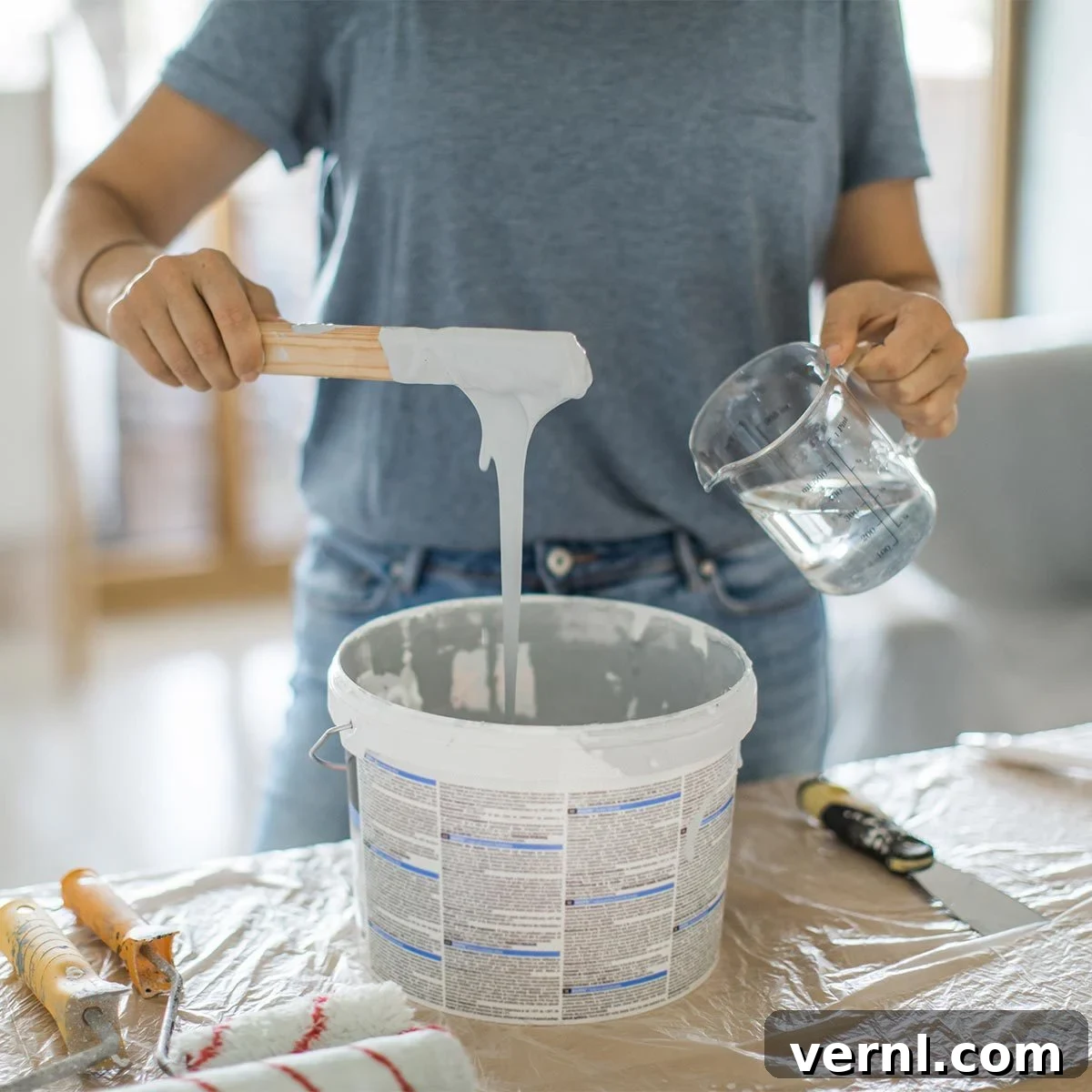
The question of whether to thin latex paint is a common one among DIY enthusiasts and seasoned professionals alike. The definitive answer hinges on manufacturer recommendations and the specific needs of your project. Paint formulations are meticulously engineered to deliver optimal results, and altering a paint’s physical composition through thinning can inadvertently compromise its performance, durability, and even void its warranty if not explicitly sanctioned by the manufacturer.
This comprehensive guide delves into the nuances of thinning latex paint, offering invaluable insights from two seasoned industry experts: Rachel Otto, the knowledgeable paint department manager at Fleury Lumber, and Shayne Pancione, owner of Pancione Painting Plus. We’ll explore the ‘why’ and ‘how’ of thinning, clarify which products are safe to use, and highlight those to rigorously avoid, ensuring your painting projects achieve a professional, lasting finish.
Understanding Latex Paint: The Modern Painter’s Choice
Latex paint, distinguished by its water-based formulation, stands as a cornerstone in both interior and exterior painting applications. Its widespread popularity stems from a versatile array of benefits that make it the preferred choice for countless projects. Available in diverse sheens, ranging from a non-reflective flat ideal for ceilings and low-traffic areas, to a lustrous high-gloss perfect for trim and doors, latex paint offers aesthetic flexibility to suit any design vision.
Beyond its aesthetic appeal, latex paint is renowned for its durability and ease of application. Whether you opt for the precision of a brush, the efficiency of a roller, or the speed of an air sprayer, latex paint glides on smoothly, making the painting process more manageable for all skill levels. Its inherent flexibility, derived from synthetic resins, allows it to withstand significant temperature fluctuations without cracking or peeling, ensuring a long-lasting finish on various surfaces.
This adaptability extends to the surfaces it can cover. From the foundational interior drywall, wood, and plaster to robust exterior concrete, siding, and stucco, latex paint forms a resilient bond. Furthermore, its water-based composition simplifies cleanup dramatically; unlike its oil-based counterparts, brushes, rollers, and even spills can be effortlessly cleaned with just soap and water, making it a more environmentally friendly and user-friendly option.
Demystifying Paint Thinner: Solvents and Compatibility
When the term “paint thinner” is used, it typically refers to a petroleum-based solvent primarily designed to reduce the viscosity of and clean oil-based paints. The most common product falling under this label is mineral spirits, valued for its lower odor and reduced toxicity compared to other potent solvents like turpentine, acetone, or naphtha. These powerful solvents work by dissolving the binders in oil-based paints, allowing them to flow more easily or be cleaned effectively from tools and surfaces.
However, a crucial distinction must be made regarding latex paint. As Rachel Otto emphasizes, “While most paint thinners are used with oil-based paints, there are some formulated to be used with latex. Read the label to see if it’s compatible.” This directive is paramount. Attempting to thin water-based latex paint with an incompatible solvent-based paint thinner can lead to disastrous results, causing the paint to curdle, separate, and become unusable. Always verify the product’s compatibility to ensure the integrity of your latex paint.
The Strategic Advantages of Thinning Latex Paint
While the decision to thin latex paint should always be approached with caution and adherence to manufacturer guidelines, there are several compelling reasons why you might strategically choose to do so to achieve superior results for specific applications. Understanding these benefits can help you make an informed decision for your next project.
Optimizing for Sprayer Applications
One of the primary motivations for thinning latex paint is to ensure optimal performance when using a paint sprayer. Sprayers, particularly HVLP (High Volume Low Pressure) and airless models, demand a consistent, specific viscosity for smooth operation and an even finish. Un-thinned latex paint, especially thicker varieties, can easily clog spray nozzles, leading to frustrating interruptions, uneven spray patterns, and a compromised finish. Rachel Otto advises, “Follow your sprayer’s operating instructions. These will include thinning ratios.” Adhering to these guidelines is crucial for preventing blockages, achieving proper atomization, and ensuring a professional, streak-free application.
Enhancing Flow, Leveling, and Finish Quality
Beyond sprayer compatibility, thinning latex paint can significantly improve its flow and leveling characteristics. “Leveling” refers to the paint’s ability to settle into a smooth, uniform film after application, effectively eliminating brush strokes and roller marks. A slightly thinned paint will spread more easily, allowing it to self-level more effectively before drying. This results in a noticeably smoother, more professional-looking finish with reduced imperfections, elevating the overall quality of your painting project. This is particularly beneficial for high-visibility surfaces where an immaculate finish is desired.
Achieving Specialized Decorative Effects
Thinning paint isn’t just about smooth finishes; it can also be a creative tool for achieving unique decorative effects. For instance, if you’re aiming for a distressed or washed look on furniture or decorative items, thinning the paint allows for greater transparency and enables techniques that highlight underlying textures or previous layers. Rachel Otto notes, “If you’re trying to get a distressed look when painting furniture, you can thin it.” This artistic application requires careful control over the thinning ratio to achieve the desired translucent or aged aesthetic without compromising the paint’s adhesion.
Extending Coverage and Maximizing Paint Efficiency
A more practical benefit of judiciously thinning latex paint is the potential to extend its coverage area. By slightly reducing the paint’s viscosity, you can sometimes make a given quantity of paint cover a larger surface area. This can be particularly useful for large projects or when you’re just shy of the amount of paint needed. However, it’s a trade-off to consider: “It may make the color a little different,” Otto cautions, “but adding water will make it go a little further.” Over-thinning can dilute the pigment intensity and potentially reduce the paint’s protective qualities, so this strategy should be employed with discretion and tested first.
Mastering the Art of Thinning Latex Paint: Techniques and Products
Successfully thinning latex paint requires precision and an understanding of the specific application method. While techniques vary, one universal principle remains paramount: “Make sure it’s very well mixed before attempting to apply it,” advises Shayne Pancione. “This applies to brush, roller or spray.” Thorough mixing ensures a consistent viscosity throughout the paint, which is crucial for uniform application.
Equally important is consulting the paint’s technical data sheet or the label for recommended thinning parameters. This information is your most reliable guide. Rachel Otto stresses, “If it says, ‘Do not thin,’ don’t thin it. If you do, the paint can crack, peel or not adhere properly to the surface.” Ignoring these instructions risks not only a compromised finish but also potentially voiding any product warranties, leading to costly reworks.
Precision Thinning for Sprayer Applications
When preparing latex paint for a sprayer, strict adherence to both the sprayer and paint manufacturers’ instructions is non-negotiable. The goal is to achieve a consistent, free-flowing liquid that atomizes effectively without clogging the nozzle. Typically, this process involves using clean, room-temperature water as the thinning agent. You’ll need a stir stick, a clean bucket, and a reliable measuring cup to ensure accurate ratios.
Begin by thoroughly stirring the latex paint in its original container to ensure all pigments and binders are evenly distributed. Then, using your measuring cup, transfer a precise amount of paint into your clean mixing bucket. Gradually add water according to the recommended thinning ratio, usually a small percentage (e.g., 5% to 10% by volume) of the paint’s total volume. After adding the water, use the stir stick to mix the paint and water thoroughly until the consistency is uniform. A common test for proper consistency involves dipping a stir stick into the thinned paint and observing how it runs off. It should flow like warm syrup, not thick like molasses or watery like milk. For critical projects, consider using a viscosity cup to achieve precise measurements. Always strain the thinned paint before pouring it into your sprayer reservoir to catch any potential lumps or debris that could clog the nozzle.
Optimizing Consistency for Brushing
Brushing can sometimes be challenging with very thick latex paints, making smooth application difficult and leaving prominent brush marks. In such cases, if permitted by the manufacturer, a minimal amount of water can significantly improve workability. “Some paints are thicker, which can make application difficult,” Otto explains. Adding just a couple of ounces of clean water per gallon can make the paint flow more smoothly, allowing for easier brushing and a more uniform finish, particularly for detailed work like trim or cutting in.
To thin for brushing, pour your well-stirred paint into a separate clean bucket. Begin by adding water one ounce at a time, mixing thoroughly after each addition. Continuously test the consistency by dipping your brush and observing the paint’s flow. Aim for a consistency akin to heavy cream – fluid enough to apply easily but still rich enough to provide good coverage. Stop adding water once the desired workability is achieved, being careful not to over-thin, which can compromise hide and durability.
Beyond water, synthetic flow improvers like Floetrol are excellent additives specifically designed for brushing and rolling. Shayne Pancione highly recommends them: “This is designed to make the paint flow smoother, level out better and avoid leaving brush strokes or roller marks. It makes brushing in trim a breeze.” Floetrol works by extending the paint’s “open time” – the period before it starts to dry – allowing more time for the paint to level itself. It achieves this without significantly diluting the paint solids, thus maintaining paint quality and durability while dramatically improving its application characteristics.
Achieving a Flawless Finish with Rolling
When applying latex paint with a roller, the goal is a consistent, even coat with minimal lap lines or texture. The same general thinning instructions and products used for brushing can apply here, particularly the use of flow improvers. Adding Floetrol when rolling is highly beneficial, as it significantly minimizes unsightly lap lines – those visible streaks where roller passes overlap – resulting in a more uniform and professional appearance across large wall surfaces.
However, Rachel Otto expresses a notable caveat regarding water thinning for rolling applications: “Otto doesn’t recommend thinning with water when applying latex paint with a roller. It doesn’t give the look the manufacturer intends and can leave streaks.” Her caution stems from the fact that even slight water dilution can reduce the paint’s viscosity too much for roller application, leading to inadequate film build, poor hide, and a streaky finish that detracts from the paint’s intended aesthetic and protective qualities. For rolling, focus on proper roller technique, using high-quality roller covers, and leveraging additives like Floetrol rather than relying on water for thinning.
Frequently Asked Questions About Thinning Latex Paint
Can you thin latex paint with water?
Yes, latex paint can be safely thinned with clean, room-temperature water, but only if explicitly recommended and within the specified ratios by the paint manufacturer. It’s crucial to consult the paint can label or technical data sheet for these guidelines. Under no circumstances should you attempt to thin water-based latex paint with solvent-based products, as this will lead to immediate and irreversible damage to the paint’s emulsion.
Is acetone a paint thinner?
Yes, acetone is indeed a powerful type of solvent-based paint thinner, known for its rapid evaporation and strong solvency. However, its utility for paint is primarily focused on removal rather than thinning. As Rachel Otto points out, “Acetone is more for removing paint. It can cause paint to separate if added as a thinner.” Its aggressive chemical properties are highly incompatible with the water-based emulsion of latex paint, causing the paint to curdle and separate immediately. Moreover, acetone should never be used for cleaning water-based paint tools or spills, as it is designed for oil-based products and can damage latex paint.
Can paint thinner remove paint?
Yes, traditional solvent-based paint thinners are effective at removing oil-based paint, particularly when the paint is still wet or tacky. They work by dissolving the binders in the paint, making it easy to wipe away from brushes, rollers, and accidental spills on non-porous surfaces. For dried oil-based paint, acetone can sometimes be effective, especially on smaller spots, but generally, stronger paint stripping products are required for larger areas or stubborn dried paint.
It’s vital to exercise extreme caution when using any paint thinner for removal. “Just be careful and use paint thinner in a well-ventilated area and wear a mask and gloves,” Rachel Otto advises, “The fumes can be hard on the lungs if breathed.” Proper ventilation is crucial to prevent the inhalation of harmful volatile organic compounds (VOCs). Additionally, solvent-based paint thinner is entirely ineffective at removing water-based latex paint and should not be used for this purpose.
Does paint thinner ruin paint?
Whether paint thinner ruins paint depends entirely on the type of paint and the type of thinner used. The fundamental rule is compatibility. Adding a solvent-based paint thinner (like mineral spirits, turpentine, or acetone) to latex (water-based) paint will unequivocally ruin it. The solvent will cause the latex polymers, which are suspended in water, to coagulate and separate, rendering the paint unusable and resulting in a lumpy, unmixable mess.
Conversely, paint thinner will not damage oil-based paint if added in appropriate, small amounts as recommended by the manufacturer. For oil-based paints, specific thinners are designed to reduce viscosity for easier application without compromising the paint’s chemical integrity or performance. The key takeaway is to always match the thinner to the paint type – water for water-based (if permitted), and appropriate solvent for oil-based.
About the Experts
- Rachel Otto is the paint department manager at Fleury Lumber in Easthampton, Massachusetts. Specializing in Benjamin Moore products, Rachel brings a decade of invaluable industry experience to her role, offering expert advice and insights into paint chemistry and application.
- Shayne Pancione is the esteemed owner of Pancione Painting Plus, a full-service residential and commercial painting company also located in Easthampton, Massachusetts. With over 25 years of extensive experience in the trade, Shayne’s practical knowledge ensures high-quality results for a diverse range of painting projects.