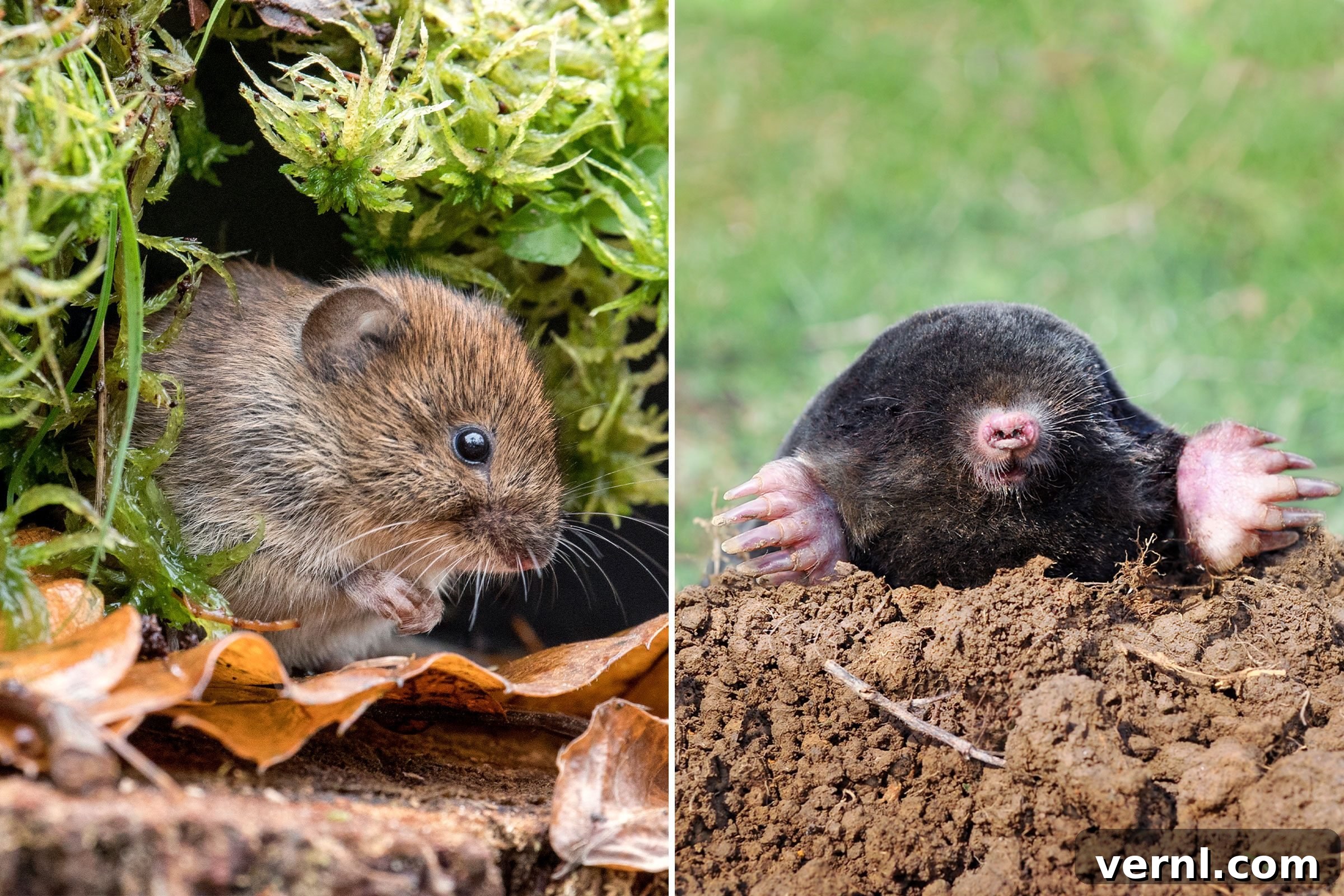
Few things are as frustrating for a homeowner or gardener as discovering mysterious tunnels or damaged plants in what was once a pristine yard. These telltale signs often point to the presence of common subterranean nuisances: moles and voles. One year, my entire flower bed became an unwitting condominium complex for moles, their intricate tunnel system collapsing after a heavy spring rain and sending all my carefully planted flora into the abyss below. We faced the daunting task of hauling in extra soil and replanting every single specimen, a vivid reminder of the impact these small creatures can have.
While both moles and voles can wreak havoc on your landscape, understanding their distinct characteristics, behaviors, and the specific damage they cause is crucial for effective identification and control. Often, one is mistakenly blamed for the actions of the other, leading to ineffective solutions. This comprehensive guide will equip you with the knowledge to differentiate between these two common garden pests and implement the most appropriate strategies to protect your lawn and garden.
What Is a Vole?
Voles, often referred to as “meadow mice,” are small, ground-dwelling rodents that primarily inhabit above-ground environments. They are nocturnal mammals, meaning they are most active under the cover of darkness. While they bear a superficial resemblance to common house mice, adult voles are typically larger, with stockier bodies, darker fur ranging from dark-brown to black, and short, fur-covered tails. Young voles, in contrast, often appear grayish.
The United States is home to a diverse array of 23 vole species, and a significant portion of these – specifically seven species – are known to cause considerable damage to landscapes and agricultural areas. Meg Pearson, a technical training manager at Critter Control, highlights the economic impact, citing a case in Washington State where a population density of 1,700 voles per acre led to a 35 percent reduction in apple orchard production, resulting in an estimated loss of $3,000 for growers. This illustrates the severity of the problem voles can pose.
Voles are prolific breeders, a factor that contributes to their potential for rapid population growth and extensive damage. According to Pearson, they can breed year-round, with a remarkably short gestation period of only 21 days. The specific species that poses the most significant threat often depends on geographical location and local environmental conditions.
Among the most frequently encountered vole species in the U.S. are:
- Prairie Voles: These voles typically inhabit drier regions of the central U.S., extending their range from Mexico northward into Ohio.
- Meadow Voles: Considered the most prolific species, meadow voles are widespread across the Eastern half of the United States, favoring open grassy areas.
- Woodland Voles: As their name suggests, these voles are found in wooded habitats throughout the Eastern U.S., often utilizing the dense undergrowth for cover.
- Water Voles: Distinct from other species, water voles are protected by law in many areas and reside near or within bodies of water, exhibiting semi-aquatic behaviors.
Voles possess prominent incisors at the front of their mouths, perfectly adapted for their herbivorous diet. Their primary food sources include plant roots, seeds, grasses, and bulbs. While they create shallow, narrow runways that snake through ground-level vegetation, these pathways are often less conspicuous than mole tunnels. Unlike moles, voles do not push excavated soil into visible mounds, which is why their presence often goes unnoticed until plants begin to suffer. This absence of dirt mounds frequently leads to moles being erroneously blamed for vole-induced damage.
The damage caused by voles is typically observed on ornamental plants, garden vegetables, and lawns. They prefer areas with heavy ground cover, which provides concealment from predators like hawks, owls, and snakes. Although primarily surface dwellers, voles will occasionally tunnel underground to access and consume plant roots, especially during colder months when surface vegetation is scarce.
What Is a Mole?
Despite often being confused with rodents due to their subterranean habits, moles belong to a distinct animal family, Talpidae, and are more closely related to hedgehogs and shrews. These fascinating creatures are uniquely adapted for an exclusively underground existence, spending nearly their entire lives beneath the earth’s surface.
Moles are small, burrowing insectivores characterized by their powerful, shovel-like front paws, perfectly designed for digging. Their bodies are streamlined, and their fur possesses a unique quality: it doesn’t lie flat in any particular direction, allowing them to move forward or backward through their tunnels without dirt accumulating or impeding their progress. This dense, velvety fur also provides insulation against cold soil temperatures.
According to the National Wildlife Federation, moles thrive in a variety of habitats, including “meadow, grassland, woodland, wetland, or riparian habitats that lie along the edges of rivers, streams, lakes and other bodies of water.” The key requirement for moles is loose, moist soil that is rich in their primary food sources.
As Meg Pearson explains, “Moles spend most of their lives underground and feed on insects and earthworms below the surface. Mole damage is associated with their tunneling.” Unlike voles, moles are not herbivores; their diet consists almost exclusively of invertebrates found in the soil. Earthworms are their preferred meal, but they also consume grubs, slugs, snails, and various other insects. While their tunneling activity can be a significant nuisance, moles play an often-underappreciated role in garden ecosystems by aerating the soil and consuming insect pests, including destructive grubs.
Moles are generally solitary animals, with individual moles maintaining extensive tunnel systems. They are constantly excavating new tunnels in search of food, which is why their presence often manifests as a network of raised ridges and dirt mounds across a lawn. These tunnels serve as their highways and hunting grounds, allowing them to efficiently patrol their territory for prey.
Voles vs. Moles: The Telltale Signs
Distinguishing between mole and vole damage is the first critical step toward effective control. Both can cause significant aesthetic and structural damage to your landscape, but their methods and manifestations differ considerably.
Mole Damage: The Landscape Architect
The most unmistakable sign of a mole infestation is the presence of extensive tunneling. If you observe long, raised ridges or irregular surface tunnels snaking across your yard, often with volcano-shaped piles of dirt at regular intervals, you probably have moles. These raised tunnels are created as moles push up the soil from their shallow feeding runs just beneath the surface. The mounds, known as molehills, are typically circular and formed from deeper excavation, where moles have dug deeper tunnels or created chambers for nesting or storing food. When you walk across a heavily infested lawn, the surface will feel soft, spongy, or “squishy” due to the collapsed tunnels beneath your feet.
Mole damage is primarily structural; their digging dislodges plant roots, causing plants to wilt and die from lack of moisture and nutrient uptake. While they don’t directly eat plants, the disruption can be just as fatal. Their presence indicates a healthy population of grubs and earthworms in your soil, which are their main food source.
Vole Damage: The Root and Bark Marauder
Vole damage presents a different set of visual cues. Voles create “dime-sized” entrance holes to their burrows, often found discreetly around the base of plants or beneath dense ground cover. Unlike moles, voles do not create large dirt mounds. Instead, they form shallow, narrow surface runways, typically 1 to 2 inches wide, that connect their burrows and feeding areas. These runways are worn paths through grass or mulch, often hidden by overlying vegetation. Following one of these surface runways will often lead directly to a vole hole.
Meg Pearson clarifies the nature of vole damage: “Voles cause visible damage to ornamentals and trees by eating away the roots and through girdling, which is chewing all around the bark of the plant. This cuts off the plant’s circulation and kills it. The gnaw marks are typically in irregular patches and at varying angles.” This direct consumption of plant material is the key differentiator from mole damage. You might pull up a seemingly healthy plant only to find its roots entirely chewed away, or observe young trees and shrubs with stripped bark, especially near the ground level or snowline in winter. These gnaw marks are distinct, irregular, and often at different angles, unlike the clean cut of a rabbit or deer.
Vole and Mole Control: Strategies for a Healthy Yard
Once you’ve accurately identified your subterranean adversary, you can implement targeted control strategies. Both moles and voles can be challenging to manage, but with persistence and the right approach, you can reclaim your garden.
DIY Vole Removal: A Proactive Approach
Trapping voles can be an effective DIY solution, especially if their numbers are not overwhelming. Oklahoma gardener Susan Kozaliek successfully eradicated voles from her yard using a clever and non-toxic method.
Kozaliek began by identifying active vole runs. She noticed her plants were dying with visible root damage. To pinpoint active tunnels, she poured play sand into the voles’ exit holes. “Sand was super easy to pack down and identify because it was different from my regular soil,” Kozaliek explained. “In active runs, the voles would kick out the sand.” This simple technique allowed her to focus her efforts precisely where they were needed.
Opting against poisons, Kozaliek purchased inexpensive mousetraps. She baited them with a mixture of rolled oats and peanut butter, a highly attractive combination for voles. She strategically placed several traps near the exit holes of active runs. To protect birds and prevent the traps from being dislodged, she covered them with small buckets and trash cans, securing them with bricks. This careful placement ensured only the target pests could access the bait. Her diligence paid off; she began catching voles each morning. “It was extremely time-consuming, but after all the money I spent on new plants and the money I was going to spend on future plants, I knew I needed to get a handle on it,” Kozaliek recounted. Her impressive effort resulted in catching 45 voles in just a couple of months.
Beyond trapping, cultural methods can help deter voles. Keep your yard tidy by removing dense ground cover, tall weeds, and heavy mulch that provide concealment for voles. Creating a gravel barrier around vulnerable plants can also make them less appealing. Some repellents, often containing castor oil, are marketed for voles, though their effectiveness can vary.
Mole Removal: Patience and Persistence
Moles can be notoriously difficult to trap, requiring a significant amount of patience and persistent effort. Because of this challenge, many people resort to using poisons, which are often perceived as an easier solution. However, poisoning moles carries substantial ethical and ecological concerns. It is widely considered inhumane and poses a grave risk to non-target wildlife, including beneficial predators like hawks, owls, and coyotes, who may suffer secondary poisoning by consuming contaminated moles. Furthermore, these meat-based poisons can also attract and harm household pets, such as dogs, who might mistake them for food or be drawn to the smell mimicking natural prey.
Similarly, kill traps, while effective, are also considered inhumane due to the suffering they inflict. Moreover, their use requires individuals to deal with the deceased animal afterward, a task many find unpleasant. For those committed to humane removal, live trapping is a viable option.
For the best results with live traps, first identify the main, active mole tunnels. This can be done by carefully uncovering a section of a tunnel by digging into the topsoil near a molehill with a stick or a post hole digger. If the hole is repaired within a day or so, it indicates an active tunnel. Next, you will need to excavate a hole large enough to accommodate the live trap comfortably within the tunnel. Place a baited live trap inside the prepared hole and carefully cover the area with soil and a weighted trash can or bucket. This not only prevents the accidental capture of unintended animals, such as birds or other small creatures, but also helps you easily locate the trap later. Once a mole is caught, it must be humanely relocated to an appropriate natural habitat far from your property.
The Best Defense: Food Source Removal and Prevention
Ultimately, the most effective long-term strategy for controlling moles is to eliminate their primary food sources: grubs and earthworms. Reducing the grub population in your lawn can significantly diminish the attractiveness of your yard to moles. Consider using products like milky spore powder, a biological control that targets Japanese beetle grubs. Additionally, modifying your watering habits can help. Moles, grubs, and earthworms all thrive in moist soil. Watering your lawn less often, allowing the soil to dry out between waterings, can create an less hospitable environment for these organisms, naturally reducing their populations.
For both moles and voles, physical barriers can offer protection. Burying hardware cloth (1/4-inch mesh) or galvanized wire fencing at least 12-18 inches deep and extending 6 inches above ground around garden beds can prevent voles from entering. For moles, creating underground barriers around specific areas might be feasible, though challenging for an entire lawn.
If your mole or vole problem persists or becomes overwhelming, contacting a professional pest control service is advisable. They possess the expertise, specialized equipment, and knowledge of local regulations to effectively and humanely manage these pests. Each infestation is unique, and it is always important to familiarize yourself with local laws regarding trapping and other control methods to ensure compliance and responsible pest management practices.