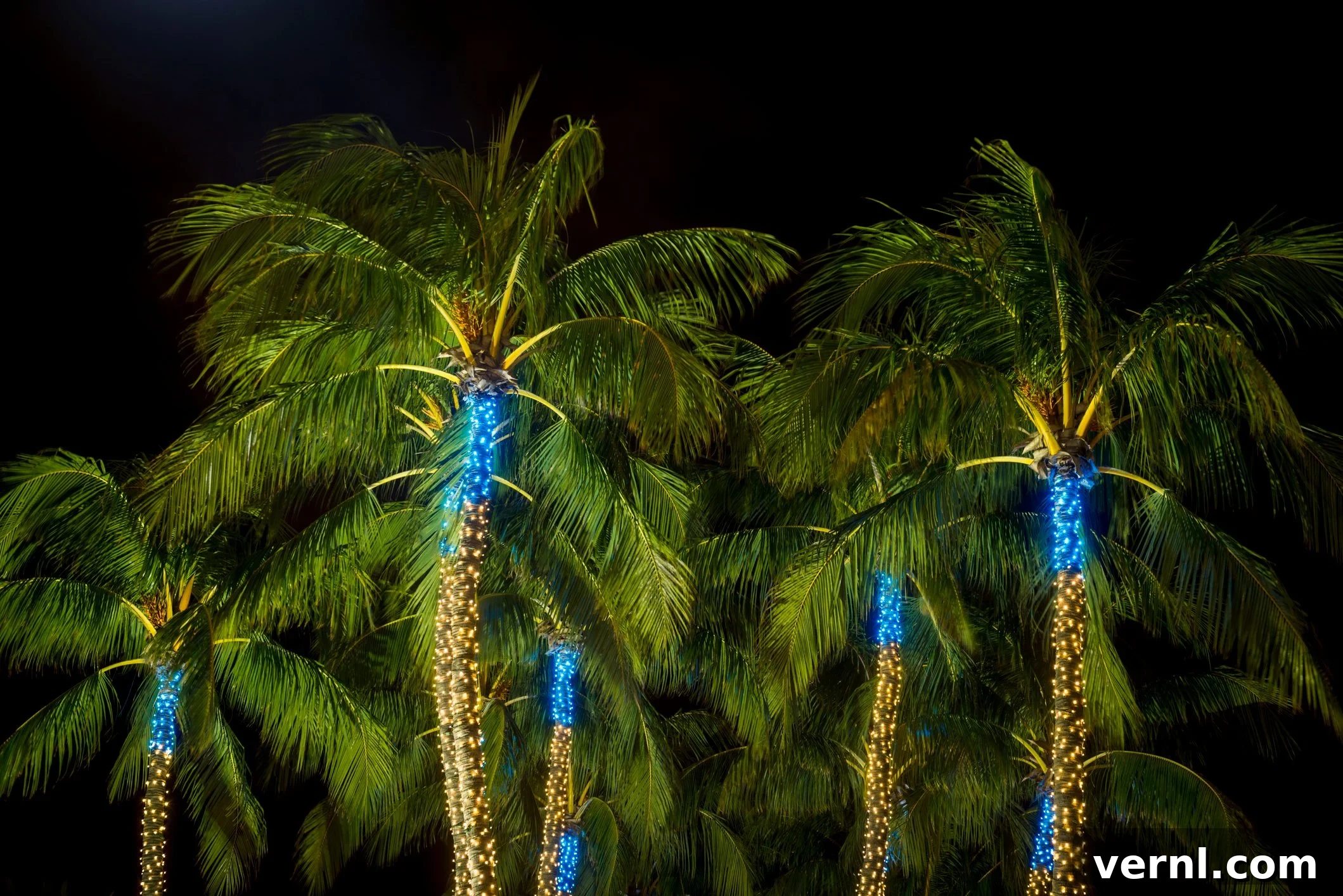
For those of us from colder climates, where winter typically brings a blanket of snow and leafless trees, the sight of palm trees often signifies a stark departure from the familiar. My own introduction to California was marked by these iconic sentinels, standing tall and proud, instantly signaling a landscape far removed from the Midwestern plains. As I drove through the sun-drenched expanse of Marin County, heading towards the majestic Golden Gate Bridge, the vast, swaying fronds of the palm trees were a vivid testament to abundant sunshine and the promise of perpetually snow-free winters. In many ways, they struck me as even more captivating than the ancient coastal redwoods or the boundless stretch of the Pacific Ocean disappearing into the horizon.
While Californians may enjoy the luxury of relatively mild winters, their enthusiasm for the holiday season is certainly no less fervent than anywhere else. During Christmastime, homes, garden shrubs, walkways, and indeed, palm trees are all transformed into dazzling displays of festive cheer. Palm trees, with their unique structure and tropical allure, offer a truly distinctive backdrop for an array of colorful fairy lights. It’s not uncommon to find palms in charming, tourist-friendly coastal towns, such as Capitola near my residence, remaining beautifully decorated throughout the entire year, embodying an endless festive spirit.
Despite living amidst this unique holiday tradition, I don’t have palm trees on my own property, nor have I ever undertaken the task of decorating one. Therefore, for this exploration into the art of illuminating palms, I turned to the expertise of Dara Greaney, the insightful CEO and founder of LEDLightExpert.com. His professional guidance offers invaluable tips for ensuring your palm tree lighting project is both spectacular and safe.
Is It Safe To Put Christmas Lights on Palm Trees?
“Yes, if done properly,” advises Greaney, emphasizing the importance of careful execution. He stresses that the choice of tree is paramount for safety and success. “Trees should ideally be mature palms, with a trunk diameter of at least eight inches. You need them to be stable, well-rooted, and not at risk of swaying excessively in the wind or becoming unstable under the added weight of decorations.” The integrity and health of the palm tree are fundamental considerations before any decoration begins. A healthy, mature tree is better equipped to handle the minimal stress of lighting.
Greaney’s preferred method for illuminating palm trees without direct attachment involves a clever and less intrusive approach. He suggests choosing an existing sturdy post or installing a new one adjacent to the palm. A strong wire is then extended between this post and the palm tree, from which the string lights can be elegantly suspended. This technique ensures that no fasteners penetrate the tree’s trunk, minimizing any potential damage or stress to the living organism. If an existing post isn’t available, installing a dedicated one for this purpose can be a worthwhile investment for recurring holiday displays.
Of course, a widely adopted alternative, particularly common in regions like Santa Cruz County, involves directly wrapping the lights around the trunk of the palm. This method offers a classic and visually striking effect. Should you opt for this approach, a stable ladder will likely be essential to safely reach the higher sections of the trunk. Concerns about the tree’s ability to support the weight of a ladder or a person are valid, but generally, mature palms are quite robust.
“Mature trees that exceed 10 inches in diameter are typically strong enough,” Greaney confirms. “They can comfortably handle the weight of a ladder and a person. However, for any trees with a smaller diameter, it’s crucial not to rest the ladder directly against the tree. Instead, position the ladder next to it, ensuring it’s stable and freestanding, to avoid putting undue pressure or causing abrasions to the trunk.” Safety should always be the top priority when working at heights.
Beyond the physical interaction with the tree, electrical safety is non-negotiable when installing outdoor Christmas lights. It is imperative to meticulously inspect all wiring and connections. Any loose, frayed, or exposed connections pose a significant fire hazard and must be rectified immediately. Furthermore, always plug your outdoor lights into an exterior Ground Fault Circuit Interrupter (GFCI) outlet. This critical safety device is designed to detect ground faults and rapidly cut power, significantly reducing the risk of electrical shock or fire should an issue arise due to moisture, damaged wiring, or other electrical faults. Using lights specifically rated for outdoor use, which are designed to withstand varying weather conditions, is also essential for a safe installation.
Why Not To Put Christmas Lights on Palm Trees
While the allure of Christmas lights on a palm tree is undeniable, the execution can sometimes lead to visually undesirable outcomes. Before embarking on your decorative project, it’s wise to consider the aesthetic impact. As Greaney amusingly suggests, “To get an idea of what you probably shouldn’t do, Google ‘lights on a palm tree.’ Imagine if you turned a replica of the Blue Origin rocket into a fountain, and you get the idea.” The point is, not every lighting scheme works for every shape, and what looks good in one context can look awkward or even comical in another. Carefully observe the natural shape of the trunk, the spread of the fronds, and visualize how the lights will accentuate these features. In many instances, a minimalist approach—where “less is definitely more”—can yield the most elegant and appealing results.
Another significant concern arises from activity on the ground level. Exposed electrical cords are not only unsightly but also present a tripping hazard for people and pets. Furthermore, they can be easily disturbed, pulled, or damaged, potentially causing the lights to detach from the tree or creating an electrical hazard. It is considerably safer to decorate a palm tree that is situated within a well-defined planter, a secluded garden bed, or along the perimeter of a property, rather than one in the middle of a high-traffic area. If you find yourself with no alternative and must decorate a palm in a frequented spot, extreme care must be taken to route power cords well away from footpaths, driveways, or areas where children and animals play. Utilizing cord protectors, burying cords safely (where appropriate and permissible), or running them along fences or walls can help mitigate these risks.
The weight of decorations is also a factor, especially when considering the delicate nature of palm fronds. It is generally not advisable to hang heavy string lights directly onto the fronds. Some traditional incandescent string lights can be quite heavy, and their weight, particularly when wet from rain or dew, could cause the fronds to droop unattractively or, worse, snap off entirely in strong winds. This not only damages the tree but also creates a falling hazard. Modern LED Christmas lights are significantly lighter than their incandescent counterparts and pose less of a risk. However, even with LEDs, it’s crucial to ensure that the fronds are mature and robust enough to support the weight, and that the lights are distributed evenly to prevent undue stress on any single frond. Inspecting the fronds for any signs of weakness or damage before decorating is a good practice.
How Do You Put Christmas Lights on a Palm Tree?
The internet is rife with debate and conflicting advice regarding the potential damage you can inflict on a palm tree by driving staples, nails, or other hangers directly into its trunk. The consensus among arborists, those who specialize in tree care, is overwhelmingly against such practices. They tend to agree that puncturing the trunk of a living tree is unequivocally a bad idea. Dara Greaney firmly aligns himself with the arborists on this crucial point.
“Nothing should ever go into the tree, ever,” Greaney asserts with conviction. “You run a significant risk of damaging or even killing the tree. Such methods are simply not necessary, as there are plenty of alternative, non-invasive ways to secure your lights. Simply wrap them up and secure them over a higher branch or around the natural contours of the trunk.” The fundamental reason against penetration is that each puncture creates an open wound, making the tree vulnerable to disease, pests, and fungal infections. Unlike some deciduous trees that can compartmentalize wounds, palms have a different vascular system, and damage to their single growing point or trunk can be fatal or lead to irreversible decline. Preserving the tree’s health must be paramount.
Palm fronds emerge exclusively from the apex, or very top, of the trunk. As the palm grows taller over time, the older fronds eventually fall off. Depending on the specific species of palm, this natural shedding process can leave behind unique triangular tabs or fibrous sheaths on the trunk. These natural features can often be skillfully utilized as secure anchoring points for string lights, allowing them to be wrapped and held in place without the need for any piercing fasteners. If, however, the trunk of your palm tree is smooth and devoid of such natural ledges or tabs, consider using methods like bungees, elastic tree-friendly straps, or other non-penetrating fastening systems. These should be snug enough to hold the lights securely but never so tight that they constrict the trunk’s growth or cause girdling. Regularly check the tension of these fasteners to ensure they aren’t causing any stress to the tree over time.
When it comes to securing string lights to the palm fronds themselves, the safest and most effective tools are twist ties or cable ties (also known as zip ties). These allow you to gently attach the lights to the fronds without causing damage. It’s crucial, however, to ensure that the ties are not overtightened, which could restrict the frond’s natural movement or growth. Also, choose UV-resistant ties if the decorations will be up for an extended period, as regular plastic ties can degrade in sunlight. Most importantly, ensure that the lights are secured firmly enough to withstand strong winds and adverse weather conditions, preventing them from falling or getting tangled. A careful, systematic approach to attachment will yield the best results.
Before you even begin the physical installation, a comprehensive plan is essential. Measure the height and circumference of your palm tree to determine the length of lights you’ll need. Decide on your desired wrapping style – a classic spiral upward, a more dense vertical wrap, or perhaps just highlighting the lower trunk. Consider the type of lights: larger C7 or C9 bulbs for a more traditional, bold look, or smaller mini-lights for a delicate, twinkling effect. Using LED lights is highly recommended due to their energy efficiency, durability, and cooler operating temperature, which is safer for trees. Gather all necessary tools beforehand: a sturdy ladder, measuring tape, plenty of zip ties or twist ties, outdoor-rated extension cords, a GFCI adapter if your outlet isn’t already GFCI protected, and work gloves. Having everything ready will make the process smoother and safer.
Palm Tree Lighting Alternatives
If the thought of physically hanging Christmas lights directly onto your prized palm trees makes you uneasy, or if you’re simply seeking a different aesthetic, there are numerous enchanting alternatives that can still highlight these magnificent trees during the holiday season. These methods often provide an equally, if not more, captivating display without any direct contact or potential stress to the palm itself.
One of the most effective and versatile approaches is to illuminate the palm trees indirectly. Consider decorating the surrounding shrubbery, garden beds, or nearby architectural features with your string lights. This creates a festive ambiance that frames the palm tree, allowing it to stand out as a natural silhouette against a sparkling backdrop. Alternatively, and perhaps even more dramatically, you can use floodlights to highlight the palm trunks and fronds. Strategic placement of uplights at the base of the tree can create stunning shadows and textures, emphasizing the unique structure of the palm. For an even more atmospheric effect, opt for colored floodlights – warm amber tones for a cozy glow, cool blues for a winter wonderland feel, or vibrant reds and greens for classic Christmas cheer. Some advanced floodlight systems even offer the capability to cycle through a spectrum of colors at regular intervals, creating a dynamic and engaging light show that truly brings your landscape to life.
Choosing solar-powered floodlights offers a fantastic blend of convenience and sustainability. These eco-friendly options eliminate the need for cumbersome extension cords running across your lawn, reducing trip hazards and simplifying installation. Furthermore, they won’t add to your electricity bill, allowing you to enjoy a beautifully lit landscape without worrying about increased power consumption. Modern solar lights are remarkably efficient, charging during the day and automatically illuminating your palms from dusk till dawn, providing a consistent and hassle-free display.
For those who appreciate a touch of sparkle and shimmer, incorporating decorative elements around the palm tree can amplify the festive atmosphere. Try wrapping strands of tinsel or garlands, perhaps adorned with reflective ornaments, around the lower part of the trunk. You can also drape lighter garlands from the fronds, ensuring they are securely attached with non-damaging ties and are not too heavy. When combined with strategically placed floodlights, these reflective materials will catch and bounce the light, creating a dazzling, multi-faceted display that sparkles and shines. This approach allows you to introduce traditional festive decorations without directly burdening the palm with heavy electrical lights.
Beyond lights and garlands, consider other natural elements. Non-toxic berries, pinecones (even artificial ones), or festive ribbons can be incorporated into garlands or tied gently around the trunk base, adding texture and color. Ground-level lighting, such as pathway lights, lighted lawn ornaments, or even projection lights casting festive patterns onto the palm, can further enhance the overall display. The goal is to create a cohesive and enchanting holiday scene, with the palm tree serving as a majestic focal point, celebrated safely and beautifully.