
In the vast world of construction and woodworking, few materials are as ubiquitous and versatile as plywood. From the sturdy framework of a new house to the elegant lines of custom furniture, plywood plays an indispensable role. It’s a material that I, like countless professionals and DIY enthusiasts, have relied on extensively – for outdoor applications like roof and wall sheathing, for indoor necessities such as subfloors and room dividers, and in the workshop for intricate cabinet and furniture projects.
However, the journey from a raw lumber yard to a finished masterpiece requires a critical understanding: not all plywood is created equal. The plywood destined for a sophisticated custom cabinet demands a significantly higher standard than what you’d use for basic roof sheathing. This brings us to a crucial question: What exactly does the lumber industry mean by “grade,” what are the various classifications, and how do they inform its specific applications? Understanding these distinctions is paramount to ensuring the success, longevity, and aesthetic appeal of any project.
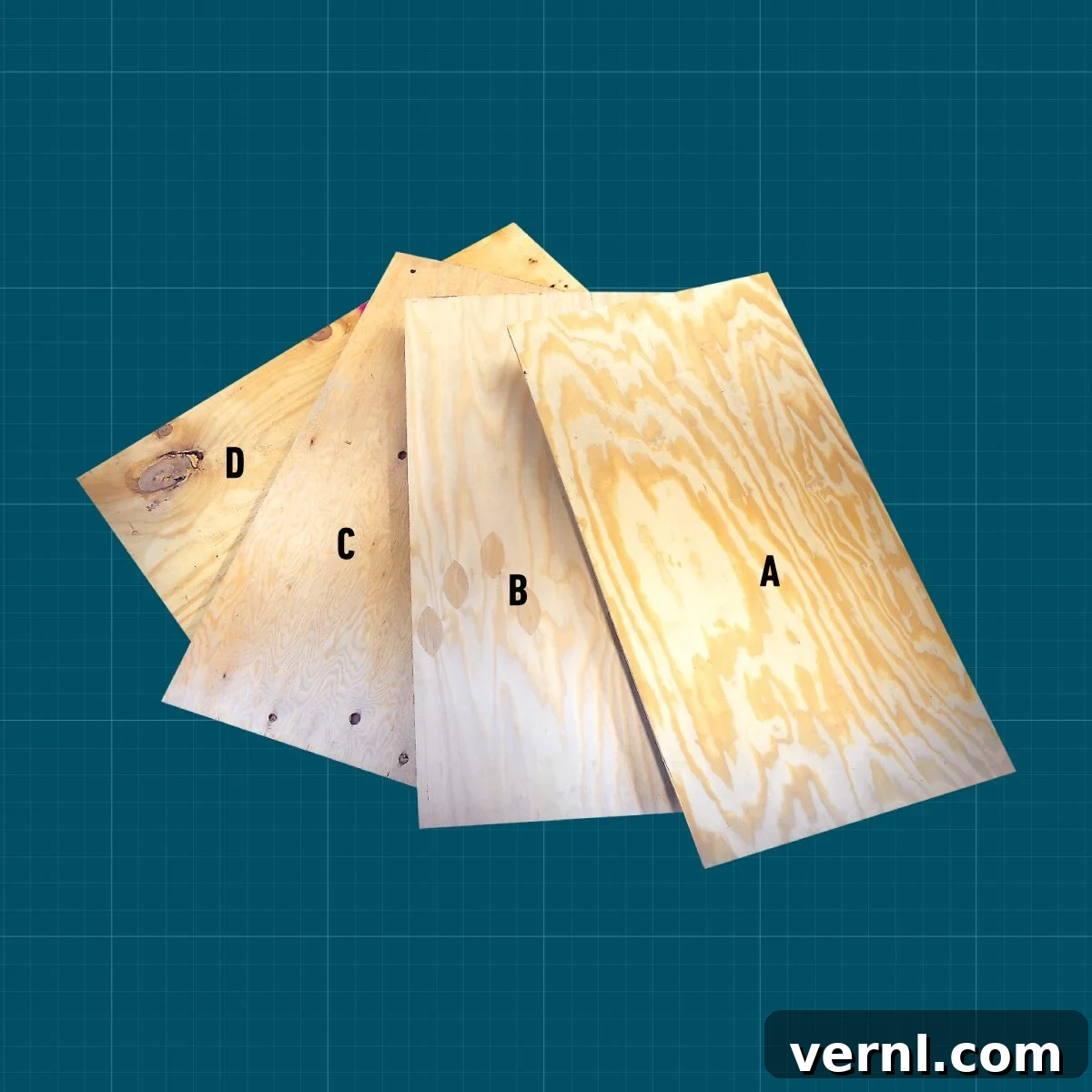
The grading system for plywood is designed to provide clear indicators of its quality, appearance, and structural integrity. “Plywood is graded through four main levels, A, B, C, and D,” explains Josh Kou, a lumber professional with a profound, lifelong interest in hardwoods. Grade A represents the pinnacle of quality, making it ideal for high-visibility applications like cabinetry and fine furniture. Conversely, Grade D occupies the lowest tier, primarily “used for structural purposes where the surface will be hidden,” according to Artem Kropovinsky, an interior designer boasting over a decade of experience. Intermediate grades, such as B and C, bridge this gap, serving a range of purposes from specific cabinetry needs (mostly Grade B) to more utilitarian applications (Grade C).
This comprehensive guide aims to demystify plywood grading, equipping you with the knowledge to confidently choose the perfect material for your next project, ensuring both structural integrity and aesthetic satisfaction.
Meet Our Plywood Experts
To bring you the most accurate and practical insights, we’ve consulted leading voices in the lumber and design industries:
Josh Kou is a second-generation lumber expert and the operations manager for NorthCastle Hardwoods. His extensive travels through Asia have enriched his understanding of diverse woodworking techniques and lumber characteristics.
Artem Kropovinsky is a distinguished interior and cabinet designer, and the visionary founder of NYC-based Arsight. His innovative designs have garnered recognition in prestigious publications such as Architectural Digest, The New York Times, Forbes, Business Insider, and Domino, underscoring his deep expertise in plywood and its myriad applications.
What Exactly Is Plywood? Deconstructing a Versatile Material
At its core, plywood is an engineered wood product remarkable for its strength, stability, and versatility. It’s crafted by peeling thin layers, known as veneers, from a tree trunk. These veneers are then carefully stacked and glued together, with each successive layer oriented perpendicular to the one below it – a process known as cross-graining. This innovative construction method is what gives plywood its superior properties compared to solid wood.
“Almost all plywood in the U.S. is made from either Douglas fir or western larch, both of which are softwoods,” notes Josh Kou. These species are favored for their strength and availability. However, for applications demanding a premium finish, “Grade A plywood is often finished with a hardwood veneer,” Kou adds. This technique offers an affordable and sustainable way to present the beauty of hardwood without the cost and stability challenges of solid hardwood lumber.
Standard Dimensions and Thicknesses
Plywood is typically sold in large, convenient sheets measuring four by eight feet (1,220 x 2,440 millimeters), making it efficient for covering large areas with minimal seams. Its thickness can vary significantly, ranging from a slender 1/4-inch (6-mm) for lightweight applications to a robust 1-3/16-inch (30-mm) for heavy-duty structural requirements. This wide range of options allows for precise material selection based on the project’s specific needs for strength, flexibility, and insulation.
The Structural Advantage: Why Plywood Excels
The genius of plywood lies in its cross-laminated construction. Because wood layers are glued in cross directions, the natural tendency of wood to expand, contract, and warp along its grain is significantly mitigated. This makes plywood far more dimensionally stable than solid wood, rendering it less susceptible to warping, twisting, or buckling in response to changes in humidity and temperature. This inherent stability makes it an excellent alternative, and often the preferred material, for both general construction and fine cabinetry, where precision and long-term performance are crucial.
Specialized Plywood Types: Beyond the Basics
What Does RTD Stand For on Plywood?
RTD, when found on plywood, stands for “Resistance Temperature Detector.” This designation signifies a manufacturing process where temperatures of each veneer layer are meticulously monitored and controlled during production. This careful oversight ensures an exceptionally reliable glue bond between layers, resulting in a more durable and better-wearing final product. Plywood with an RTD classification often suggests higher quality control in its manufacturing, leading to enhanced performance characteristics.
What Is Marine-Grade Plywood?
Marine-grade plywood is a highly specialized product engineered for superior resistance to moisture and fungal decay. Its production involves the use of waterproof adhesives and, often, wood preservatives, creating sheets that can withstand prolonged exposure to water without delaminating or deteriorating. Crucially, the veneers used in marine-grade plywood, whether hardwood or softwood, must be entirely free from defects that could trap moisture or compromise structural integrity.
As its name implies, marine-grade plywood is the material of choice for boat builders, used in hulls, decks, and other components frequently submerged or exposed to harsh marine environments. Beyond nautical applications, contractors also favor it for sheathing and subfloors in areas prone to excessive moisture, such as bathrooms, kitchens, or regions with high humidity, where standard plywood would quickly fail.
What Is Exterior-Grade Plywood?
Exterior-grade plywood, identified by the “X” rating in its designation (e.g., CDX), is also designed to resist moisture, making it suitable for outdoor applications or environments with intermittent wetting. However, it differs from marine-grade plywood in several key aspects. Manufacturers typically use lower-grade but still exterior-rated adhesives in its production. Furthermore, the softwood veneers may contain knots and other defects, provided they do not compromise the panel’s structural integrity. While it offers good moisture resistance for general outdoor use, it is not intended for continuous exposure to water or for applications requiring the extreme durability of marine-grade plywood.
Plywood Grades Explained: A-D Classification and Beyond
The core of plywood selection lies in understanding its grading system, which primarily focuses on the quality of the veneer on its face and back. The four principal grades, A, B, C, and D, represent a descending scale of surface quality and repair standards.
- Grade A: The Premium Standard
“This is top-tier,” states Artem Kropovinsky, emphasizing its superior quality. Grade A plywood features a smooth, sanded surface that is entirely free of knots, patches, or open defects. Any minor imperfections are skillfully repaired to create a uniform and aesthetically pleasing finish. This grade is the gold standard for visible surfaces in cabinetry, high-end furniture, and interior decorative panels where a flawless, paint-ready or stain-ready surface is paramount. Its pristine appearance makes it the choice for projects where the plywood itself is a design element. - Grade B: The Workhorse with Good Looks
Slightly lower in quality than Grade A, Grade B plywood still offers a commendable surface. It may present minor blemishes, such as tight knots up to 1 inch in diameter, small splits that have been repaired, or neatly done wood patches. Despite these minor imperfections, it maintains a good, smooth surface that is highly suitable for painting, veneering, or even light staining where a rustic character is desired. “It’s not top drawer,” Josh Kou acknowledges, “but it’s perfectly serviceable.” This grade is a popular choice for cabinet interiors, drawer boxes, and furniture components where some surface work is acceptable, offering a balance between quality and cost. - Grade C: The Structural Contributor
Grade C plywood comes with more noticeable defects and knots, which can be up to 1-1/2 inches in diameter. Other permissible imperfections include small knotholes, splits, and discolorations. While its appearance is less refined, its structural integrity remains sound. According to Kropovinsky, it’s ideally “suitable for structures that require strength but don’t have to look good.” Common applications include subflooring, wall and roof sheathing, and utility panels that will be covered by other materials or are not visible in the final assembly. It offers robust performance where aesthetics are not a primary concern. - Grade D: The Hidden Performer
Representing the lowest grade in terms of surface quality, Grade D plywood may feature knots and defects up to 2-1/2 inches, as well as unpatched knot holes, open splits, and other significant imperfections. Its rough appearance dictates its primary use: “for structural purposes where the surface will be hidden,” Kropovinsky confirms. Josh Kou recommends Grade D when “it doesn’t matter what it looks like as long as it can roll with the punches and take a beating in transit.” This grade is typically used for temporary construction, packaging, or as an unseen structural component where cost-effectiveness and raw strength are the main requirements.
Plywood Sub-grades: Tailoring Quality to Specific Needs
In many applications, the quality requirements for both sides of a plywood sheet differ significantly. Only one side might be visible, or different functional needs might exist for the face and back. This gives rise to various sub-grades, which combine the primary grades for the face and back veneers. Here’s Josh Kou’s detailed rundown of common sub-grades and their typical uses, providing a nuanced approach to material selection:
- AA: The Symmetrical Perfectionist
AA grade plywood features a defect-free, sanded surface on both sides. This makes it an excellent choice for interior work where both faces of the panel will be exposed and require a premium finish. Think high-end furniture, cabinet doors, exposed shelving, and architectural paneling where impeccable aesthetics are critical from all angles. - AAX (AA Exterior): Beauty and Brawn for the Outdoors
Similar to AA in its superior surface quality on both sides, AAX is engineered for exterior use thanks to its weather-resistant adhesive. It’s perfect for applications like durable sign boards, robust boxing, specialized boat components (above the waterline), and any other outdoor project where a high level of finish is demanded on both faces of the panel, enduring the elements with grace. - AB: Practical Elegance for Single-Sided Exposure
AB plywood is ideal when only one side of the finished product needs to boast a top-quality, Grade A finish, while the back (Grade B) can have minor imperfections. It’s often employed in cabinetry, particularly for drawer bases where the pristine A-graded side faces up, or for cabinet sides where one side will be against a wall. “This is my most common choice for a cabinet material,” Kou notes, highlighting its balance of quality and cost-effectiveness for practical applications. - ACX: Smooth Surfaces for Moist Environments
ACX plywood features a Grade A face for a smooth finish and a Grade C back, combined with an exterior-grade adhesive (the ‘X’). This makes it perfect for areas exposed to high levels of moisture where a smooth, paintable, or aesthetically pleasing surface is required for practical or cosmetic reasons. ACX is commonly found in soffits under rooflines, durable truck and boxcar linings, agricultural farm buildings, and commercial refrigerators, where moisture resistance and a presentable face are key. - BB: The Reliable Utility Panel for Interiors
BB grade represents a standard utility grade for everyday internal use. Both faces are Grade B, meaning they will be relatively smooth but may contain a few minor repairs like patches or wood filler, and some tight knots. It’s a solid choice for paint-finished projects where perfect clarity isn’t essential but a decent surface is needed. “I’ve made perfectly serviceable cabinets and furniture from this stuff,” Kou shares, attesting to its functional value. - BBX: Robust and Ready for the Elements
With Grade B faces and an exterior-grade adhesive, BBX is a good, solid workaday board ideal for many external applications. It’s frequently used for shed and barn walls, exterior utility boxes, and general outdoor construction where durability and a reasonably smooth surface are needed. There’s even a pre-oiled version for concrete forms that can be cleaned and reused, showcasing its robust nature. - BCX and BDX: Industrial Strength with a Decent Face
BCX features a Grade B face and a Grade C back, while BDX has a Grade B face and a Grade D back, both utilizing exterior-grade adhesives. These grades make excellent truck linings and tanks, and builders frequently use them as a base for exterior coatings. They are also great as utility panels for industrial shelving where a decent top finish is required, or for bins where an interior finish is not critical but the exterior needs some resilience and a modicum of appearance. - CC: Unyielding for Heavy-Duty Applications
CC grade plywood, with Grade C veneers on both sides, is renowned for its toughness. It’s designed for extreme utility applications where raw strength and resistance to abuse are paramount, and appearance is irrelevant. You’ll find it used for flooring in boxcars and trucks, external decking, balconies, robust cable reels, durable shipping pallets, and other demanding industrial uses. - CDX: The Ubiquitous Structural Exterior Panel
CDX is arguably the most common and widely recognized plywood sub-grade. It combines a Grade C face with a Grade D back and features an exterior-grade adhesive, making it suitable for exterior use where moisture resistance is needed but a pristine finish is not. “It’s suitable for exterior use due to the adhesive used in its manufacture,” says Artem Kropovinsky. The C side typically faces out, providing a marginally better surface, while the D side faces inward or is obscured. It is the go-to material for roofing and exterior sheathing, temporary fencing, and rough construction where structural integrity and weather resistance are key.
Frequently Asked Questions About Plywood Grades
What’s the Best Grade of Plywood?
When considering sheer visual quality and smoothness, AA grade plywood stands as the undisputed best. However, the true “best” grade is always contextual, depending entirely on the intended use of the material. For high-visibility outdoor projects requiring aesthetic excellence and durability, AAX or ACX are preferable. For structural outdoor applications, CDX is often the most appropriate and cost-effective choice. It’s about matching the grade to the specific demands of your project, balancing appearance, durability, and cost.
What’s the Most Expensive Plywood?
Consistently, AA grade plywood holds the title for the most expensive. This premium price reflects the meticulous selection of defect-free veneers and the extensive sanding required to achieve its flawless finish on both sides. For instance, a single 4-foot by 8-foot sheet of 3/4-inch maple-faced plywood, sanded to perfection on both sides, can cost nearly $90. In stark contrast, a comparable 3/4-inch sheet of utility-grade CDX plywood, designed for unseen structural work, typically costs less than $60, highlighting the significant price difference driven by grade and finish quality.
What Is Cabinet-Grade Plywood?
The term “cabinet-grade plywood” refers to panels suitable for the construction of cabinetry, where surface quality, stability, and workability are crucial. For projects requiring a clear finish (stain or natural lacquer) that highlights the wood grain, any plywood with at least one A-grade face is considered cabinet grade. This ensures a beautiful, blemish-free visible surface. If the cabinets are intended for painting or veneering, where the underlying wood grain won’t be prominently displayed, plywood with at least one B-grade face is generally sufficient, offering a smooth enough surface for effective finishing.
What Is Furniture-Grade Plywood?
Similar to cabinet-grade, “furniture-grade plywood” emphasizes aesthetic appeal and structural integrity for furniture construction. For fine furniture intended for clear finishing, you’ll need at least one A-grade face to achieve a high-quality, visible surface. For furniture that will be painted or covered with a veneer, a B-grade face on at least one side is typically acceptable. For exterior furniture, where durability against the elements is paramount, specific exterior grades like AAX, ACX, or BCX are recommended, as they combine good surface quality with weather-resistant adhesives and core materials.