
Driving through familiar streets or exploring a new city, you might have noticed an unusual sight: streetlights casting a distinct purple glow instead of the usual vibrant yellow or crisp white. At first, you might dismiss it as an optical illusion or a trick of the light. However, as these mysterious purple luminaries continue to appear in various locations, a question inevitably arises: What exactly are these purple LED streetlights, and why are they becoming such a common urban phenomenon?
This intriguing shift in urban illumination is far from a design choice or an artistic statement. Instead, it points to a significant, albeit unexpected, issue within modern infrastructure. Lighting experts are now shedding light on this widespread occurrence, explaining the underlying causes, the increasing prevalence, and critically, how these altered lights could impact visibility and safety for drivers and pedestrians alike, both now and in the years to come.
Unveiling the Mystery: What Do Purple Streetlights Signify?
Contrary to popular belief or speculation, purple streetlights do not carry any symbolic meaning, nor are they a deliberate aesthetic upgrade. The simple truth behind their striking hue lies in a manufacturing flaw within the original product. Michele Lapicco, a design consultant for Fine Art Handcrafted Lighting, confirms that streetlights typically turn purple due to an inherent manufacturing issue.
“These lights were originally installed as standard white LED streetlights,” Lapicco explains. “However, due to a failure in the phosphor coating that is essential for balancing the color temperature, these lights have gradually started to emit a purplish hue over time.” This unexpected transformation has become noticeably more common as cities across the nation have rapidly upgraded their infrastructure to adopt energy-efficient LED technology in recent years, a move aimed at reducing energy consumption and operational costs.
The underlying science is relatively straightforward. Most white LEDs generate light using a blue LED chip coated with a yellow phosphor material. This phosphor absorbs some of the blue light and re-emits it as yellow light. The combination of the remaining blue light and the emitted yellow light then creates what our eyes perceive as white light. When this critical phosphor coating degrades, cracks, or delaminates, it can no longer effectively convert the blue light. The result is an unfiltered blue light, which often appears purplish to the human eye, particularly when combined with ambient lighting conditions. This degradation is not an indication of the lights nearing the end of their operational life cycle in a typical sense, but rather a premature failure of a key component.
The Science Behind the Shade: Why Are Streetlights Turning Purple?
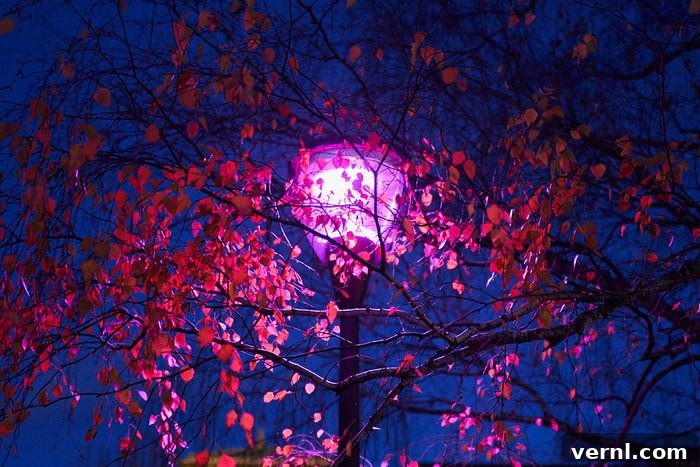
As previously established, the transformation of streetlights to a purple glow stems from a straightforward issue: either a significant manufacturing defect in specific batches or an accelerated degradation of essential components within the light fixture. Alisha Kessler, a lighting product manager at Enbrighten, further elaborates on this technical fault, explaining the precise mechanism at play.
“The purple hue is directly caused by the degradation of the phosphor layer found in certain LED streetlights,” Kessler states. She emphasizes that this phosphor layer is specifically responsible for the crucial task of converting the intense blue light emitted by the LED diode into a balanced, uniform white light that is optimal for public illumination. “If this coating wears down prematurely – which has unfortunately occurred with some batches from various manufacturers – it subsequently reveals the cooler, purplish light that exists underneath,” she adds.
This rise in purple streetlights is entirely unintentional and certainly not an aesthetic choice, yet it has been observed across numerous states throughout the country. This widespread phenomenon is largely attributable to the broad adoption and extensive use of the same affected models within the supply chain. These particular faulty units were primarily manufactured in mid-2017 and subsequently installed in 2018 across countless municipal lighting projects. According to a detailed report by USA TODAY, Acuity Brands Lighting was identified as one of the companies that produced streetlights affected by this specific issue, with the problem becoming widely evident and prominent during 2021 and 2022.
The challenge for cities and utility companies has been immense. The rapid adoption of LED technology was driven by compelling benefits such as significantly lower energy consumption, reduced maintenance costs due to longer lifespans, and improved light quality. However, this unforeseen manufacturing defect has introduced new complexities, requiring extensive efforts to identify, assess, and replace thousands of faulty fixtures. While many purple streetlights in affected areas nationwide have already begun to be replaced, the full scope of the problem and the timeline for complete remediation remain significant logistical challenges for municipalities and utility providers.
Beyond Aesthetics: How Purple Streetlights Impact Vision and Road Safety
Streetlights are meticulously designed with a primary objective: to enhance safety for drivers, pedestrians, and cyclists, particularly during the critical nighttime hours. They provide essential visibility, illuminating potential hazards, road signs, and the general environment. However, the unexpected purple hue emanating from these defective LED units can have a tangible and concerning negative impact on vision and, by extension, public safety.
Michele Lapicco highlights these critical safety concerns. “Purple LED light can significantly impact visibility, especially at night, primarily because it lacks the comprehensive, full-spectrum coverage that white light offers,” she explains. This deficiency in spectral breadth means that the purple light can distort color perception and severely impair depth perception for anyone navigating the illuminated area. The consequences are far-reaching: “This distortion might reduce contrast, making it considerably harder for drivers or pedestrians to accurately judge distances, perceive changes in the road surface, or recognize potential hazards, particularly in areas that already suffer from insufficient lighting or poorly reflective signage,” Lapicco warns.
Consider the implications: a driver might misjudge the distance to an approaching vehicle or a pedestrian attempting to cross the street. Cyclists and pedestrians might find it harder to discern obstacles or the edges of sidewalks. The unusual and monochromatic nature of purple light can also lead to increased eye strain and discomfort over prolonged exposure, potentially contributing to driver fatigue. Unlike the warm, broad spectrum of traditional incandescent lights or the clearer, balanced output of functional white LEDs, purple light creates an environment where visual information is compromised, making decision-making on the road more challenging and potentially dangerous.
Furthermore, the visual impact extends beyond just safety. Urban aesthetics and the feeling of security within communities are also subtly affected. A cityscape bathed in an unexpected purple glow, while perhaps novel at first glance, can ultimately feel eerie or disorienting, detracting from the intended purpose of reliable and consistent urban lighting.
Ultimately, Alisha Kessler powerfully reiterates a fundamental principle: the quality of public infrastructure components, especially those impacting safety, is paramount. “While the purple glow can indeed look oddly beautiful or strikingly unique,” she concludes, “safety and clarity must always be the foremost priorities when making decisions that affect both public well-being and the visual integrity of our urban environments.” The unexpected shift to purple streetlights serves as a potent reminder that even minor manufacturing defects in widely adopted technologies can have significant, unforeseen consequences that demand prompt and effective solutions.
Addressing the Glitch: Solutions and Future Outlook
The identification of this widespread streetlight defect has prompted significant responses from municipalities, utility companies, and manufacturers alike. The primary solution involves the systematic replacement of the faulty purple-emitting fixtures with new, correctly functioning white LED lights. This process, however, is not without its challenges. It entails substantial logistical planning, considerable financial investment, and diligent coordination across various public and private entities.
Many cities have initiated ambitious replacement programs, often working with the original manufacturers under warranty agreements or securing new contracts with alternative suppliers. The sheer volume of affected lights means that this replacement effort can span months or even years, depending on the scale of the problem in a given area and the resources available. For instance, a single municipality might have thousands of these faulty lights, requiring dedicated crews and specialized equipment for their removal and installation. This unexpected expenditure adds a burden to city budgets that had initially factored in long-term savings from LED upgrades.
The incident also serves as a crucial learning experience for the entire lighting industry. It underscores the critical importance of rigorous quality control, extensive long-term testing, and robust material science in the manufacturing of components for public infrastructure. While the push for energy efficiency is vital, it must always be balanced with an uncompromising commitment to reliability, durability, and, most importantly, safety. Future LED product development will undoubtedly incorporate enhanced safeguards and more stringent testing protocols to prevent similar widespread issues.
Looking ahead, the future of street lighting will continue to evolve, with an increasing focus on smart city technologies, adaptive lighting systems, and enhanced resilience. Lessons learned from the purple streetlight phenomenon will contribute to the development of more robust and dependable lighting solutions, ensuring that our urban environments remain well-lit, safe, and visually clear for everyone. The temporary aesthetic oddity of purple streetlights ultimately highlights the continuous pursuit of excellence in public infrastructure and the relentless dedication to ensuring public safety remains at the forefront of technological advancement.
Sources
- USA TODAY: Have you seen a purple streetlamp? A puzzling coast-to-coast phenomenon explained.
About the Experts
- Michele Lapicco, design consultant to Fine Art Handcrafted Lighting
- Alisha Kessler, a lighting product manager at Enbrighten
Related
- If You See a Blue Stop Sign, Here’s What It Means
- If You Spot This Yellow Device on Your Windshield, You’ve Been Barnacled
- What Do Shoes on Power Lines Mean?