Have you ever found yourself gazing at your cherished but aging couch, caught in a dilemma: should you breathe new life into it through reupholstery, or simply replace it with a new one?
For many, the decision to reupholster is a clear one. Driven by a desire to minimize waste, a recognition of solid furniture foundations, and a smart approach to spending, reupholstering offers a compelling alternative. It’s a choice that resonates with a growing number of individuals, including myself, who prefer to revitalize existing pieces rather than contribute to landfills.
This trend is fueled by a powerful combination of factors: significant cost savings, a commitment to sustainability, and the deep sentimentality often attached to beloved furniture. Moreover, the satisfaction of a successful DIY project often plays a role for those who enjoy hands-on work. Why invest in something new when you can skillfully refresh and reimagine what you already possess?
According to Raf Michalowski, an acclaimed interior design professional and the visionary founder of Meble Furniture, “Reupholstering a couch presents an excellent opportunity to achieve the aesthetic of a brand-new piece of furniture without incurring the expense of purchasing an entirely new one. It’s also an invaluable method for preserving family heirlooms, updating their style, and integrating them seamlessly into a modern living space.”
So, what’s the actual investment involved in reupholstering a couch? The answer, as you might expect, isn’t a simple, fixed figure. The total cost is influenced by a diverse array of variables, each playing a crucial role in the final price tag.
Factors Influencing the Cost to Reupholster Your Couch
Before embarking on your reupholstery journey, it’s vital to grasp the various elements that can significantly impact the overall cost. Understanding these considerations will help you budget effectively and make informed decisions.
- Your Geographical Location: Much like real estate, your geographic location profoundly affects reupholstery costs. Businesses operating in bustling metropolitan areas typically face higher overheads, including rent and labor wages, compared to those in smaller towns. Consequently, services in urban centers often come with a higher price tag. Always inquire with local professionals for precise estimates tailored to your region.
- Type and Style of Couch: The complexity of your couch’s design is a major cost determinant. A minimalist two-seater sofa will naturally be less expensive to reupholster than an elaborate sectional, a vintage Chesterfield with its deep button tufting, or an antique piece featuring intricate carvings and delicate trimmings. More complex designs demand increased labor, specialized skills, and potentially more fabric, all contributing to a higher cost. Elements like attached cushions, intricate armrests, or unique leg designs can also add to the complexity.
- Size of the Couch: This is a straightforward factor: a larger couch requires more fabric, more padding, and considerably more labor hours to strip, repair, and re-cover. A sprawling sectional will command a higher price than a compact loveseat or a single armchair, simply due to the sheer volume of materials and effort involved.
- Fabric Selection: The choice of upholstery fabric is one of the most significant cost variables, impacting both the upfront price and the long-term durability and aesthetic. High-end materials such as genuine leather, luxurious silks, designer patterns, or specialized performance fabrics (stain-resistant, pet-friendly) can significantly elevate the total cost. Conversely, durable yet more common options like cotton blends, synthetic microfibers, or basic linen are more budget-friendly. The type of weave, pattern repeat, and fabric width also influence how much yardage you’ll need and, consequently, the final material cost.
- Intricate Details and Finishing Touches: Beyond the basic fabric application, specific design details can add substantially to the cost. Features like decorative buttons, exposed nailhead trim, elaborate piping, fringe, pleating, skirted bases, or intricate contrast stitching require additional time, meticulous precision, and specialized skills from the upholsterer. Each added detail translates directly into more labor hours and potentially more specialized materials.
- Interior Repair and Component Replacement: The cost estimation often assumes the couch’s internal structure is sound. However, if the springs are sagging, the webbing is broken, the frame is compromised, or the foam cushions have lost their density and support, these internal repairs will incur additional charges. Replacing old, worn foam with new, high-density foam or repairing a creaking frame adds to both material and labor costs, ensuring the renewed piece is not just aesthetically pleasing but also structurally sound and comfortable.
- Time of Year for Service: Surprisingly, the season can influence pricing. Upholstery shops often experience peak demand before major holidays (like Christmas or Thanksgiving) when people want their homes looking pristine for guests, or during popular renovation seasons (spring and early fall). During these busy periods, some businesses might implement higher charges due to increased demand or limited availability. Planning your project during off-peak times could potentially lead to better rates or faster service.
- Pickup and Delivery Charges: Transporting a bulky piece of furniture like a couch can be a logistical challenge. Many upholstery businesses offer pickup and delivery services, but these often come with an additional fee. It’s crucial to clarify these potential charges upfront when getting a quote to avoid unexpected costs.
Understanding Upholstery Fabric Costs
Whether you opt for a professional upholsterer or choose the DIY route, fabric remains one of the most substantial components of the overall cost. More than just an aesthetic choice, the fabric impacts durability, longevity, and ease of maintenance.
For those working within a stringent budget, synthetic nylon upholstery fabric typically represents the most economical choice, often ranging from $10 to $15 per yard. Known for its strength and commendable stain resistance, nylon is a practical option. However, it generally offers lower UV resistance, meaning it can fade in direct sunlight, and its aesthetic isn’t typically considered luxurious. As a synthetic material, it also doesn’t align with sustainable preferences for natural fibers.
At the upper end of the spectrum, you’ll find exquisite materials like luxurious velvet and delicate silk, with prices typically ranging from $55 to $70 per yard, and sometimes significantly more for designer or specialty weaves. While these fabrics offer unparalleled visual appeal and a luxurious feel, they are often more challenging to work with, requiring expert handling during the reupholstery process and demanding specialized care for maintenance. Their aesthetic impact, however, is undeniable.
My personal choice for my own couch project was a beautiful, heavy linen damask in a rich dark teal. This fell into the mid-priced category, costing approximately $32 per yard. I gravitated towards this option not only for its natural elegance but also for its inherent properties: excellent breathability, quick-drying capabilities, and relative ease of maintenance. The damask weave, a classical pattern, creates a naturally stronger and more resilient fabric, promising enhanced longevity and superior resistance to daily wear and tear compared to simpler weaves.
Beyond these, numerous other fabric options offer a balance of affordability and durability. Chenille, a soft and fuzzy synthetic, provides a plush texture and good wear resistance, often in the $25-$40 per yard range. Microfiber, another popular synthetic, is lauded for its remarkable stain resistance, durability, and smooth feel, typically costing $20-$35 per yard. Cotton and linen blends offer natural breathability and a classic look, often priced between $15-$45 per yard, depending on the blend and quality. Wool, known for its resilience and natural fire resistance, can range from $40-$80 per yard. When considering fabric, also factor in the fabric repeat if you choose a patterned material, as this can affect the total yardage required to ensure a cohesive look.
Considering a DIY Reupholstery Project?
Embracing the challenge of DIY reupholstery can be incredibly rewarding, but it demands more than just enthusiasm. You’ll need a foundational set of DIY skills, an ample supply of patience, and excellent organizational savvy. Before you even think about cutting fabric, it’s imperative to thoroughly research and internalize professional upholstery tips and techniques.
For couches with simpler designs – think clean lines, minimal embellishments, and straightforward cushion construction – DIY reupholstering is certainly within reach for a dedicated beginner. However, if your couch boasts intricate curves, complex tufting, or unique design elements, be prepared for potential roadblocks and a steeper learning curve. The key is to approach the project with a methodical mindset: take your time, don’t be afraid to undo errors, and patiently restart difficult sections. Remember, every mistake is an opportunity to learn. If you find yourself needing comprehensive guidance, our detailed guide on how to reupholster furniture provides step-by-step instructions and invaluable insights.
To successfully tackle a DIY reupholstery project, here are some essential basic tools you’ll need to gather:
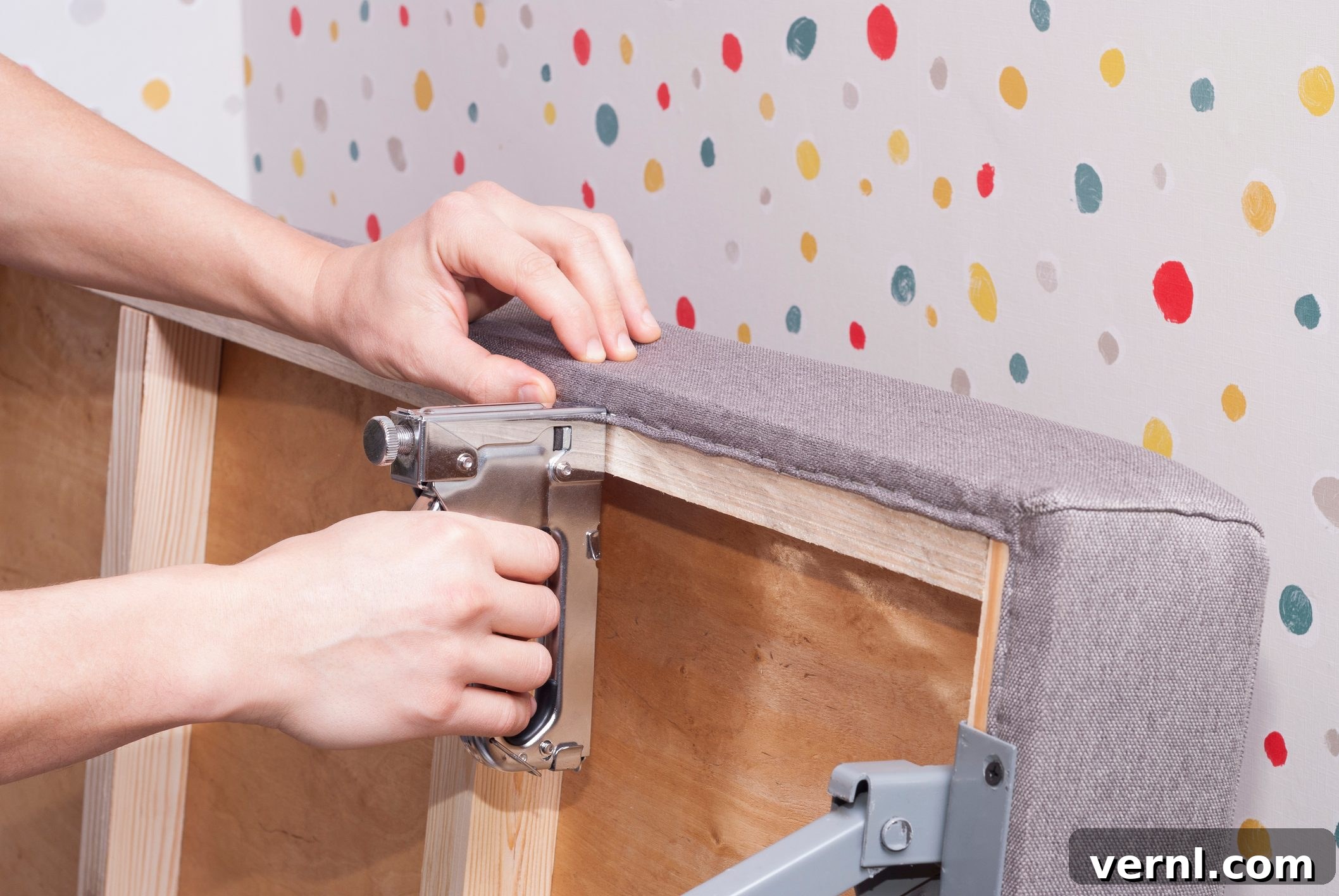
- Heavy-duty staple gun (electric or pneumatic recommended for ease) and plenty of staples, or a traditional tack hammer for smaller tacks;
- Staple remover or a claw tool for efficient removal of old staples and tacks;
- Rawhide mallet or a rubber mallet for gently tapping and shaping fabric or components without damage;
- Specialized upholstery needles (curved and straight) and strong upholstery thread for hand-stitching intricate areas;
- Sharp, heavy-duty fabric scissors capable of cutting through multiple layers of upholstery fabric;
- Needle-nose pliers for gripping and manipulating staples, tacks, or small components;
- Soft, flexible tape measure for accurate measurements of curves and contours;
- Plenty of pins (straight pins and T-pins) for holding fabric in place during fitting and sewing;
- Upholstery chalk or fabric marker for marking cutting lines and patterns on your new fabric;
- Strong adhesive suitable for upholstery applications (e.g., spray adhesive for foam, fabric glue for trim);
- Seam ripper for carefully deconstructing the old upholstery and correcting any sewing mistakes.
National Average Cost to Reupholster a Couch
Nationwide, the average cost for professional couch reupholstery typically hovers around $1,750, encompassing both materials and labor. When breaking down this cost, materials generally constitute 40% to 45% of the total, covering the fabric, padding, and any necessary internal components. The remaining 55% to 60% is allocated to labor, with upholsterers charging anywhere from $40 to $100 per hour, depending on their expertise, location, and the complexity of the project.
A standard three-seater sofa, for instance, typically requires between eight and 12 hours of skilled labor to complete the entire reupholstery process. However, the cost for fabric alone can range significantly, from $600 to $4,000, illustrating the vast impact of material choice. Additional services, such as re-stuffing or replacing cushions, incorporating intricate tufting, undertaking frame repairs, or working with particularly challenging shapes and bespoke features, will inevitably drive the total cost higher.
Tufting is a specific technique that not only ensures an even and stable distribution of internal filling but also serves as a popular decorative element. It involves stitching buttons or studs tightly into the couch fabric, passing through the padding, and securing them firmly at the back. This often creates a classic diamond pattern. Tufting is a labor-intensive process, requiring more fabric (due to the inward pulls) and a higher degree of specialized skill, which can increase the overall price of reupholstery by up to 30%.
To give you a clearer idea of potential costs for different couch types:
- Reupholstering a simple loveseat generally ranges from $600 to $1,800.
- A more traditional camel-back sofa, known for its distinctive hump-shaped back, typically falls within the $1,000 to $1,200 range.
- The most costly standard couch to reupholster is often a sectional, due to its modular nature and increased surface area, with prices ranging from $1,500 to $4,000 or even higher for very large or complex configurations.
It’s important to obtain detailed quotes from several reputable upholsterers, ensuring that all aspects – from fabric choice and internal repairs to labor and potential delivery fees – are clearly itemized. This will provide you with the most accurate understanding of the investment required to transform your beloved couch.
In conclusion, reupholstering your couch is a thoughtful and often cost-effective way to preserve sentimental pieces, reduce environmental waste, and refresh your living space with a custom look. While the initial cost can vary widely, understanding the factors involved empowers you to make an informed decision that aligns with your budget and vision. Whether you choose to embark on a DIY adventure or entrust your furniture to a professional, the result can be a beautifully restored piece that brings joy and comfort for years to come.