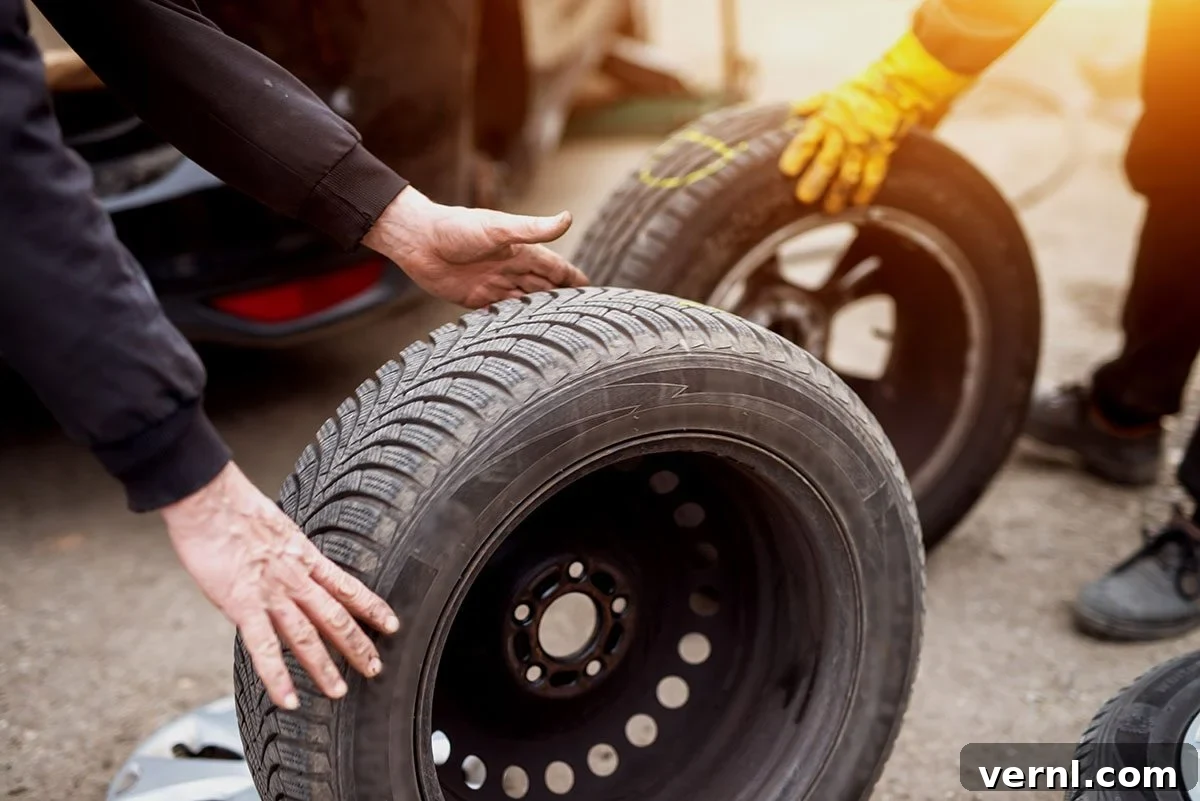
Some car maintenance tasks are second nature, like changing the oil. However, other equally critical aspects of vehicle upkeep, such as comprehensive tire maintenance, often go overlooked. Beyond regularly checking tire pressure, one of the most vital tasks on your automotive checklist should be consistent tire rotation.
Neglecting tire rotation can lead to significant financial costs as tires wear out prematurely. More importantly, it poses a considerable safety risk. Duane “Doc” Watson, a technical trainer at Bosch Mobility Aftermarket, emphasizes, “Routinely rotating your tires will help spread wear evenly, which not only prolongs the life of your tires, it helps prevent tire blowouts on the road.” This proactive measure ensures that all four tires experience uniform wear, contributing significantly to your vehicle’s overall safety, performance, and longevity.
In this comprehensive guide, we’ll delve into everything you need to know about tire rotation, from its fundamental definition to the diverse benefits it offers, helping you keep your vehicle in optimal condition and your journeys safer.
What Exactly Is Tire Rotation?
At its core, tire rotation is a straightforward yet highly effective maintenance procedure that involves periodically changing the position of each tire on your vehicle. The primary objective is to ensure that all tires wear evenly across their treads, maximizing their useful life and maintaining consistent performance. Different positions on a vehicle subject tires to varying stresses and wear patterns. For instance, front tires on a front-wheel-drive (FWD) vehicle often bear the brunt of steering, braking, and acceleration, leading to faster wear on their outer edges.
During a tire rotation, tires are moved from one wheel position to another according to specific patterns. This system ensures that a tire that was previously on the front left might end up on the rear right, allowing it to experience different forces and thus promoting more balanced wear across the entire set. While the basic idea involves swapping front and back, and left and right, the specific pattern depends on factors such as your vehicle’s drivetrain (FWD, RWD, AWD/4WD) and whether your tires are directional or non-directional.
Common Tire Rotation Patterns:
- Forward Cross (Rear-Wheel Drive & Four-Wheel Drive): Rear tires move to the front on the same side, while front tires cross to the opposite side in the rear. For example, the right rear tire goes to the right front, and the right front tire crosses to the left rear.
- Rearward Cross (Front-Wheel Drive): Front tires move to the rear on the same side, while rear tires cross to the opposite side in the front. For example, the left front tire goes to the left rear, and the left rear tire crosses to the right front.
- X-Pattern (Can be used for Front-Wheel Drive): All tires cross to the opposite side and move diagonally. The front right moves to the rear left, the front left to the rear right, and vice versa.
- Five-Tire Rotation (Vehicles with Full-Size Spares): If you have a full-size matching spare tire, including it in your rotation schedule can help prolong the life of all five tires, ensuring they wear down at a similar rate.
Understanding these patterns, or entrusting your vehicle to a professional who does, is crucial for achieving the maximum benefits of tire rotation.
When Is the Optimal Time to Rotate Your Tires?
Establishing a consistent schedule for tire rotation is key to reaping its full benefits. A widely accepted baseline for how often to rotate your tires is every 5,000 to 8,000 miles. However, this is a general guideline, and the most accurate recommendation for your specific vehicle can be found in your car’s owner’s manual. This manual will provide the exact mileage interval recommended by the manufacturer, often tailored to your vehicle’s design and weight distribution.
A convenient way to remember your tire rotation schedule is to align it with other routine maintenance tasks. Many vehicle owners choose to have their tires rotated when they get their oil changed, as oil changes typically occur with a similar frequency. This integration into your existing maintenance routine makes it easier to stay on top of both crucial tasks without missing an appointment.
Factors Influencing Rotation Frequency:
- Driving Habits: Aggressive driving, frequent hard braking, or rapid acceleration can accelerate tire wear, necessitating more frequent rotations.
- Vehicle Type: Certain vehicles, such as high-performance cars, heavy-duty trucks, or vehicles that frequently tow, may experience different wear patterns and could benefit from more frequent rotations.
- Road Conditions: Regularly driving on rough roads, gravel, or through challenging terrain can also contribute to uneven wear, prompting earlier rotations.
- Tire Type: Some high-performance tires or specific tire compounds might have different wear characteristics.
Regularity is paramount. Whether it’s every 5,000 miles or aligned with your oil changes, sticking to a proactive schedule will ensure your tires perform optimally throughout their lifespan.
The Compelling Benefits of Regular Tire Rotation
Tire rotations aren’t just a suggestion; they are a fundamental component of proper vehicle maintenance that delivers a multitude of advantages, impacting everything from your safety on the road to your wallet.
1. Enhanced Tire Lifespan and Cost Savings
One of the most immediate and tangible benefits of regular tire rotation is the significant extension of your tires’ lifespan. Over time, each tire is exposed to different angles and forces on the road, leading to varying rates and patterns of wear on their treads. For instance, the front tires on a FWD vehicle tend to wear faster due to their role in steering and propulsion, while rear tires might exhibit different wear characteristics. By routinely rotating them, you help even out this wear across all four tires. This balanced distribution of wear can extend the life of your tires by approximately 20% or more, delaying the need for costly replacements and saving you hundreds of dollars in the long run.
2. Improved Vehicle Performance and Handling
Evenly worn tires provide a consistent contact patch with the road, which is crucial for optimal vehicle performance and handling. When treads are uniformly distributed, your car maintains better grip, stability, and responsiveness. This is particularly noticeable in slippery conditions, such as rain or light snow, where consistent traction can significantly improve your ability to steer and brake effectively. A well-rotated set of tires ensures that your vehicle responds predictably, giving you greater confidence and control behind the wheel.
3. Increased Safety
The safety aspect of tire rotation cannot be overstated. Unevenly worn tires can be prone to dangerous failures, including tread separation or sudden blowouts, especially at higher speeds. As Duane “Doc” Watson highlighted, spreading wear evenly directly helps to prevent such critical tire failures. Consistent tire rotation ensures that your tire’s structural integrity is maintained across all four wheels, contributing to a safer driving experience for you and your passengers. Better grip and handling also reduce the risk of accidents by improving your vehicle’s ability to react to sudden road hazards.
4. Optimized Fuel Efficiency
While often overlooked, tire rotation can also contribute to better fuel economy. Tires with uneven wear can increase rolling resistance, forcing your engine to work harder to maintain speed. By keeping your tires uniformly worn, you minimize this resistance, allowing your vehicle to operate more efficiently and potentially reducing your fuel consumption. This small improvement can add up to noticeable savings at the gas pump over time.
5. Smoother, Quieter Ride
Unevenly worn tires can lead to increased road noise and vibrations that detract from your driving comfort. When tire treads wear unevenly, they can create flat spots or irregular patterns that generate audible humming or rumbling sounds, and sometimes even cause the steering wheel or car to vibrate. Regular rotation helps to maintain the tire’s intended profile, resulting in a significantly smoother ride and decreased road noise, enhancing the overall comfort of your journey.
6. Maintained Tire Warranty
Many tire manufacturers require proof of regular tire rotation as a condition for their treadwear warranties. Failing to adhere to the recommended rotation schedule could void your warranty, leaving you responsible for the full cost of replacing tires that wear out prematurely. Keeping meticulous records of your rotations ensures you can leverage your warranty if needed.
Understanding Tire Wear Patterns: What Your Tires Are Telling You
Tires exhibit various wear patterns, and understanding them can provide valuable insights into your vehicle’s health, even beyond the need for rotation. While rotation helps mitigate these issues, severe or specific patterns often point to underlying mechanical problems.
Common Uneven Wear Patterns:
- Center Wear: If the tread is worn primarily in the center, it often indicates overinflation. Too much air pressure causes the tire to bulge slightly, reducing the contact patch to the center of the tread.
- Shoulder Wear (Both Edges): Excessive wear on both outer edges of the tire suggests underinflation. Insufficient air pressure causes the tire to sag, placing more weight and friction on the shoulders.
- One-Sided Wear: If only one edge of the tire (inner or outer) is wearing significantly faster, it’s a strong indicator of an alignment issue. Your wheels might not be parallel to each other or perpendicular to the ground, causing the tire to drag or scrub unevenly.
- Feathering: This pattern involves a feathered or saw-tooth appearance across the tread blocks, where one side of the block is higher than the other. It typically points to alignment problems (specifically toe issues) or worn suspension components.
- Tire Cupping (Scalloping): This distinct pattern involves alternating high and low spots around the circumference of the tire, giving it a scooped-out or scalloped appearance. As mentioned, it’s often a sign of worn or damaged suspension components like shock absorbers or struts, which allow the tire to bounce instead of maintaining consistent contact with the road. Chris “Moose” Pyle, an auto expert with JustAnswer.com, notes that tires also “wear differently on the front and rear,” especially in vehicles like trucks, 4x4s, or those rarely carrying rear cargo, where front tires might wear on the sides and rear tires in the center. Tire cupping can cause noticeable noise (a rumbling or thumping sound) and vibrations while driving, which are not only annoying but also contribute to premature tire failure. Consistent tire rotation helps distribute this type of wear more evenly and can sometimes mask minor suspension issues temporarily, but the underlying cause should always be addressed.
While tire rotation addresses the natural variances in wear, understanding these patterns empowers you to catch more serious problems early, potentially preventing more expensive repairs down the line.
DIY vs. Professional Tire Rotation: What You Need to Know
When it comes to rotating your tires, you generally have two options: taking your vehicle to a professional service center or performing the task yourself.
Professional Tire Rotation: Convenience and Expertise
Having your tires rotated by a professional typically costs between $20 to $50, depending on the service provider and any additional services bundled with the job. Many tire retailers offer free tire rotation if you purchased your tires from them, so it’s always worth inquiring about this benefit before making a purchase. The advantages of professional service include:
- Expertise: Technicians are familiar with various rotation patterns for different vehicle types and tire designs.
- Specialized Equipment: Shops use hydraulic lifts and precise torque wrenches, ensuring a safe and accurate rotation.
- Additional Inspections: Often, a professional rotation includes a thorough inspection of your tires for damage, proper inflation, and checks of your brakes and suspension components.
DIY Tire Rotation: Saving Money with Caution
If you’re mechanically inclined and have the right tools, you can rotate your own tires to save money. This option requires a few essential tools and a safe, flat spot to work. Key tools include:
- A reliable car jack and at least two sturdy jack stands.
- A lug wrench for removing lug nuts.
- A torque wrench to tighten lug nuts to the manufacturer’s specified torque, which is crucial for safety.
- Wheel chocks to prevent the vehicle from rolling.
While DIY rotation is cost-effective, it’s paramount to prioritize safety. Always ensure the vehicle is securely supported on jack stands and follow your car’s manual for the correct lifting points and lug nut torque specifications. Incorrectly tightening lug nuts can lead to serious safety issues, including wheels detaching.
The Undeniable Cost-Effectiveness of Tire Rotation
Ultimately, tire rotation is a prime example of how a small, routine maintenance task can yield significant long-term financial benefits. Beyond the immediate savings on fuel and extended tire life, it also prevents more severe and expensive problems down the road. Evenly worn tires reduce strain on your vehicle’s suspension and drivetrain components, potentially avoiding costly repairs to those systems. By investing a minimal amount of time or money into consistent tire rotation, you are not only safeguarding your investment in your tires but also contributing to the overall health and longevity of your entire vehicle. It’s a simple action that delivers substantial returns in terms of safety, performance, and financial prudence.
About the Experts
- Duane “Doc” Watson is a technical trainer at Bosch Mobility Aftermarket. He boasts over 45 years of experience in automotive repair, has trained thousands of technicians, and has garnered numerous industry accolades, including Chevrolet Technician of the Year and Buick Service Master of the Year.
- Chris “Moose” Pyle is a master-certified technician with more than two decades of automotive experience. Since 2006, he has served as an expert for JustAnswer.com, where he routinely addresses hundreds of car maintenance and repair inquiries daily.