In the evolving world of garden design, succulents have emerged as undeniable stars. Their captivating array of shapes, textures, and colors has not only captured the imagination of plant enthusiasts but has also made them an increasingly popular choice for a wide range of landscape applications. While larger succulent varieties often command attention as striking focal points or elegant container plants, their smaller, more diminutive cousins are gaining significant recognition for their exceptional potential as versatile and visually appealing ground covers.Joyce Corbett, an acclaimed expert from Classic Courtyards, eloquently expresses her admiration for these remarkable plants. “Succulents are some of my favorite ground covers to use in the garden,” she shares. “They’re not just beautiful; they’re incredibly drought-tolerant and demand very little attention to maintain their stunning appearance. In fact, they almost seem to thrive with less intervention, preferring to be left alone to flourish naturally.” This sentiment perfectly encapsulates the low-maintenance allure that draws so many gardeners to incorporate succulents into their outdoor spaces.Beyond their aesthetic charm and minimal care requirements, succulents offer a sustainable solution for modern landscapes. Their inherent ability to store water in their leaves, stems, or roots makes them ideal for xeriscaping and water-wise gardening, significantly reducing the need for frequent irrigation. This characteristic is particularly valuable in regions prone to drought or for environmentally conscious gardeners looking to conserve precious resources. Whether you’re aiming to create a vibrant tapestry across your garden floor, stabilize a sloped area, or simply introduce unique textures and colors, low-growing succulents present a wealth of possibilities.For those eager to transform their gardens with these resilient beauties, we’ve curated a selection of 8 exceptional low-growing succulents perfect for ground cover applications. These plants promise to deliver a captivating blend of beauty, durability, and ease of care.Before diving into our featured varieties, it’s crucial to understand a few fundamental care principles that apply to nearly all succulents. Regardless of the specific type, these plants universally demand well-drained soil to prevent root rot, their most common nemesis. Additionally, while many are celebrated for their drought tolerance, most will benefit from some supplemental watering, especially during establishment or prolonged dry spells. The precise amount and frequency of watering are fluid variables, influenced by factors such as the plant’s exposure to sun, ambient temperatures, and the soil’s composition.A reliable watering guideline is to thoroughly saturate the soil to a depth of approximately 8 inches, then allow the soil to completely dry out before initiating the next watering cycle. This “soak and dry” method mimics their natural habitat conditions and encourages robust root development. However, during periods of intense heat or extended drought, a slight increase in watering frequency may be necessary to support their vitality. Joyce Corbett emphasizes the importance of attentive observation: “If the leaves are starting to wrinkle, you know it’s time to water,” she advises. “Well-established plants will naturally require less frequent watering, and during cooler ‘shoulder seasons’ when temperatures are moderate, their water needs will also significantly decrease.” This intuitive approach ensures your succulents receive precisely what they need, when they need it.
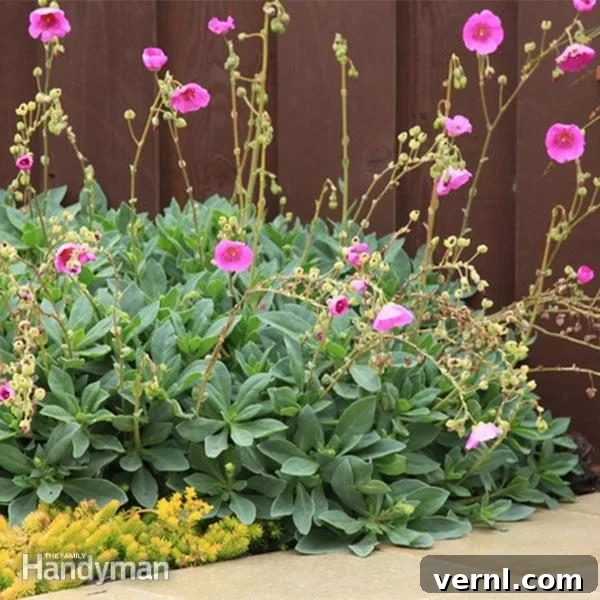
Rock Purslane
(Calandrinia spectabilis)
Rock Purslane is a spectacular succulent admired for its striking foliage and an abundance of vibrant blooms. Its gray-green leaves form a dense, attractive mound, providing a cool, understated base for the explosion of color that follows. From spring through fall, this plant undergoes a magnificent transformation as it produces an astonishing display of magenta flowers. Each blossom, approximately 2 inches in diameter, offers a bold splash of color, lasting for a single day before new flowers emerge the following morning to take their place, ensuring a continuous show throughout the growing season. This sequential blooming habit creates a dynamic and ever-changing visual spectacle in the garden.
For an especially captivating garden tableau, consider pairing Rock Purslane with the intriguing Pig’s Ear (Cotyledon orbiculata), another succulent known for its unique, paddle-shaped leaves and charming orange flowers. This combination offers a delightful contrast in both form and color, enhancing the visual interest of any planting. While Rock Purslane thrives particularly well in mild Mediterranean climates, its adaptability allows it to be successfully grown as a container plant in a wider range of environments. In colder regions where it is not hardy, it can be admirably treated as an annual, providing seasonal beauty before being replanted each year. Its vigorous growth and stunning floral display make it an excellent choice for borders, rock gardens, or mass plantings where a low-growing, colorful ground cover is desired.
- Origin: Chile
- Where it will grow: Remarkably hardy to 20 degrees Fahrenheit (minus 6.7 degrees Celsius), making it suitable for USDA Zone 9 and warmer climates. Its resilience also extends to container growing where it can be protected from harsher winters.
- Water requirement: Low, demanding minimal irrigation once established. It prefers dry conditions between waterings, aligning with its drought-tolerant nature.
- Light requirement: Flourishes in full sun, where it produces the most abundant blooms. It can also tolerate filtered shade, especially in hotter inland climates, though flowering may be slightly reduced.
- Mature size: Typically reaches 1 foot in height, forming a substantial spread of about 3 feet wide. When in full bloom, the flower stalks can elevate its overall height to approximately 3 feet, adding vertical interest to its mounded form.
Caucasian Stonecrop
(Sedum spurium)
Defying the common misconception that succulents are exclusive to warm, arid regions, Caucasian Stonecrop (Sedum spurium) stands out as a testament to their incredible diversity and hardiness. This exceptional creeping ground cover shatters geographical boundaries, thriving in a broad spectrum of climates, specifically hardy from USDA Zones 3 to 8. Its intrinsic beauty lies not only in its robust nature but also in its exquisitely formed leaves, which are tightly whorled and often graced with charming red tinges, especially when exposed to ample sunlight or cooler temperatures. This subtle coloration adds a layer of visual depth even when the plant is not in bloom.
As late spring transitions into summer, Caucasian Stonecrop unveils its most captivating feature: a breathtaking blanket of star-shaped pink flowers. These delicate yet profuse blooms completely envelop the foliage, transforming the plant into a vibrant carpet of color. Beyond their aesthetic appeal, these flowers serve as a magnet for local pollinators, particularly butterflies, adding dynamic life and movement to the garden. This species is an excellent choice for filling gaps between pavers, cascading over rock walls, or creating a verdant, low-maintenance lawn alternative in areas with moderate foot traffic. Its ability to thrive in challenging conditions, coupled with its attractive year-round foliage and seasonal floral display, makes it an invaluable addition to any landscape.
A notable cultivar, S. spurium ‘Red Carpet’, is showcased in the foreground of many plantings, celebrated for its intensified red hues and dense growth habit. In complementary contrast, the blue-gray foliage of S. reflexum ‘Blue Spruce’ often provides a stunning backdrop, highlighting the diverse color palette achievable with various Sedum species. This particular combination illustrates how different stonecrop varieties can be effectively layered to create rich textual and chromatic interest within a single planting area.
- Origin: Caucasus region of Eastern Europe
- Where it will grow: Remarkably resilient, hardy to an astonishing minus 40 degrees Fahrenheit (minus 40 degrees Celsius), allowing it to flourish across a wide range of climates from USDA Zones 3 to 8. This makes it one of the most cold-tolerant ground cover succulents available.
- Water requirement: Low; once established, it is highly drought-tolerant and requires minimal supplemental watering. It prefers well-drained soil and can tolerate periods of dryness, making it perfect for arid or low-water gardens.
- Light requirement: Performs best and exhibits its most intense foliage coloration in full sun. While it can tolerate some partial shade, too much shade may lead to leggy growth and reduced flowering.
- Mature size: Grows modestly to a height of 3 to 6 inches, but spreads vigorously to form a lush carpet 1 to 2 feet wide, effectively covering ground and suppressing weeds.
Blue Chalksticks
(Senecio serpens)
Blue Chalksticks (Senecio serpens) is a highly coveted succulent, revered for its distinctive and alluring blue-gray foliage. Its upright, cylindrical leaves, each about an inch long, are arranged densely along its stems, creating a visually soothing and textured ground cover. Over time, these lovely stems gradually spread outwards, forming a captivating mat that provides exceptional visual interest in frost-free environments. The plant’s subtle beauty is further enhanced in summer when it produces delicate flowers, typically ranging in color from pristine white to soft chartreuse. These blooms, while not as showy as some other succulents, add a delicate touch to its already appealing structure.
One of Blue Chalksticks’ most remarkable attributes is its ability to create stunning color contrast within the garden. When strategically planted adjacent to plants with vibrant green foliage, such as the exotic Kangaroo Paw (Anigozanthos spp.), the cool blue-gray tones of the Senecio truly pop, offering a sophisticated and eye-catching visual dynamic. This makes it an excellent choice for designers aiming to introduce varied palettes and textures into their landscapes. It flourishes particularly well in areas characterized by mild Mediterranean climates, where its needs for ample sunlight and well-drained soil are readily met. Beyond its aesthetic merits as a stellar ground cover, Blue Chalksticks is also widely utilized for its practical applications in erosion control, its versatility in container plantings, and its designation as a valuable fire-wise plant, contributing to fire-resistant landscaping efforts.
In many exemplary garden designs, Blue Chalksticks can be observed elegantly intertwining between larger architectural plants, such as the imposing Furcraea macdougalii in the background, while harmonizing beautifully with the ‘Elijah Blue’ cultivar of blue fescue (Festuca glauca ‘Elijah Blue’) in the foreground. This layering technique showcases its adaptability and how it can effectively bridge the visual gap between plants of varying heights and forms, creating a cohesive and appealing landscape composition.
- Origin: South Africa
- Where it will grow: Hardy to 20 degrees Fahrenheit (minus 6.7 degrees Celsius), making it an excellent choice for USDA Zone 9 and warmer climates, particularly those that experience little to no frost.
- Water requirement: Low; once established, it requires infrequent watering, thriving in dry conditions. Overwatering is detrimental, so ensure soil dries completely between sessions.
- Light requirement: Prefers full sun to develop its most intense blue-gray coloration and dense growth. It can tolerate filtered shade, especially in extremely hot desert climates, but may become less compact.
- Mature size: Reaches an average height of 1 foot and spreads impressively to 2 to 3 feet wide, forming a dense and beautiful mat.
Parry’s Agave
(Agave parryi)
While larger agave species are renowned for their majestic presence, it’s the smaller to medium-sized varieties that are quietly revolutionizing ground cover choices. Parry’s Agave (Agave parryi), with its undeniably attractive and perfectly symmetrical rosette pattern, stands out as a prime example of this emerging trend. Its compact yet robust form makes it an absolutely wonderful water-wise ground cover, offering both visual elegance and ecological benefits. The tightly packed, stiff, blue-gray leaves create a compelling textural contrast, particularly when positioned alongside rough-hewn boulders or coarse-textured gravels, elevating the garden’s sensory experience.
This particular agave, along with other smaller agave species, demonstrates exceptional performance in arid climates, including the challenging conditions of low-desert environments. Unlike some succulents that might falter under intense solar radiation and scorching summer heat, these resilient agaves are perfectly equipped to handle full sun exposure and extreme temperatures. This makes them an invaluable asset for landscapes where plants suited for milder Mediterranean climates might struggle to survive or thrive. Their architectural form and year-round interest provide a steadfast backbone to any arid garden design, offering an elegant solution for low-maintenance, water-efficient landscaping.
In many inspiring landscape photographs, such as the one referenced, you can observe A. parryi var. truncata gracefully nestled among its larger agave relatives. This not only highlights its suitability for mixed succulent plantings but also showcases how it can contribute a distinct sense of scale and visual rhythm when integrated into a diverse succulent collection. Its ability to maintain a strong, sculptural presence while remaining relatively compact positions it as a sophisticated and practical ground cover option for modern, sustainable gardens.
- Origin: American Southwest and Mexico
- Where it will grow: Extremely hardy, tolerating temperatures ranging from minus 10 to 20 degrees Fahrenheit (minus 23.3 to 6.7 degrees Celsius). This impressive hardiness means it can thrive in a wide array of USDA Zones, typically 5 to 9, depending on the specific variety or cultivar.
- Water requirement: Low; it is exceptionally drought-tolerant once established, requiring very infrequent watering. It thrives on minimal moisture, making it a champion of water conservation.
- Light requirement: Prefers full sun to achieve its most compact growth and vibrant leaf coloration. It can also tolerate filtered shade, especially in the hottest desert climates, where a bit of afternoon protection can be beneficial.
- Mature size: Varies slightly by variety, but generally grows between 1 to 3 feet tall and equally wide, forming a substantial and visually impactful rosette.
Upright Myrtle Spurge
(Euphorbia rigida)
Upright Myrtle Spurge (Euphorbia rigida) is a distinctive and highly valued plant that offers a captivating display of color and texture, particularly beneficial for drought-tolerant landscapes. Its most striking feature is its chartreuse flowers, which emerge in late winter and gracefully transition through shades of green before settling into an attractive tan as they mature into spring. This evolving color palette provides a welcome and long-lasting visual interest during a time when many other garden plants are still dormant. Complementing these unique blooms are the plant’s pointed, blue-gray leaves, arranged in striking spirals along its stems. This architectural arrangement offers an exceptional decorative texture that persists throughout the entire year, ensuring continuous visual appeal.
One of the most impressive characteristics of Upright Myrtle Spurge is its remarkable tolerance to a broad range of temperatures. It can effortlessly withstand scorching heat exceeding 100 degrees Fahrenheit (37.8 degrees Celsius) and yet remain unfazed by bone-chilling cold down to minus 20 degrees Fahrenheit (minus 28.9 degrees Celsius). This extraordinary resilience makes it a versatile choice for a vast array of climates and garden settings. To create a truly impactful design, consider planting Upright Myrtle Spurge in odd-numbered groupings of three or five. This grouping strategy enhances its natural form and visual weight. It pairs particularly well when nestled alongside large boulders, where its texture contrasts beautifully, or integrated with flowering perennials such as the vibrant Beardtongue (Penstemon spp.), creating a harmonious and resilient planting scheme.
- Origin: Mediterranean region
- Where it will grow: Remarkably hardy to minus 20 degrees Fahrenheit (minus 28.9 degrees Celsius), securing its place as a robust perennial in USDA Zone 5 and warmer regions. Its hardiness allows it to survive severe winter conditions, making it an excellent choice for cold-climate succulent gardens.
- Water requirement: Low; it is incredibly drought-tolerant and requires minimal water once established. It thrives on neglect, preferring dry soil conditions and infrequent watering, which makes it ideal for xeriscapes.
- Light requirement: Flourishes in full sun, which promotes the most vibrant foliage and robust flowering. It can also tolerate filtered shade, particularly in hotter climates, but may become less dense and produce fewer blooms.
- Mature size: Typically grows to a height of 2 feet with an impressive spread of 3 feet wide, forming a dense, mounded habit that effectively covers ground and adds significant textural interest.
Resin Spurge
(Euphorbia resinifera)
Resin Spurge (Euphorbia resinifera) is a captivating succulent native to the arid landscapes of Morocco, immediately recognizable by its unique form and texture. Composed of striking square, light-green stems, this plant grows in dense clumps, often giving it the appearance of a sculptural cactus. The distinctive sides of its stems are intricately covered in small, brown spines, adding another layer of intricate detail and a protective, rugged aesthetic. While young specimens maintain a manageable size, older and well-established plants can grow quite large, developing an imposing presence that makes them perfectly at home when juxtaposed against towering columnar cactuses, creating a dramatic desert landscape scene.
For smaller garden spaces or more intimate designs, juvenile Resin Spurge plants look particularly stunning when positioned next to natural boulders. The contrast between the plant’s angular, textured stems and the smooth, organic curves of the stone creates a compelling visual dynamic. It also integrates beautifully with other drought-tolerant perennials, such as the cheerful Desert Marigold (Baileya multiradiata) and the delicate Blackfoot Daisy (Melampodium leucanthum). These pairings not only enhance the overall aesthetic but also contribute to a resilient and water-wise garden ecosystem. The architectural beauty and low-maintenance nature of Resin Spurge make it an excellent choice for modern desert gardens, rockeries, or as a distinctive container specimen.
In many well-designed landscapes, Resin Spurge can be seen forming an exquisite living frame around a magnificent Peruvian Apple Cactus (Cereus repandus). This masterful arrangement is often further adorned by the vibrant presence of Soap Aloe (Aloe maculata) and its richly colorful flowers, creating a multi-layered tapestry of textures, forms, and hues that is both visually stunning and ecologically harmonious. This demonstrates the plant’s versatility in creating complex, yet sustainable, garden compositions.
Caution: It is vital to handle Resin Spurge with care, as its milky sap is known to be toxic. Avoid contact with skin and eyes, and wear gloves when pruning or working closely with the plant to prevent irritation or adverse reactions.
- Origin: Morocco
- Where it will grow: Hardy to 20 degrees Fahrenheit (minus 6.7 degrees Celsius), suitable for USDA Zone 9 and warmer climates. It excels in hot, dry conditions, making it a perfect fit for desert and Mediterranean-style gardens.
- Water requirement: Low; highly drought-tolerant, requiring minimal water once established. It prefers dry conditions and infrequent watering, making it ideal for water-conserving landscapes.
- Light requirement: Thrives in full sun, which encourages its most robust growth and distinctive stem coloration. In extremely low desert regions, it can benefit from some afternoon shade to protect it from the most intense heat.
- Mature size: Can reach an impressive height of 2 to 3 feet and spread widely to 3 to 5 feet, forming a substantial and impactful clump over time.
Royal Dewflower
(Drosanthemum speciosum)
The Royal Dewflower (Drosanthemum speciosum) is a truly dazzling succulent ground cover, celebrated for its spectacular floral displays that promise to transform any garden space into a vibrant tapestry of color. From late spring into summer, this plant bursts forth with an incredible profusion of flowers, ranging in captivating shades of pink, purple, and red, depending on the specific variety. These brilliant blooms are so abundant that they virtually carpet the entire plant, almost completely obscuring the underlying foliage and creating an unforgettable visual spectacle. When not adorned with its breathtaking flowers, the Royal Dewflower still offers aesthetic value with its narrow, gray-green leaves. These delicate leaves provide a visually cooling element to the garden, offering a soft, muted backdrop that complements other vibrant plants.
A notable characteristic of Royal Dewflower is its natural spreading habit. It readily roots wherever its stems come into contact with bare soil, enabling it to efficiently expand and create a dense, colorful mat up to 3 feet wide. This self-propagating ability makes it an excellent choice for quickly covering slopes, filling in large areas, or creating a living carpet that suppresses weeds. However, despite its low-growing allure, it’s important to resist the temptation to walk on it, as this succulent does not tolerate foot traffic well. Its delicate structure can be easily damaged, compromising its health and appearance. For gardeners specifically seeking a show-stopping succulent with purple flowers, this species, with its numerous purple-hued varieties, is an exceptional and highly rewarding choice.
An exquisite example of its ground-covering prowess is often seen in landscapes where D. speciosum ‘Rosea’ gracefully drapes over and completely covers gentle slopes. This application not only highlights its stunning beauty but also its practical utility in stabilizing soil and reducing erosion, all while providing a long season of intense color and textural interest. Its rapid spread and vivid flowers make it a dynamic and impactful addition to Mediterranean and coastal gardens, or any sunny spot needing a touch of dramatic color.
- Origin: South Africa
- Where it will grow: Hardy to 20 degrees Fahrenheit (minus 6.7 degrees Celsius), thriving in USDA Zone 9 and warmer climates. It prefers mild, coastal conditions but can adapt to warmer inland areas with appropriate care.
- Water requirement: Low; once established, it is remarkably drought-tolerant, requiring minimal and infrequent watering. Good drainage is paramount to prevent root issues.
- Light requirement: Demands full sun to produce its most abundant and vibrant floral display. In very hot desert regions, it can benefit from partial afternoon shade to protect its delicate blooms from scorching.
- Mature size: Typically grows to a modest height of 6 to 12 inches but spreads generously to 3 feet wide, forming a dense and colorful living carpet.
Candelilla
(Euphorbia antisyphilitica)
Candelilla (Euphorbia antisyphilitica) introduces a distinct and captivating dimension to the landscape with its unique growth habit and textural appeal. Rather than spreading outwards in a low-lying fashion, this succulent features narrow, waxy stems that grow primarily upright, creating a visually intriguing vertical element. The plant’s expansion occurs as new stems emerge along its outer perimeter, gradually increasing its overall width while maintaining its characteristic upright posture. This method of growth allows Candelilla to form dense, textural clumps that are both elegant and resilient, providing a structural presence that differs from typical spreading ground covers.
In the springtime, delicate and tiny pale pink flowers bloom along the upper half of these waxy stems, offering a subtle yet charming display. Small, inconspicuous leaves may also appear during this period, though they are typically shed quickly, leaving the sculptural stems as the plant’s dominant feature for most of the year. The waxy coating on its stems not only gives Candelilla its distinctive appearance but also plays a crucial role in its drought tolerance, helping to minimize water loss through evaporation. To create a visually dynamic and appealing garden design, consider planting Candelilla in staggered rows. This arrangement accentuates its upright form and the linear quality of its stems, creating a rhythmic pattern that adds depth and sophistication to arid or contemporary landscape settings. Its unique form and minimal water needs make it an excellent choice for xeriscapes, rock gardens, and areas where a distinctive, low-maintenance structural plant is desired.
- Origin: Native to New Mexico, southwestern Texas, and Mexico
- Where it will grow: Hardy to 10 degrees Fahrenheit (minus 12.2 degrees Celsius), making it suitable for USDA Zone 8 and warmer climates. Its native range speaks to its exceptional tolerance for hot, dry conditions.
- Water requirement: Low; Candelilla is extremely drought-tolerant and requires very little water once established. It thrives in arid conditions and can suffer from overwatering, so ensure excellent drainage.
- Light requirement: Thrives in full, reflected sun, which means it can handle intense sunlight, even when bouncing off walls or paving. This makes it ideal for the hottest, brightest spots in the garden where other plants might scorch.
- Mature size: Grows to a height of 1 to 2 feet and spreads to 2 to 3 feet wide, forming a dense cluster of upright, waxy stems that provide year-round interest.
Embracing the Succulent Ground Cover Revolution
The increasing popularity of succulents as ground covers is no fleeting trend; it’s a recognition of their unparalleled beauty, resilience, and sustainability. From the continuous magenta blooms of Rock Purslane to the striking blue-gray rosettes of Parry’s Agave and the unique upright stems of Candelilla, each variety offers a distinct character that can elevate your garden design. These low-growing powerhouses not only minimize water consumption and maintenance efforts but also introduce an extraordinary palette of textures and colors, creating dynamic and captivating landscapes.
Whether you’re looking to fill a sunny slope, add vibrant color to a rock garden, or establish a water-wise planting that thrives on neglect, the 8 succulents profiled above offer superb solutions. Their adaptability to various climates, from the cold hardiness of Caucasian Stonecrop to the desert resilience of Resin Spurge, means there’s a perfect succulent ground cover waiting for almost every gardener. By embracing these remarkable plants, you’re not just planting a garden; you’re cultivating a sustainable, low-maintenance, and endlessly beautiful outdoor haven that will flourish for years to come. Dive into the world of succulent ground covers and discover the effortless elegance they bring to your landscape.
Related Links:
- A Beginner’s Guide to Growing Succulents
- Browse Thousands of Stunning Landscape Photos
- Find a New Ladder or Step Stool for Outdoor Maintenance
FAQ – Frequently Asked Questions About Succulent Ground Covers
Do succulents need full sun to thrive as ground cover?
While most succulents are famously sun-loving, the term “full sun” can be nuanced. Generally, the majority of ground cover succulents require a minimum of six hours of direct sunlight per day to exhibit their best growth, most vibrant coloration, and abundant flowering. However, in regions with extremely intense summer heat, some varieties might benefit from filtered or partial afternoon shade to prevent scorching, particularly during the hottest parts of the day. Always refer to the specific light requirements for each succulent species to ensure optimal health and performance.
How fast do succulent ground covers spread?
The spreading rate of succulent ground covers can vary significantly depending on the species, growing conditions, and climate. While some varieties, like certain Sedums or Royal Dewflower, can spread relatively quickly by rooting wherever stems touch the soil, most succulent ground covers tend to spread at a more modest pace. A common average rate is about one inch per month. Factors such as consistent moisture (without overwatering), adequate sunlight, and nutrient-rich, well-draining soil can encourage faster establishment and spread, allowing them to fill in spaces effectively over time.
About the Expert
- Joyce Corbett is the esteemed owner of Classic Courtyards, a renowned landscaping firm based in West Springfield, Massachusetts. With an impressive career spanning over forty years, she brings a wealth of experience in both innovative landscape design and meticulous installation, making her a trusted authority in horticultural practices.